Maui Food & Dining






Eat Your Way to a Prosperous 2013
By Vanessa Wolf
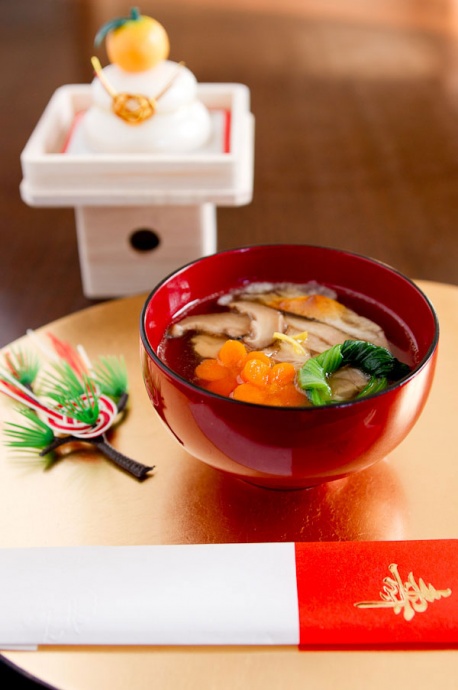
Ozoni soup. Photo courtesy PBS.
There are many superstitions surrounding increasing your odds of good fortune in the coming year and what you put in your mouth.
For example, on the mainland, only brave Southerners dare to pass up an offer of black-eyed peas, greens, and cornbread on New Year’s Day.
The black-eyed pea tradition dates back to the Civil War, when William Tecumseh Sherman made his march to sea in the fall of 1864.
As they marched, Sherman’s soldiers stripped the countryside of crops, killed and ate livestock, and robbed the stores in their path. However, they passed over the “field peas,” or what we today called black-eyed or pigeon peas. Southerners left with only those black-eyed peas were said to feel lucky to have them to survive the winter with.
Greens of all kinds are considered lucky all over the world because they resemble money.
Grains – including corn – are symbols of long life and abundance. Cornbread is believed to be included in the Southern tradition because Abraham Lincoln issued the Emancipation Proclamation – freeing the slaves – on January 1, 1863.
Have a relative that always sends you a box of mandarin oranges every Christmas? Rather than saying what you’re probably thinking – “Wow. That’s kind of a crappy gift,” perhaps sincerely thank them next time, as many believe oranges bring luck.
Pomegranates also get the nod, as their many seeds symbolize the upcoming year’s prosperity.
Pork, a regular feature on Maui tables, is also considered lucky because pigs are fat, which in luck terms is yet another symbol of affluence and good fortune.
Here in the islands, red ahi tuna is considered a lucky tradition, perhaps because fish swim in schools, which invoke the idea of abundance.
However, ask many folks raised here in Hawaii, and they usually have a family tradition reaching back to roots in Japan.
Ozoni Soup is a mandatory first meal offering on Oshogatsu, Japan’s New Year’s Day holiday and easily the most important day of the year in Japan.
Although there may be a few regional or family variations, the soup typically includes dashi (seafood or fish stock), greens of some type (usually mizuna or spinach), and a white savory mochi dumpling.
In the interest of your good fortune and for those who weren’t lucky enough to grow up here or have a family recipe passed down, we offer up food blogger Marc Matusmoto’s family recipe.
Marc Matusmoto’s Ozoni Soup
Ingredients
- 1 cup water + 4 cups water (There’s a reason it’s written that way. Read on.)
- 4 dried shiitake mushrooms
- 1 pound boneless chicken thighs
- 8 slices carrot, carved into the shape of a cherry blossom
- 1/4 cup sake
- 2 teaspoons salt
- 1 tablespoon soy sauce
- 1 small bunch spinach, lightly boiled and drained
- 4 mochi
- 1 yuzu (for zesting)
Directions
- About an hour before you prepare your Ozoni, put 1 cup of water in a bowl along with the dried shiitake mushrooms.
- Put the chicken in a colander. Boil a kettle of water and pour it over the chicken, letting the water go down the drain. This removes blood and impurities from the meat, giving you a clear soup.
- Put the chicken in a pot along with the remaining 4 cups of water, the carrots, sake, and salt, and then simmer for 20 minutes, skimming to remove any scum that rises to the top. Remove the chicken and set it aside.
- Add the soy sauce, along with the soaking liquid from the shiitake mushrooms to the soup and then adjust salt to taste. Slice up the shiitake mushrooms and add them to the soup.
- Lay down a sheet of aluminum foil in a toaster oven then toast the mochi until it inflates and turns golden brown along the top. You can also just microwave it until it inflates.
- To serve, place piece of grilled mochi at the bottom of the bowl, then add a few slices of chicken. Gather a few strands of spinach and tie them in loop and place in the bowl. Add the soup along with two slices of carrot and some shiitake mushrooms. Garnish with some yuzu zest* and serve. (If you can’t find a yuzu, which is entirely likely, lemon zest will do.)
Enjoy and Happy New Year!
Sponsored Content