

Update: Episode 32 of the ongoing Halemaʻumaʻu eruption at Kīlauea begins

Update:
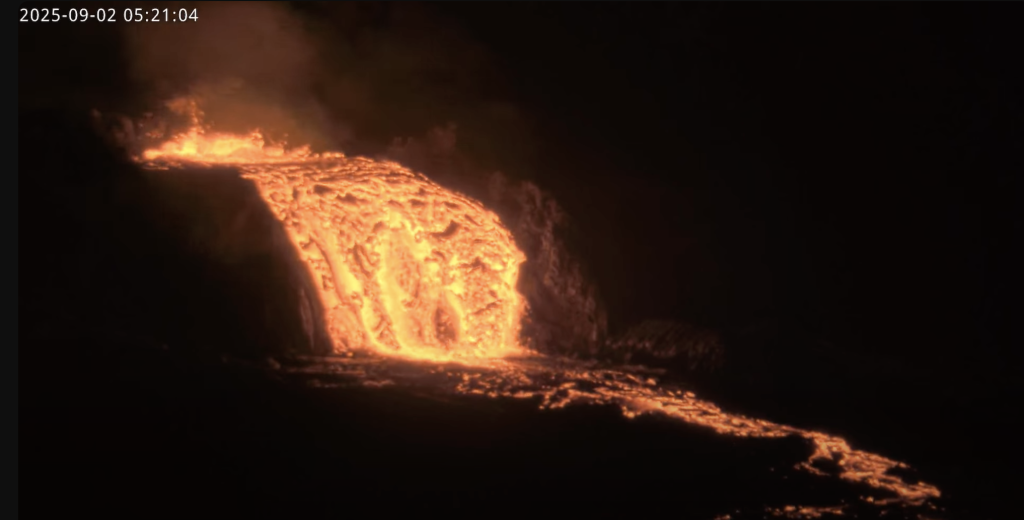
Episode 32 of the ongoing Halemaʻumaʻu eruption ended abruptly at around 8 p.m. on Tuesday, Sept. 2, 2025 after more than 13 hours of continuous fountaining. Lava fountains reached up to 500 ft during this episode and averaged more than 250 cubic yards per sec of lava, the highest output for a short-lived fountain episode. Volcanic gas emissions have greatly decreased at the end of the eruption. Lava flows from this episode covered 40-50% of the floor of Halemaʻumaʻu within the southern part of Kaluapele. Slow movement or incandescence may continue as flows cool and solidify over the coming days.
Update:
Episode 32 of the ongoing Halemaʻumaʻu eruption began at 6:35 a.m. HST on Sept. 2. At that time, north vent dome fountains transitioned into taller lava fountains, which have since become inclined at about 45 degrees northeast, similar to but less inclined than those of episode 31, according to the Hawaiian Volcano Observatory.
Current fountains are about 500 feet high and arcing an equivalent distance into Halemaʻumaʻu crater. Past episodes have produced incandescent lava fountains over 1,000 feet high and the eruptive plume is currently 9000 feet above ground level up to 20,000 feet above ground level.
According to the National Weather Service, winds are blowing from the northeast direction today, which suggests that volcanic gas emissions and volcanic material will be distributed to the southwest of Halemaʻumaʻu crater. If the fountains remain inclined ash and tephra will be greatly reduced but high SO2 gas emissions may impact communities to the south and west of Kīlaueaʻs summit.
Previous post:
The onset of episode 32 sustained fountaining is likely in the next 24-48 hours if Kīlauea continues to inflate and overflows continue, according to a status update from the Hawaiian Volcano Observatory.
The HVO reports intermittent precursory low-level activity for episode 32 of the ongoing Halemaʻumaʻu eruption started with a short overflow from 12:43 to 12:45 a.m. on Sept. 2. This was followed by a series of more vigorous cyclic overflows at 2:48 a.m. followed by others at 2:58, 3:12, 2:33, 3:58, 4:11, and 4:25 a.m with durations of 6, 10, 14, 17, 7, 8 and 11 minutes, respectively.
Each overflow ended with minor drainbacks of less than 3 to -6 feet. Fountains are about 10-15 feet high. Precursory overflows are expected to continue and indicate that degassed magma is being pushed from the vent. The cyclic low-level precursory activity will probably become continuous in less than 24 hours, according to the HVO.
The overflows were preceded by spattering in the north vent that was first visible around 8 p.m. HST on Aug. 31.
According to the National Weather Service, winds are forecast to blow from the east to northeast direction today, Sept. 2, which suggests that volcanic gas emissions and volcanic material may be distributed to the south and southwest.
- All eruptive activity is confined to Halemaʻumaʻu crater within Hawaiʻi Volcanoes National Park; commercial airports in Hawaii County (KOA and ITO) will not be affected by this activity.
- Three Kīlauea summit livestream videos that show eruptive lava fountains are available here: V1cam, V2cam, V3cam.
- KPcam and MKcam provide views of the plume height for aviation purposes.
In recent episodes of the ongoing eruption within Halemaʻumaʻu, low-level precursory activity has lasted from a few hours to a few days. This activity can include eruptive vent spattering, small dome fountains, and lava overflows, the HVO reports.
At the start of previous episodes, precursory activity has rapidly escalated into sustained high fountaining over minutes to tens of minutes. During previous episodes, fountains reached heights of more than 1,000 feet and the eruptive plume reached heights of up to 20,000 feet above ground level soon after sustained high fountaining began, according to the HVO.
The tiltmeter at Uēkahuna has recorded approximately 19 microradians of inflationary tilt since the end of the last episode, during which it recorded 22 microradians of deflationary tilt. Low level cyclic seismic tremor began at the same time as the overflows at 2:48 a.m. HST and continues beneath Halemaʻumaʻu crater, according to HVO scientists.
Most episodes of Halemaʻumaʻu lava fountaining since Dec. 23, 2024, have continued for around a day or less and have been separated by pauses in eruptive activity lasting generally at least several days.
- Timeline of eruptive episodes since Dec. 23, 2024: https://www.usgs.gov/volcanoes/kilauea/science/eruption-information.
No changes have been detected in the East Rift Zone or Southwest Rift Zone. An advisory will be issued when sustained high lava fountaining begins, marking the start of episode 32, or earlier if the situation warrants a further update.
Kīlauea Volcano Alert Level/Aviation Color Code remain at WATCH/ORANGE. All current and recent activity is within Hawaiʻi Volcanoes National Park.
Sponsored Content