DBEDT forecasts gradual growth, stronger recovery by 2027
The Department of Business, Economic Development and Tourism (DBEDT) today released its third quarter 2025 Statistical and Economic Report, forecasting Hawai‘i’s economy to expand by 1.3% in 2025, a small upward revision from its previous forecast.
Rising tariffs and heightened policy uncertainty are expected to add to one-off inflationary pressures by late 2025 and into 2026, with the Honolulu Consumer Price Index projected to increase during this period, according to the DBEDT.
These conditions are expected to weigh on economic activity, keeping growth subdued through 2026.
A gradual recovery is anticipated beginning in 2027 as inflationary pressures ease and the economy moves closer to its long-term potential, reaching 1.8% growth by 2028.
The sectors driving much of Hawai‘i’s growth are construction, health care and professional services with tourism forecast to recover more slowly but steadily.
Hawai‘i GDP Expands in First Quarter; Non-Tourism Sectors Provide Stability
Hawai‘i’s economy strengthened in the first quarter of 2025, with real Gross Domestic Product (GDP) rising by $1.3 billion, or 1.5%, compared with the same quarter in 2024. Overall economic activity is now 1.8% above pre-pandemic levels recorded in late 2019, a milestone surpassed in the third quarter of 2023.
In the same period, tourism-related industries delivered mixed results. Arts, entertainment and recreation declined 2.4%, while retail trade rose 2.4%, slightly above pre-pandemic levels. Accommodation and food services remained 13.7% below late 2019 activity. Transportation and warehousing declined 5.1% compared to pre-pandemic levels.
By contrast, non-tourism industries showed steadier momentum. Professional services continued to expand, healthcare services advanced with sustained demand, and the information sector posted gains, now performing above its pre-pandemic benchmark. Together, these non-tourism sectors are helping offset the uneven rebound in Hawai‘i’s visitor-related industries.
Labor Market Remains Healthy and Robust
Hawai‘i’s labor market continued to be strong through July 2025, building on steady gains in recent quarters. In July, the state had the third-lowest unemployment rate (not seasonally adjusted) in the nation, tied with North Dakota. The civilian labor force and employment both expanded, while unemployment and the jobless rate declined. Non-agricultural wage and salary jobs also rose, underscoring broad-based growth. Federal job losses in the state have been offset by private sector and state and local government job gains.
The civilian labor force was 687,800 in July 2025, up 3,200 or 0.5% from a year earlier. The labor force increased by 1.3% year to date in July compared to the same period in 2024. Civilian employment was 670,100 in July 2025, an increase of 7,250 or 1.1% year-over-year. In the first seven months of 2025, employment rose by 1.5% and the unemployment rate fell 0.2 percentage points to 2.7% compared to the same period of 2024, confirming continued resilience in the labor market.
Construction Sector Provides Steady Support
Hawai‘i’s construction industry continued to expand through July 2025 and served as an important source of economic growth. Construction jobs rose by 3.8% in July, adding 1,500 positions compared with a year earlier. Government contracts are driving growth in this sector, increasing 31.2% in the first half of the year. State government capital improvement project (CIP) expenditures, however, declined by double digits over the same period.
Private building activity was strong, with statewide authorizations increasing 33.4%, or $843.0 million, in the first seven months of 2025 compared with the same period a year earlier. Maui County led with a 50.1% gain, with all counties posting year-to-date growth. Rising costs remain a factor: in the first quarter of 2025, the Honolulu Construction Cost Index increased 3.4% for single-family residences and 3.0% for high-rise buildings.
Hawai‘i’s Visitor Market Grows in First Half, Faces Mid-Year Challenges
Hawai‘i’s visitor industry posted moderate growth in the second quarter of 2025, with increases in arrivals and spending despite reduced airline seat capacity. Total visitor arrivals by air and cruise ship rose 2.0%, or 49,200, compared with the same quarter of 2024. For the first half of 2025, arrivals increased 2.3%, or 109,650. Visitor spending by air and cruise ship rose to $11.0 billion in the first half, up 6.5% from a year earlier. The statewide hotel occupancy rate averaged 72.9% in the second quarter, unchanged from the prior year.
Domestic travel continued to drive growth, with arrivals up 3.5% in the first half. International arrivals were more subdued, falling 2.5% year-to-date. By market, arrivals from the US West increased 4.9% in the second quarter, while US East arrivals declined 1.4%. Japanese arrivals grew 4.0% for the quarter. Overall airline capacity declined 2.8% in the second quarter, with both domestic and international seats down. Despite these constraints, the average daily visitor census increased 1.9% in the quarter, reflecting steady demand for Hawai‘i’s travel market.
However, statistics for July 2025 point to a slowdown. Total visitor arrivals by air and cruise ship declined to 873,430, down 4.4% compared with July 2024. Total visitor spending also fell, which suggests momentum is softening as we enter the second half of the year.
Inflation Pressure Expected to Build in 2025
Inflation, as measured by the Honolulu Consumer Price Index for Urban Consumers (CPI-U), has decreased from 4.1% in January 2025 to 2.3% in July. DBEDT expects inflationary pressures to intensify in the second half of 2025 and into early 2026 as the effects of heightened tariffs make their way through the economy, before easing in 2027.
National and International Conditions Add to Uncertainty
Broader national and global trends are shaping Hawai‘i’s economic outlook in 2025. At the national level, moderate US growth has been tempered by lingering inflation, tighter credit conditions and ongoing policy uncertainty. These factors are slowing consumer spending and business investment, with ripple effects expected for Hawai‘i in the coming quarters.
Internationally, trade tensions and tariffs continue to weigh on global demand, while recovery in key markets remains slower than anticipated. Global inflation and financial uncertainty are also affecting travel patterns and import costs, adding to local price pressures.
DBEDT expects these headwinds to dampen Hawai‘i’s growth through 2026, before conditions gradually improve and external demand strengthens in 2027 and beyond.
According to the August 2025 Blue Chip Economic Indicators, US real growth is forecast at 1.6% in 2025 and 1.5% in 2026 — both upward revisions from the previous month. The August 2025 Blue Chip International Consensus Forecasts kept growth projections for Japan, Germany, the United Kingdom and Canada unchanged, while raising expectations for Mexico, South Korea and China. Currency projections were also revised, with the dollar falling in value relative to the Japanese yen and euro by the end of 2025.
Forecast Summary: Slower Growth Followed by Gradual Recovery
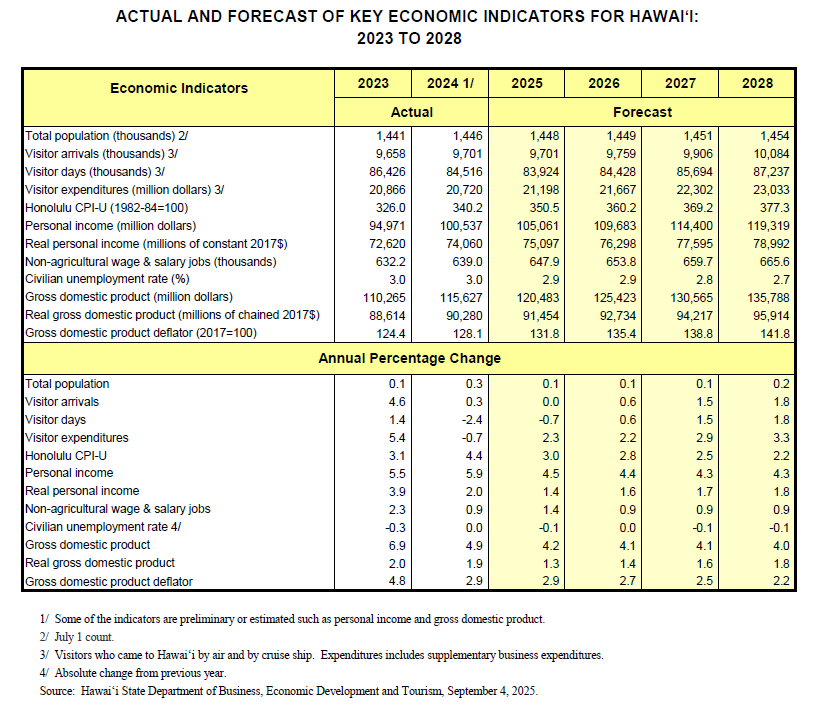
DBEDT projects Hawai‘i’s real gross domestic product (GDP) to grow by 1.3% in 2025 and 1.4% in 2026, before strengthening to 1.8% in 2028 as the effects of tariffs subside and the economy returns to its potential. Nominal GDP is forecast to reach $120.5 billion in 2025 and $135.8 billion by 2028.
Honolulu’s Consumer Price Index (CPI-U) is projected to increase 3.0% in 2025 and then moderate gradually to 2.2% by 2028, reflecting easing inflationary pressures over time. Employment is expected to expand steadily, with non-agricultural wage and salary jobs rising from 647,900 in 2025 to 665,600 in 2028. The civilian unemployment rate is forecast to edge down from 2.9% in 2025 to 2.7% in 2028. Personal income is projected to grow from $105.1 billion in 2025 to $119.3 billion in 2028, while real personal income will rise more modestly as inflation pressures ease.
Visitor arrivals are forecast at 9.7 million in 2025, surpassing 10 million by 2028. Visitor expenditures are projected to grow from $21.2 billion in 2025 to $23.0 billion in 2028.
Statement from DBEDT Director James Kunane Tokioka
Hawai‘i’s economy, like the rest of the country, is navigating a period of slower growth and rising prices. Our forecasts confirm that while the pace of growth will slow in the near term, Hawai‘i’s long-term fundamentals remain intact. We expect subdued growth in 2025 and 2026 and accelerated growth in 2027 as the economy adjusts to a new tariff regime. Construction, steady job gains and solid visitor spending will continue to provide stability during this period.
I am confident in Hawai‘i’s resilience. Our people, our industries and the enduring strength of our communities will carry us through this transition. Together, we will emerge stronger, with new opportunities for growth and prosperity in the years ahead.
The full report is available at dbedt.hawaii.gov/economic/qser/.
Sponsored Content