 Hawai'i Journalism Initiative
Biggest water users in West Maui before fire were non-owner-occupied homes, report finds

Nearly 100 applications for existing use water permits in West Maui show that single-family homes were the biggest users of water before the August 2023 wildfire, with some non-owner-occupied homes consuming even more water than ones lived in by owners, according to a report released Wednesday by state water commission staff.
The report offers a public look into water use prior to the fire and will help guide the state Commission on Water Resource Management as it decides who should get future permits to use water in West Maui.
HJI Weekly Newsletter
Get more stories like these delivered straight to your inbox. Sign up for the Hawai‘i Journalism Initiative's weekly newsletter:
Even with significantly reduced water use in the wake of the Lahaina fire, the commission is “still seeing signs that West Maui’s groundwater resources are strained,” Ciara Kahahane, the deputy director of the commission who grew up in Lahaina, told reporters Wednesday.
“Rainfall in West Maui has been significantly below normal over the last five years, so it’s going to take a lot of rain to build back a healthy reserve of groundwater,” Kahahane said. “And while we all hope for more rain, we have to prepare for the current pattern of drought in West Maui to continue.”
The data in the report comes from 93 applications for existing use water permits in West Maui that are undergoing commission review after Lahaina aquifers were designated as a surface water and groundwater management area in 2022. That decision required all existing and new users in the area to get permits from the state. The applications were due the day before the fire.
Commission staff combed the application data to create the report in response to Lahaina community members who wanted to know about water use in the area, Kahahane said. The analysis revealed “interesting findings” on how residents were conserving water and where the biggest uses were going.
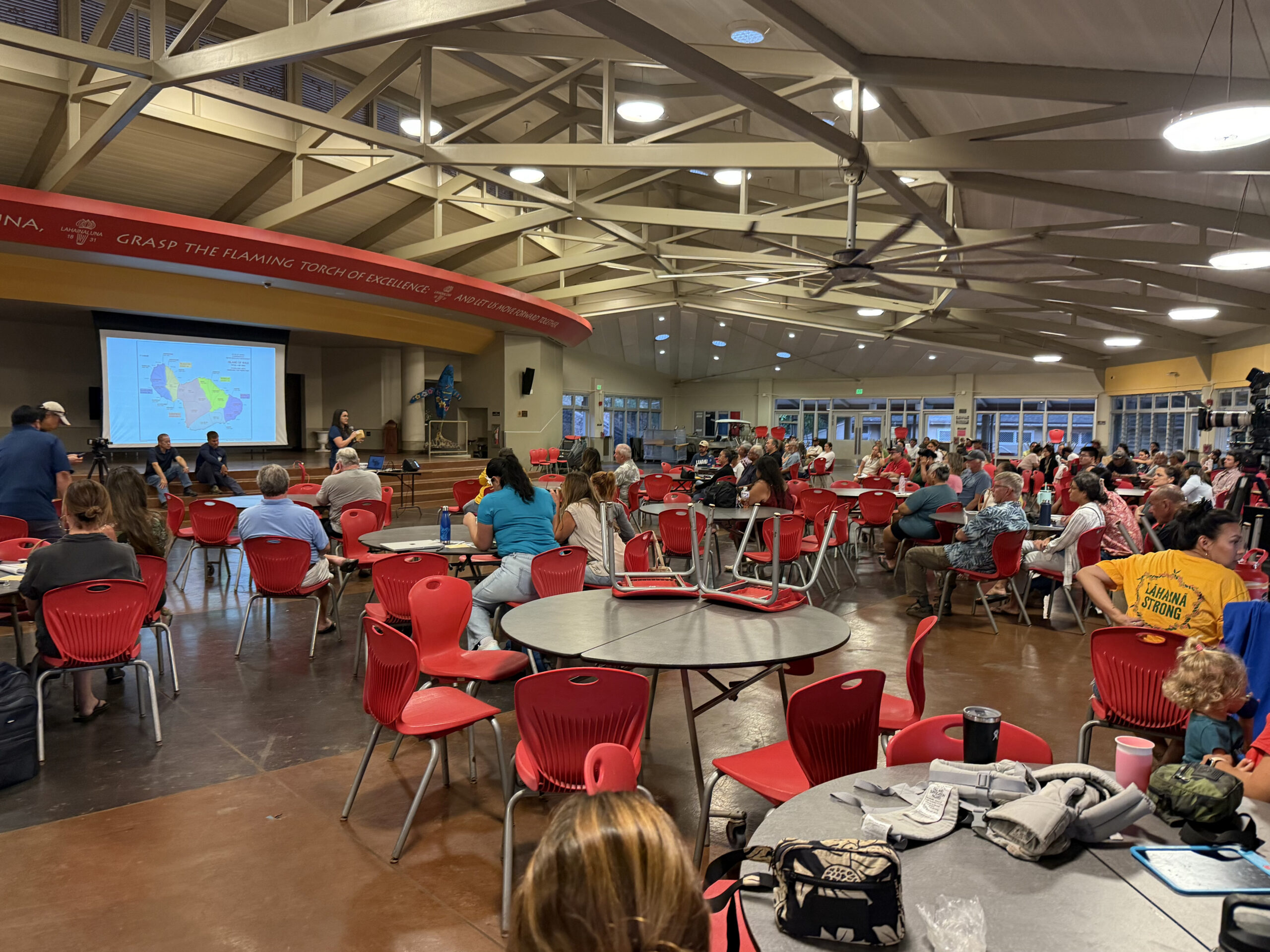
Before the fire, single-family homes were the largest category of users with 5.5 million gallons of water used per day, followed by hotels at about 3.5 million, Kahahane said.
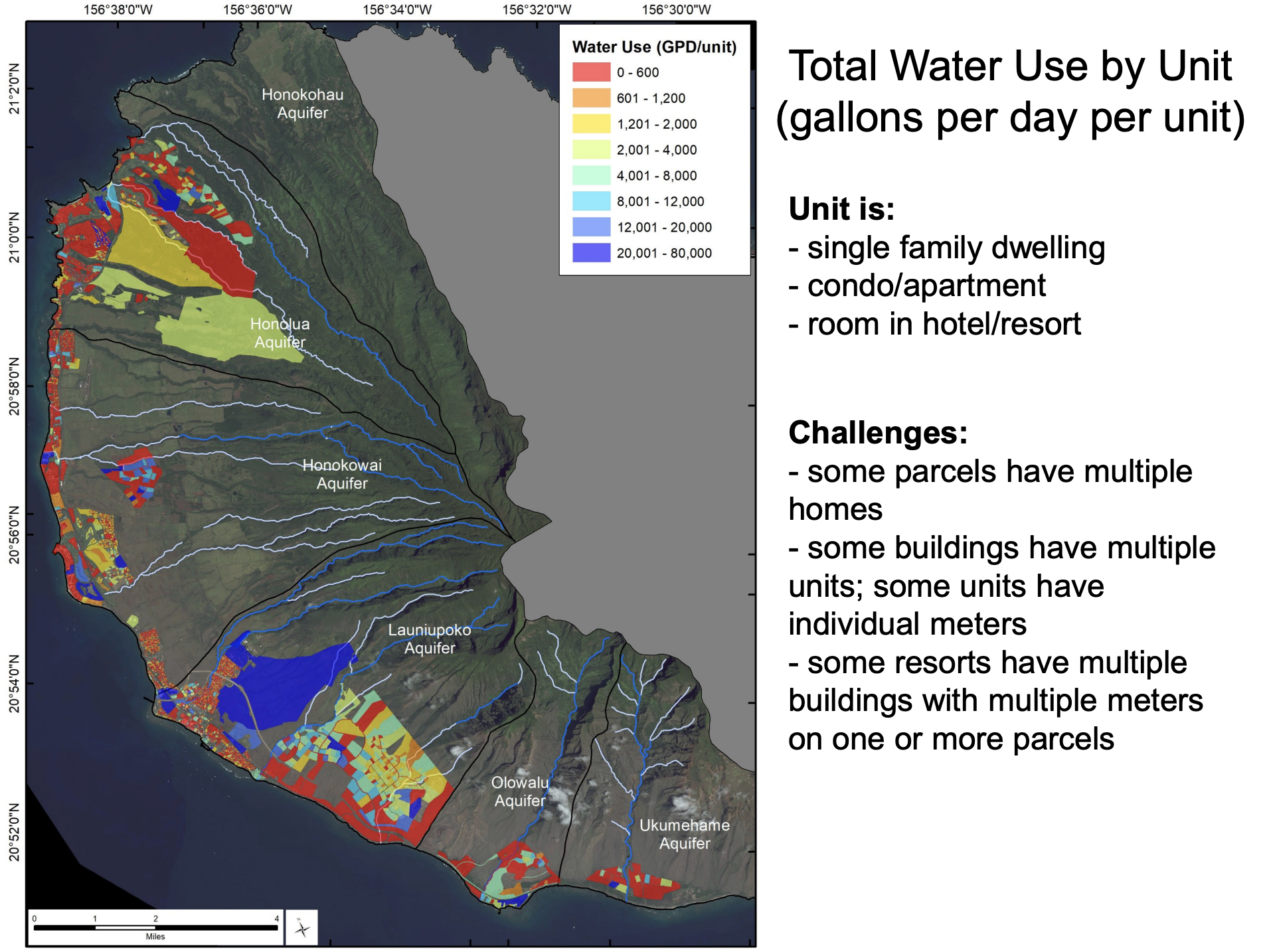
Of the 3,537 single-family dwelling meters, 77.9% were using less than 1,000 gallons of water on average per day, and more than half were consuming less than 500 gallons of water per day. The county standard is 600 gallons per day for single-family homes.
However, a smaller percentage of homes, 9.7%, were using much more. The applications showed that 358 single-family home meters were using 2,000 gallons of water or more each day, and many of those meters belonged to non-owner-occupied homes, which can include long-term rentals, short-term rentals and second homes.
“Non-owner-occupied homes frequently use more water than owner-occupied ones, especially on the private water systems,” Kahahane said. “And they also often constitute a majority of the single-family dwelling meters on those systems.”
For example, in the Kapalua area served by Hawai‘i Water Service, owner-occupied homes averaged 781 gallons per day across 52 water meters, while non-owner-occupied homes averaged 2,709 gallons per day across 207 water meters.
Overall, the average daily water use of non-owner-occupied, single-family dwelling meter homes was 1,469 gallons per day, about twice that of the 721 average gallons per day used by owner-occupied single-family dwelling meter homes, the report showed. When classified by land use, non-owner-occupied homes on agricultural and apartment-zoned properties used over 4.5 times more water than owner-occupied homes on the same types of parcels.
Kahahane said she couldn’t speculate on why some non-owner-occupied homes used more water, saying “it could be due to a number of factors,” including the use of the homes and the size of the properties.
“Certainly the size of the parcel has something to do with the amount of water that’s used for irrigation,” Kahahane said. “And the trend of non-owner-occupied versus owner-occupied that we see is a lot more pronounced on larger lots.”
In the Nāpili-Honokōwai area and Lahaina town where homes are serviced by the Maui County Department of Water Supply, the pattern only applies to non-owner-occupied homes on larger lots and in the historic district.
In Lahaina town, 802 of the 1,901 water meters (42%) were for non-owner-occupied homes, but in other areas, they were the majority. In Launiupoko, 219 of the 266 single-family dwelling meters (82%) were for non-owner-occupied homes, and in Olowalu, 39 of the 51 single-family dwelling meters (76%) were for non-owner-occupied homes.
Calculating water use by hotel rooms was harder because hotels use different water systems and vary in terms of landscaping, pools and water features, restaurants and other amenities, the report said. Some are on private systems and can irrigate with non-potable water, while users on the county system only have access to potable water to use for irrigation and other non-potable water uses.
Among the hotels and resorts, water use was as follows:
- Kā‘anapali, 2.8 million gallons per day for an average of 82,532 gallons per day per meter
- North Lahaina, 1.6 million gallons per day for an average of 15,815 gallons per day per meter
- South Lahaina, 166,274 gallons per day for an average of 27,712 gallons per day per meter
- Kapalua, 75,863 gallons per day for an average of 12,644 gallons per day per meter
Kahahane said the hotels’ use of potable water for irrigation is an infrastructure problem — the county doesn’t have a dual-line system that would allow delivery of non-potable water to the hotels on their system. Kapalua and Launiupoko have dual-line systems, as do some areas of Kā‘anapali.
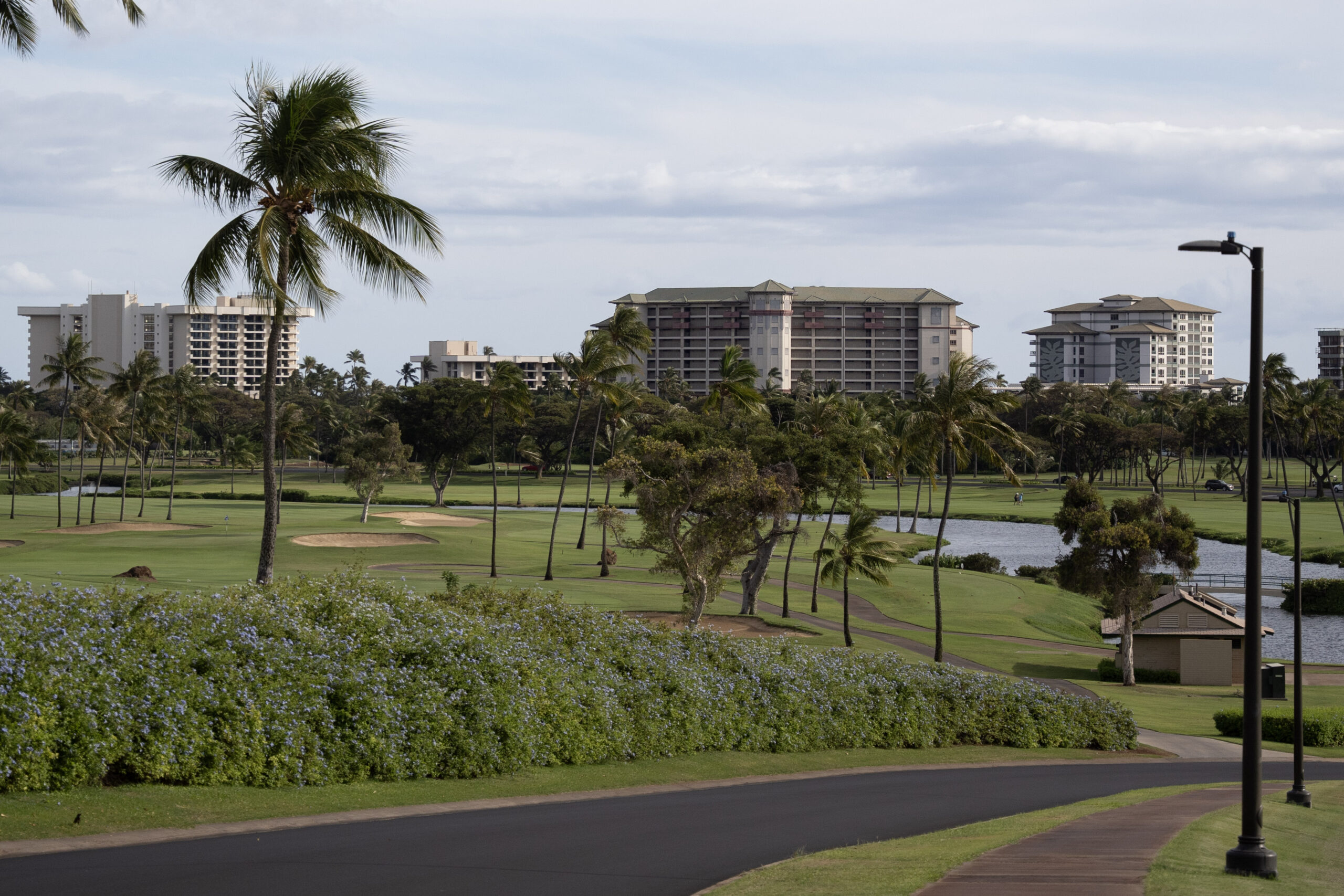
“We’re going to have to work with these folks, hotel operators and the like, to think more proactively and think more creatively about what other kinds of sources might be available besides just surface and groundwater resources, whether it’s R1 (recycled water), whether it’s desalination or other scalping or other uses of recycled water within their business,” Kahahane said.
After reviewing the data, Kahahane said she was most surprised to learn that “so many people are very judicious with their water use.” But one of the biggest concerns “on the flip side, is how many really large users there are of water.”
The report shows that chloride levels in production wells are rising, a key early indicator that groundwater resources are stressed.
Kahahane said that if every unit in West Maui that is currently hooked up to a single-family dwelling meter cut back water use to 1,000 gallons per day, the area could save about 1.7 million gallons of water per day.
Jonathan Scheuer, water resource expert and co-author of the book “Water and Power in West Maui,” said Wednesday that he was “actually struck” by how the data “really matches what many in the community have been saying all along, that it’s not about having a shortage of water per se, but that certain users are really using way more water than others.”
“There’s a lot of opportunity for people to be much more efficient in their water use and have water for important projects that we want, including rebuilding, including permanent affordable housing for local residents,” Scheuer said.
Before the fire, people noted how Kā‘anapali to the north and Launiupoko to the south appeared “super green and luxury” while Lahaina remained dry in the middle.
He said the trend of non-owner-occupied homes using more water “has obvious implications for Bill 9,” the mayor’s proposal to phase out over 7,000 vacation rentals in apartment districts. The data could fuel the argument that non-owner-occupied homes are impacting water resources.
Tadashi Yanai, the billionaire founder of the clothing brand Uniqlo and the owner of Kapalua Golf, thinks there’s enough water to go around but believes it’s not being managed well. In August, Yanai’s TY Management Corp. sued Maui Land & Pineapple Co., claiming they failed to maintain the Honokōhau ditch system that supplies the golf course, forcing the closure of the courses for two months and the cancellation of The Sentry PGA golf tournament.
Yanai told the Hawai‘i Journalism Initiative Wednesday that water is being wasted in Maui Land & Pine’s system.
“It starts with the responsibility to supply the water,” Yanai said through an interpreter. “If they did a very good job of preserving the water, we would not come into this situation where we are suffering from the tight supply of water. So if they did a better job, this situation would not have happened.”
Yanai, who was on Maui Wednesday to present a $750,000 check to several local organizations, said he understood community concerns over water being used for golf courses.
“But in the case of Kapalua, I personally believe that we have enough supply of water at the source,” Yanai said.

Maui Land & Pine countersued in September, claiming that TY Management ignored irrigation restrictions for months and used water that was meant for fire protection in Kapalua. The company said TY Management was using the browning golf course as “a narrative for a defamatory publicity campaign.”
“With all due respect to Yanai-san, if TY were truly concerned over any ‘waste’ of water, the proper place to raise those concerns would be the Commission on Water Resource Management, not the courts,” Maui Land & Pine said in a statement to the Hawai‘i Journalism Initiative on Wednesday. “There has not been a waste of water. There simply has not been enough rainfall to supply stream water to all off-stream users in West Maui.”
Kapalua customers who rely on the company’s system have been told to limit water for irrigation during the drought. But many users, including the Kapalua Golf courses, “refused to conserve … which affected water levels in reservoirs that pressurize Kapalua’s fire systems,” the company said.
Scheuer said the dispute is a reflection of the current water issues in West Maui, and a big reason why the water commission needs to move more quickly to decide on the water permit applications.
There’s no timeline for when the permit reviews could be finished, and staff have said it could take years to review the 93 applications for existing uses and 48 for new uses. The commission plans to discuss the water user report at its 9 a.m. meeting on Tuesday. (It can be viewed Live Stream via YouTube.)
“These two companies are now sort of in crisis, fighting over a really, really scarce resource during a time of drought, without the water commission ready to do its allocation job, which would give much greater clarity,” Scheuer said.
West Maui’s water struggle is a lesson for the county and the state to say “let’s get ahead of these kinds of problems, and start to have the tough discussions about where we want to develop water, where we have to protect in-ground or in-stream uses of water,” Scheuer said. “It’s getting drier, and our demands are going up.”