 Hawai'i Journalism Initiative
With $130M in new ‘green fees’ expected, Hawaiʻi eyes 75 projects to address a long list of environment-related needs
An advisory council created by Gov. Josh Green to help the State of Hawai‘i decide how to spend hundreds of millions in new funding from a first-of-its-kind climate impact tax has recommended 75 priority projects for the first round.
Since convening in August, the 10 volunteer members of the council have combed through more than 600 applications from state agencies, environmental organizations and other community groups requesting more than $2 billion for projects aimed at environmental stewardship, climate and hazard resilience, and sustainable tourism. Many of the recommended projects were spurred by the Maui wildfires and would help address needs such as brush management and hazard prevention data.
HJI Weekly Newsletter
Get more stories like these delivered straight to your inbox. Sign up for the Hawai‘i Journalism Initiative's weekly newsletter:
The recommendations have been sent to Green and state lawmakers. The ones that get approved for funding by the State Legislature this session will be the first to benefit from the “green fee” law that was passed last year to increase taxes on visitor lodging and cruise ships. Hawaiʻi is the first state to establish a climate impact fee.
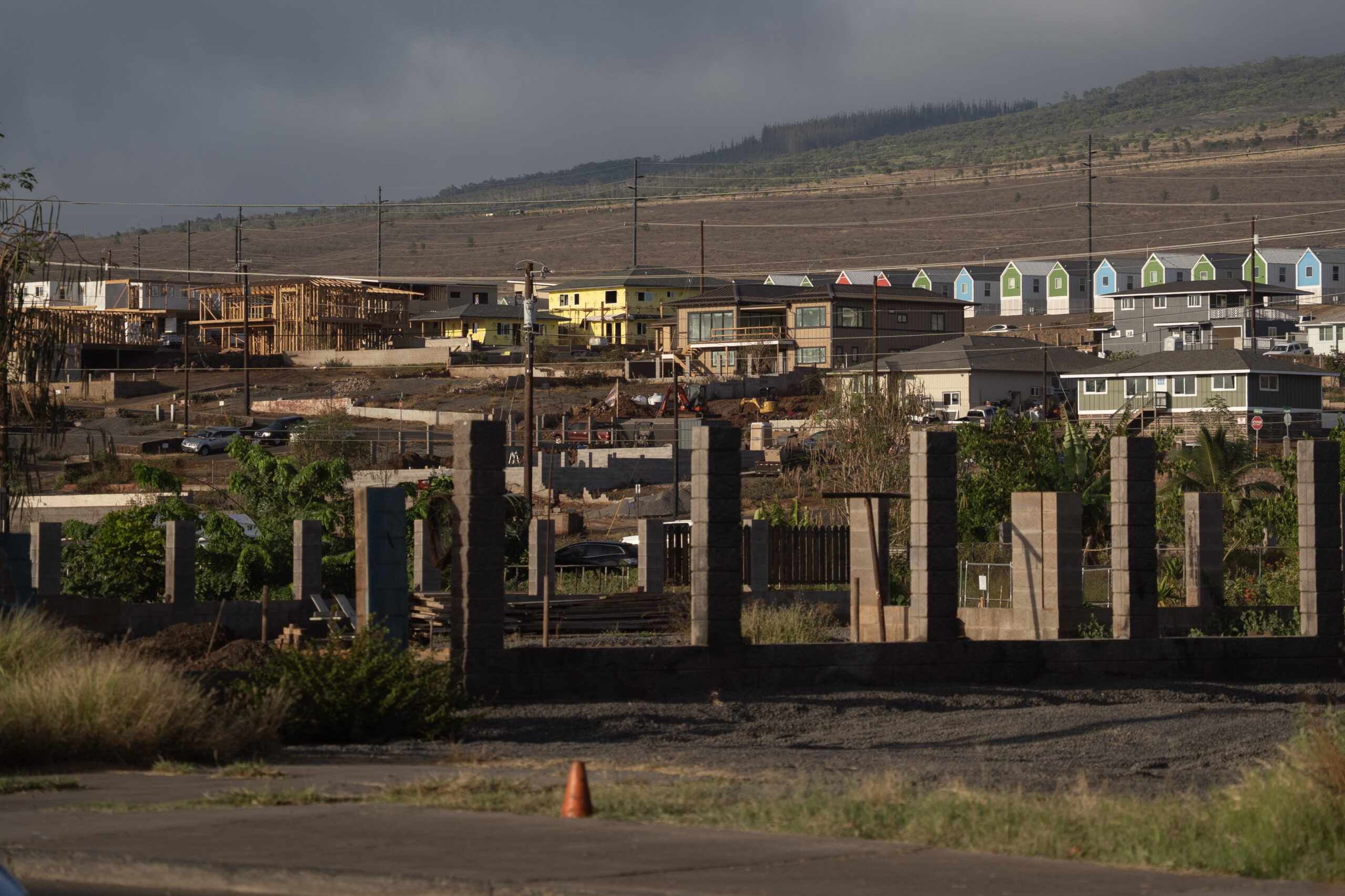
“A lot of this was born out of the tragedy in Lahaina,” Jeff Mikulina, chair of the Green Fee Advisory Council, said during a webinar Monday to publicly share the council’s recommendations.
“It’s meant to fix things that are broken, and Lahaina really showed us how broken we are when it comes to climate resilience.”
The green fee, which increases transient accommodation taxes from 10.25% to 11%, took effect Jan. 1 and is expected to generate nearly $130 million in the first round of use — $42 million in the current fiscal year 2026, which ends June 30, and $87 million in fiscal year 2027, which ends June 30, 2027.
The green fee is expected to generate more than $100 million in each fiscal year after that. About 30% of those revenues are anticipated to come from cruise ships, if the courts allow them to be taxed, the advisory council told the Hawai‘i Journalism Initiative on Monday.
Recently, a federal appeals court temporarily blocked the fee from applying to cruise ships that operators argue are exempt from state tax laws. Mikulina said the state Attorney General’s office “is actively litigating the case, and they’re confident they’ll prevail,” so the advisory council isn’t changing its funding recommendations for now. But he said they will be closely watching the case.
“Cruise visits do place real pressure on our harbors, beaches, wastewater systems, emergency services, cultural sites and those very systems that the green fee is designed to strengthen,” Mikulina said. “… We certainly hope the state prevails and the cruise ship (industry) pays their share.”
Even if the courts ultimately rule against applying the increased tax to cruise ships, the law is written to allow for the green fee to be applied to other visitor accommodations like hotels.
Based on the expected funding, the initial projects recommended by the council total $126.41 million and are spread fairly evenly across three categories: $42.54 million for environmental stewardship, $41.72 million for climate resilience and hazard mitigation, and $42.15 million for sustainable tourism.
Advisory council member Jack Kittinger, a conservation scientist and research professor at Arizona State University who also leads Conservation International’s Center for Regenerative Economies, said the combined request for $2 billion from state agencies and community groups in just the first year shows how much of a gap there is “between our current resources and what we need.”
Kittinger said the council reviewed the projects based on the criteria of the “five R’s”: the tangible “results” the project could achieve, the “readiness” to proceed, the “relevance” to the targeted areas, the “relationships” that could be leveraged between government and the community to make it succeed, and the “region,” to ensure a wide array of needs across the state were funded.
Every project was scored by three different advisory council members and the most impactful were chosen for recommendation. Projects that don’t make it into the first round will still have opportunities to apply in future years, Kittinger said.
For climate resilience and hazard mitigation, 31 projects and initiatives made the cut, with $21 million going toward fire mitigation, $6.7 million toward multihazard mitigation, and $6.4 million toward climate research. Some of the wildfire-related projects include:
- $6 million for the Hawai‘i Wildfire Risk Reduction Program and Firewise Communities Program that helps neighborhoods take proactive, science-based steps to reduce wildfire danger.
- $4 million for statewide brush and vegetation removal to reduce fire risk, improve drainage and maintain defensible space around schools.
- $3 million for statewide climate resilience crews to manage vegetation, reduce fuel loads and maintain defensible space in high-risk areas.
- $2 million to support state Department of Hawaiian Home Lands wildfire mitigation projects and establish a full-time homestead firewise support specialist position.
- $1 million for InSAR satellite data to monitor ground deformation and elevation changes, which can reveal soil moisture, vegetation stress and slope movement that, combined with thermal imagery, can identify areas where dry vegetation and unstable terrain create high-risk areas.
- $1 million for “pre-covery pods,” insulated containers stocked with long-lasting, shelf-stable meals that can be placed in hard-to-reach communities who may be cut off by disasters.
Other notable funding for climate resilience and hazard mitigation projects included $5 million to retrofit 750 homes for hurricanes, $2 million to help small businesses recover from the economic effects of natural disasters, and $500,000 to use cutting-edge technology to do climate modeling that gauges the risks of sea level rise, wildfire, extreme heat, declining rainfall, deepening drought and coastal erosion in West Maui.
“We know that for most hazards in Hawai‘i, the risk and the hazards are overlapping, and that compounds community vulnerability,” said Dennis Hwang, faculty at the University of Hawai‘i Sea Grant College Program.
Hwang said the goal of the projects is to tackle the issues with a holistic approach. Programs to support investment in native plants, for example, will help in vegetation management and reducing fire risk, Mikulina pointed out.
A total of 28 projects were selected for environmental stewardship funding, with $24.2 million for native species and terrestrial ecosystems, $17.55 million for aquatic resources and coastal ecosystems, and $250,000 for freshwater resources and watersheds.

Most of the funding — over $30 million — would go towards a Green Fee Community Stewardship Program offering grants for specific focus areas, including $10.56 million for reforestation and habitat recovery, including on Maui, Moloka‘i and Lāna‘i; $5.75 million for marine management and ridge-to-reef initiatives to manage fisheries and coral, including in East Maui; $5 million to control the spread of invasive plants and animals on all islands; $2.5 million for 20 Makai Watch groups like the one at Maui’s Honolua Bay; and $2.25 million to restore and manage coastal habitats, including sand dunes.
Another 13 projects were chosen for sustainable tourism funding, with $25 million for beach and park improvements, $12.1 million for visitor and resident education and stewardship, and $4.55 million for infrastructure and capacity building.
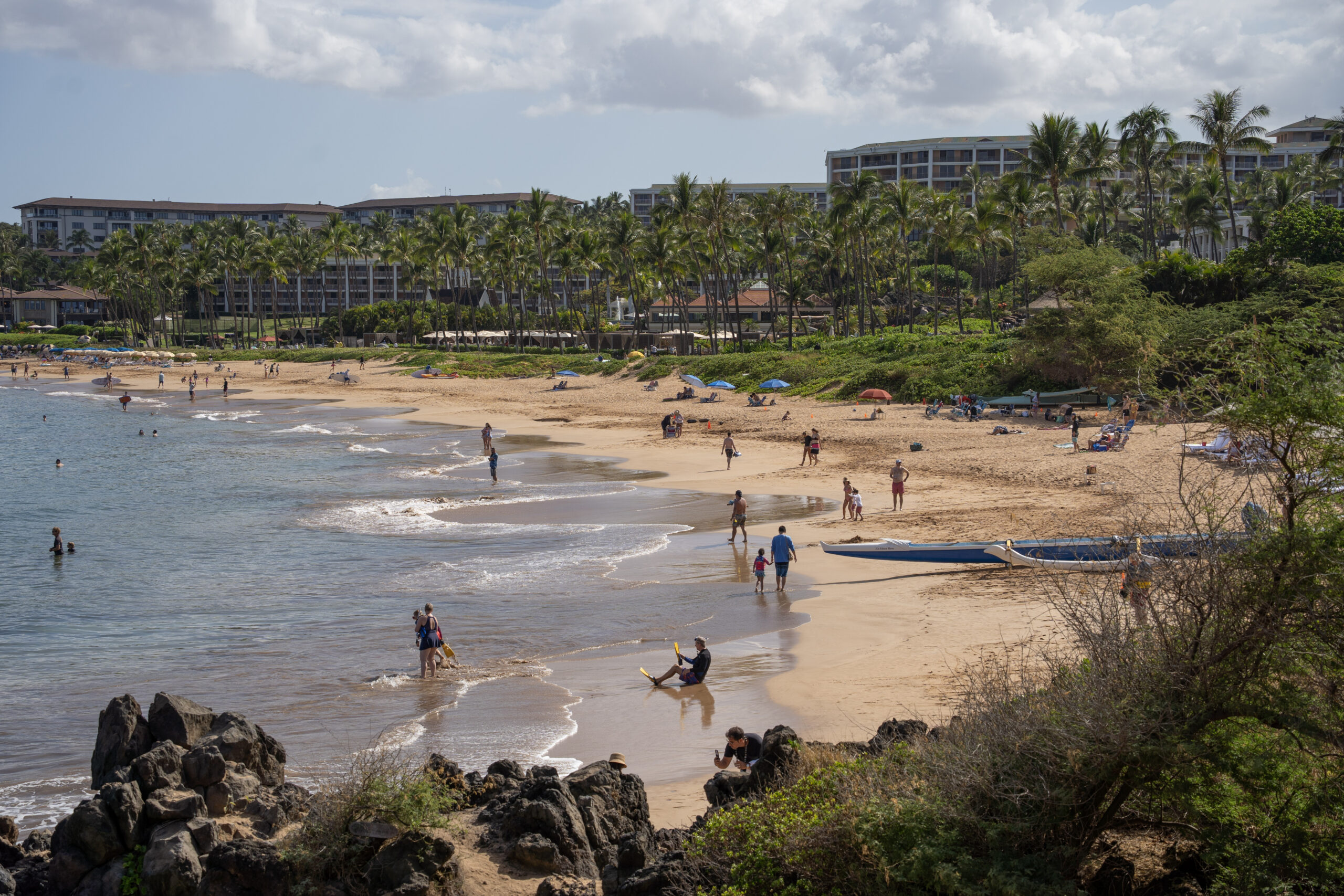
One of the recommended initiatives calls for $4 million for restoration work and long-term planning at Kā‘anapali Beach, one of West Maui’s most popular stretches of coastline that has struggled with shoreline erosion over the years. There is also $2 million for coastal resiliency projects such as sand nourishment and shoreline stabilization at Kahana Bay and Kapalua Bay, also tourist hotspots that have faced major erosion.
The council also recommended setting aside $500,000 for monitoring and evaluation for each funding category and a public online dashboard that would allow the community to track the funding and its impacts.
Advisory council members said they hoped the funding would be passed as a full package. Once approved, funding will be available on July 1 and will need to be spent by July 1, 2027. The funds will be given out to the state departments and agencies which will be tasked with carrying out projects they’ve proposed or distributing the funding to the selected community groups.
Mikulina said this is just the start of what the state hopes will be “a long-term commitment” to projects that benefit the environment and prepare for a changing climate. He said the council’s first-year recommendations “are the starting line” in what will be a marathon to prove that the green fees can work.
“This isn’t a one-time sort of experiment,” he said. “This is an ongoing, dedicated resource to help take better care of our climate resilience and our natural resource.”