



 Hawai'i Journalism Initiative
As artificial intelligence evolves at warp speed, Maui educators, students working to ‘stay on top of things’
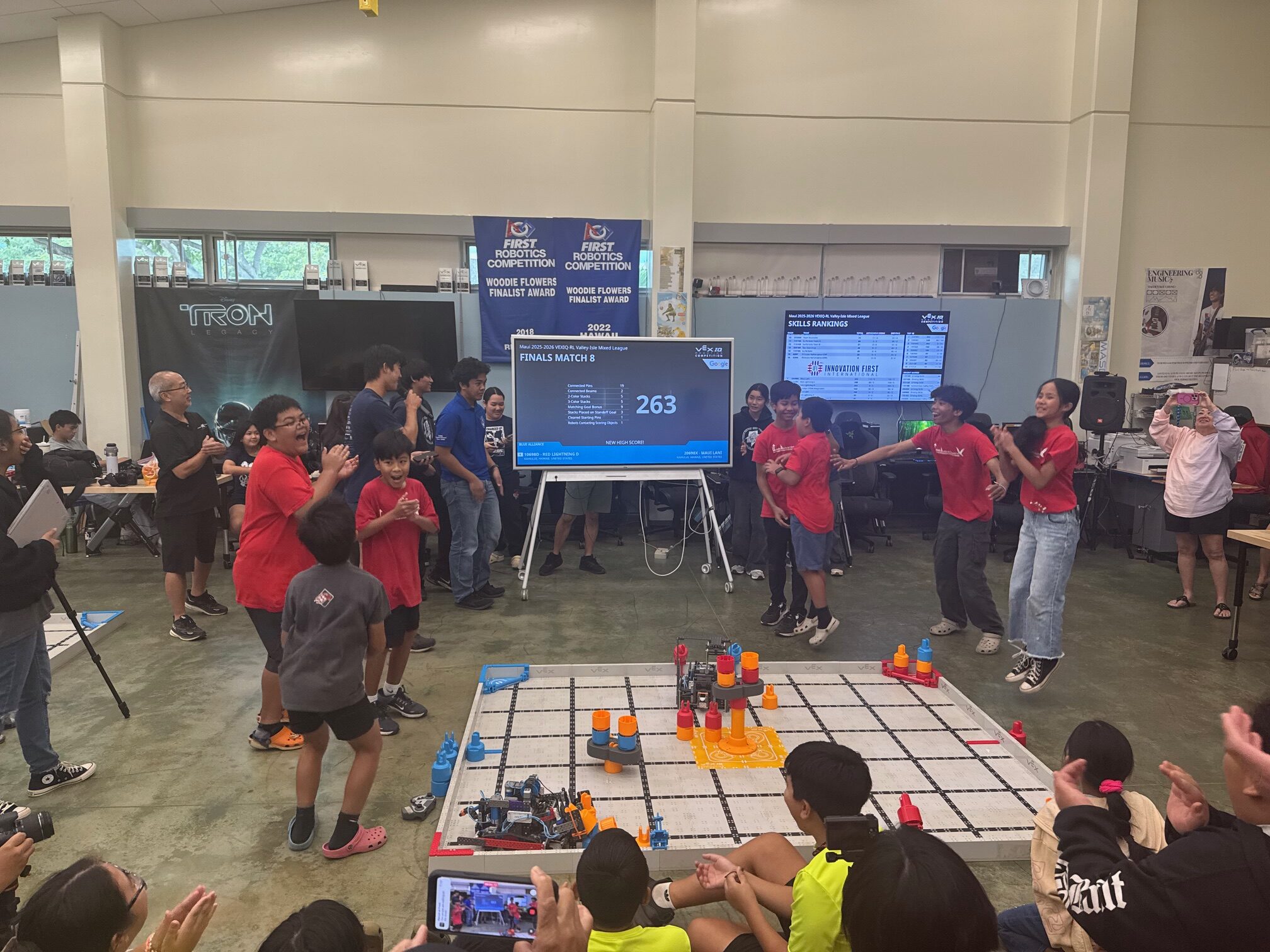
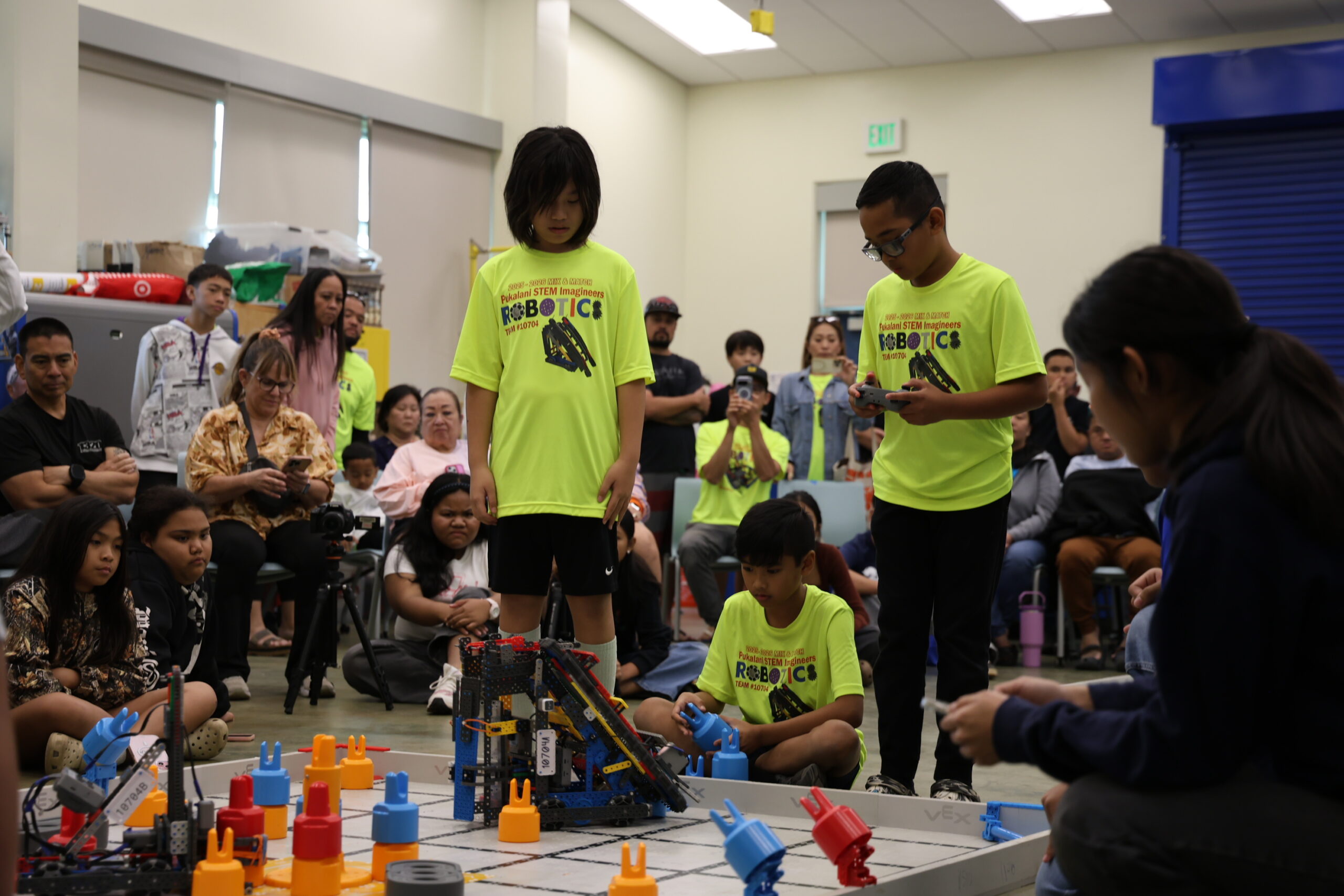
More than 100 elementary and intermediate students filled the Harrison and Helen Miyahira STEM Center at Maui High School on Jan. 24 for a robotics competition that showcased just how quickly artificial intelligence has evolved.
“AI is so much bigger for these kids now than it was when we were their age,” said senior Dominick Guiwa, the Maui High School robotics captain, who also uses the tools of AI to help him in programming, mathematics and English.
Just in the past five years, Guiwa said AI has come a long way fast, enabling him to more quickly and efficiently tackle the specifics and pursue the complexity of projects. “AI is able to give me that feedback that I couldn’t see for myself,” he said.
HJI Weekly Newsletter
Get more stories like these delivered straight to your inbox. Sign up for the Hawai‘i Journalism Initiative's weekly newsletter:
The AI explosion has changed nearly everything in education, revolutionizing the way things now are taught, the way students can augment and speed up their learning process, and even how teachers operate, said Keith Imada, who teaches STEM (science, technology, engineering and mathematics) at Maui High.
The 62-year-old Imada, who also teaches physics, computer science and engineering on the Kahului campus, said it also is a learning process for teachers, who are trying to keep up with the ever-evolving technology.
Imada said he is still learning and developing precisely how to use AI in his classes, but it is a technology that he knows students have discovered and will definitely be using, so he is integrating it into his lesson plans.
“In the engineering design process, one of the most important things at the beginning, besides identifying the problem, is doing the research in order to come up with a probable solution,” Imada said. “(The students) have AI editors that can help you identify areas of weakness, and it even selects things that you can practice. So, in that way, it’s a big help.”
Guiwa, along with Maui High seniors Alaina Hook and Aleizay Angel, served as student ambassadors who guided 16 teams through the VEXIQ Robotics Championships of the Valley Isle Mixed League.
The league, for students in grades 4 through 8, runs a series of five Saturday competition days once a month from September to January each year, culminating with the championship.
Each competition has three scored portions — an interview with judges, their notebook that documents the development of their robot, and one-minute timed teamwork sessions in a 6-foot by 8-foot arena with another team. The robots are controlled by the youngsters.
While these young competitors are farther along than Guiwa, Hook and Angel at the same age, the older trio also are part of the generation of high school students about to start college with opportunities that are growing broader and more complex than when they were in elementary and intermediate school.
Hook has been accepted to Ohio State University where she plans to study welding engineering or mechanical engineering. Angel’s dream school is Stanford where she hopes to study biomedical engineering. Guiwa’s wish list of dream schools includes Yale, Harvard, Princeton, Stanford and MIT. He wants to work in cyber or national intelligence in Washington, D.C., or perhaps become a doctor.
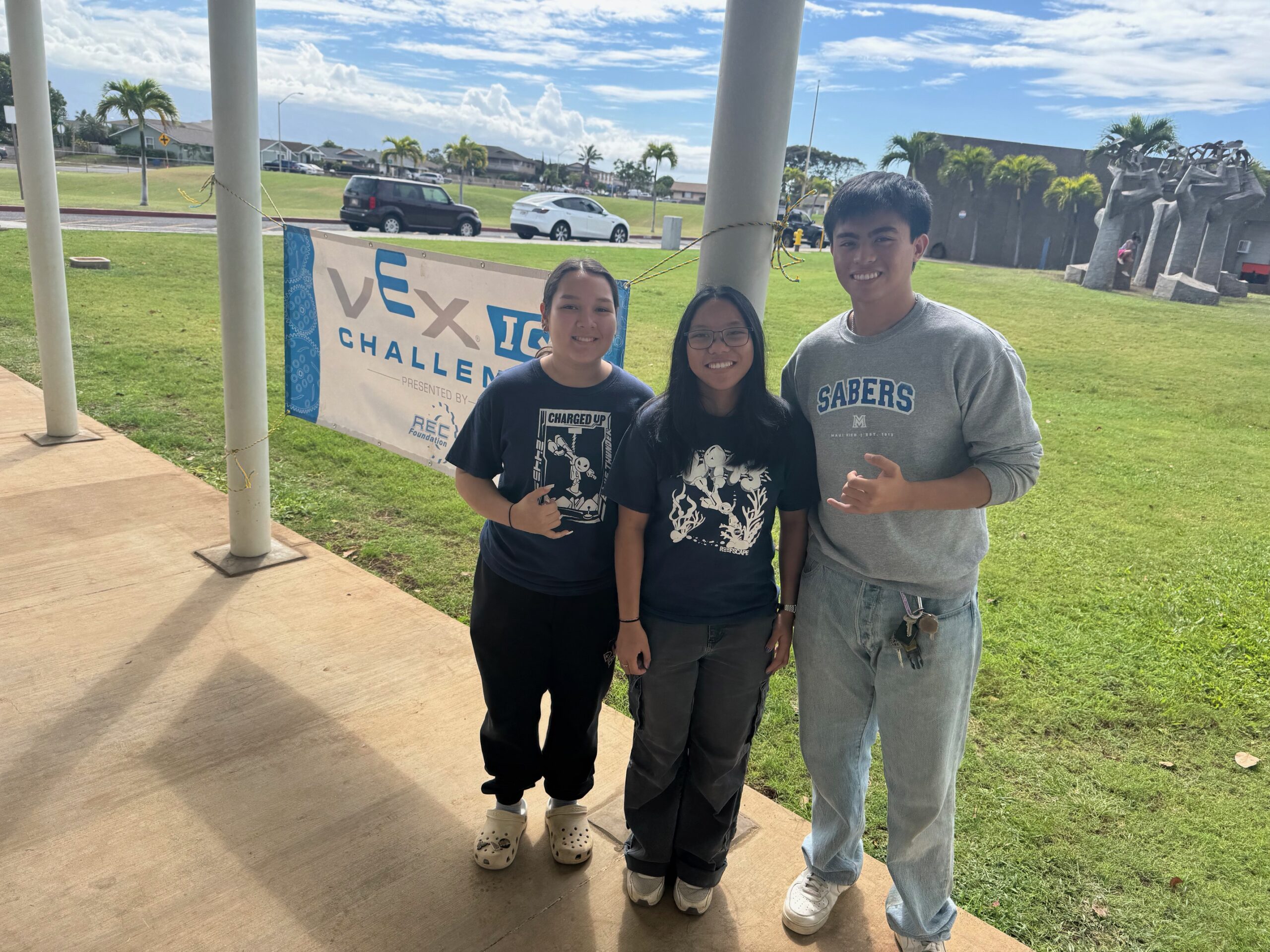
“I would like to explore engineering going into the cyber route, cybersecurity route, or national intelligence, or biomedical engineering going into the neurosurgery route,” Guiwa said.
He knows AI will be a big part of his future, especially as the technology continues to grow at warp speed.
“I definitely do think that AI is something that will be essential in the future as a tool for both students and for innovation in teaching,” Guiwa said.
It was their standout study of robotics — Hook started in elementary school, Angel started in intermediate school and Guiwa began as a Maui High freshman — that helped lead them to their bright college futures.
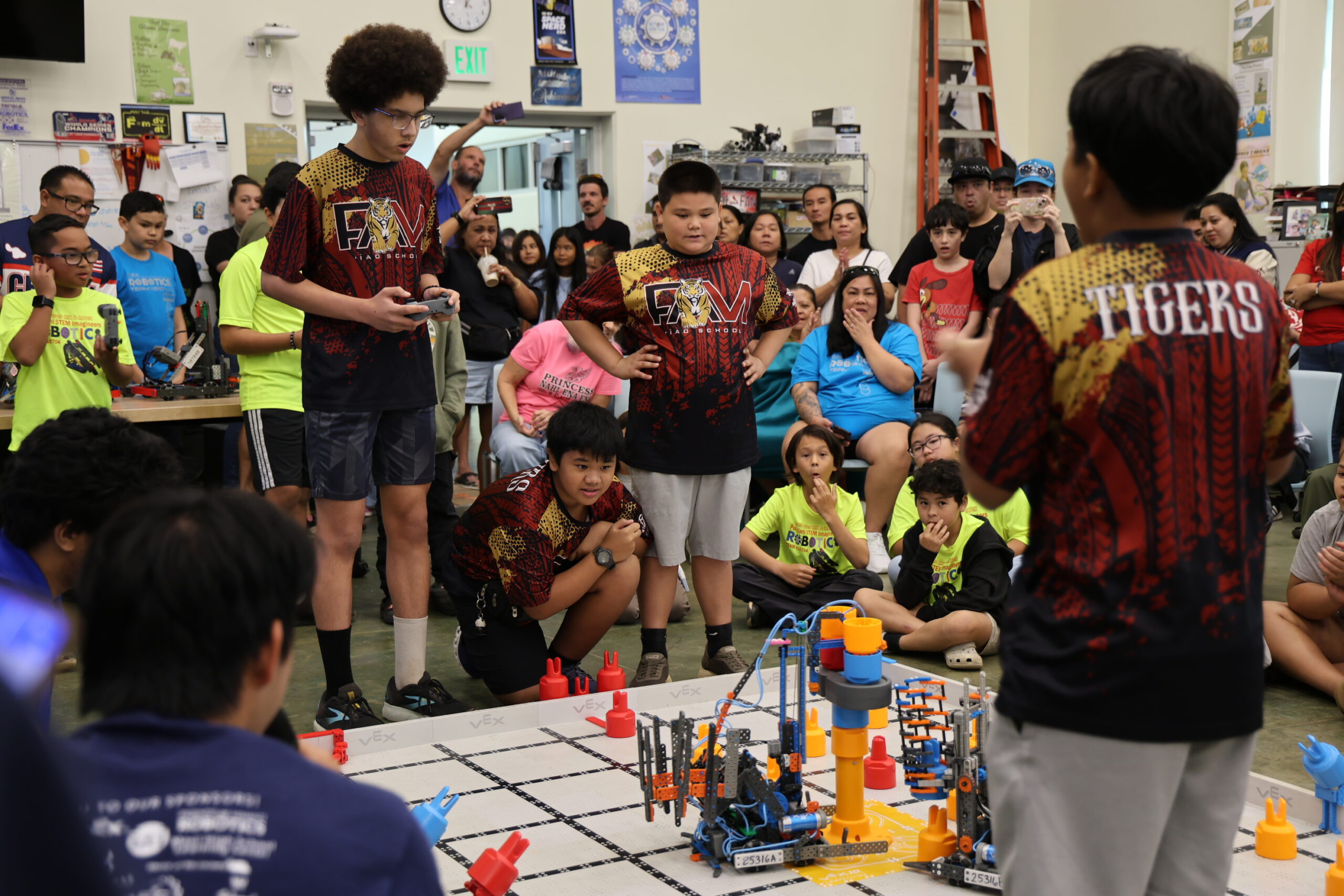
“It is an absolute delight to help these kids out, especially these younger ones, because every day and every second I get to see how passionate they are,” Guiwa said. “Every time that they are jumping for joy or showing an expression of satisfaction, I can relate to how hard they worked and the skills and leadership that they’ve built because what they do matters.”
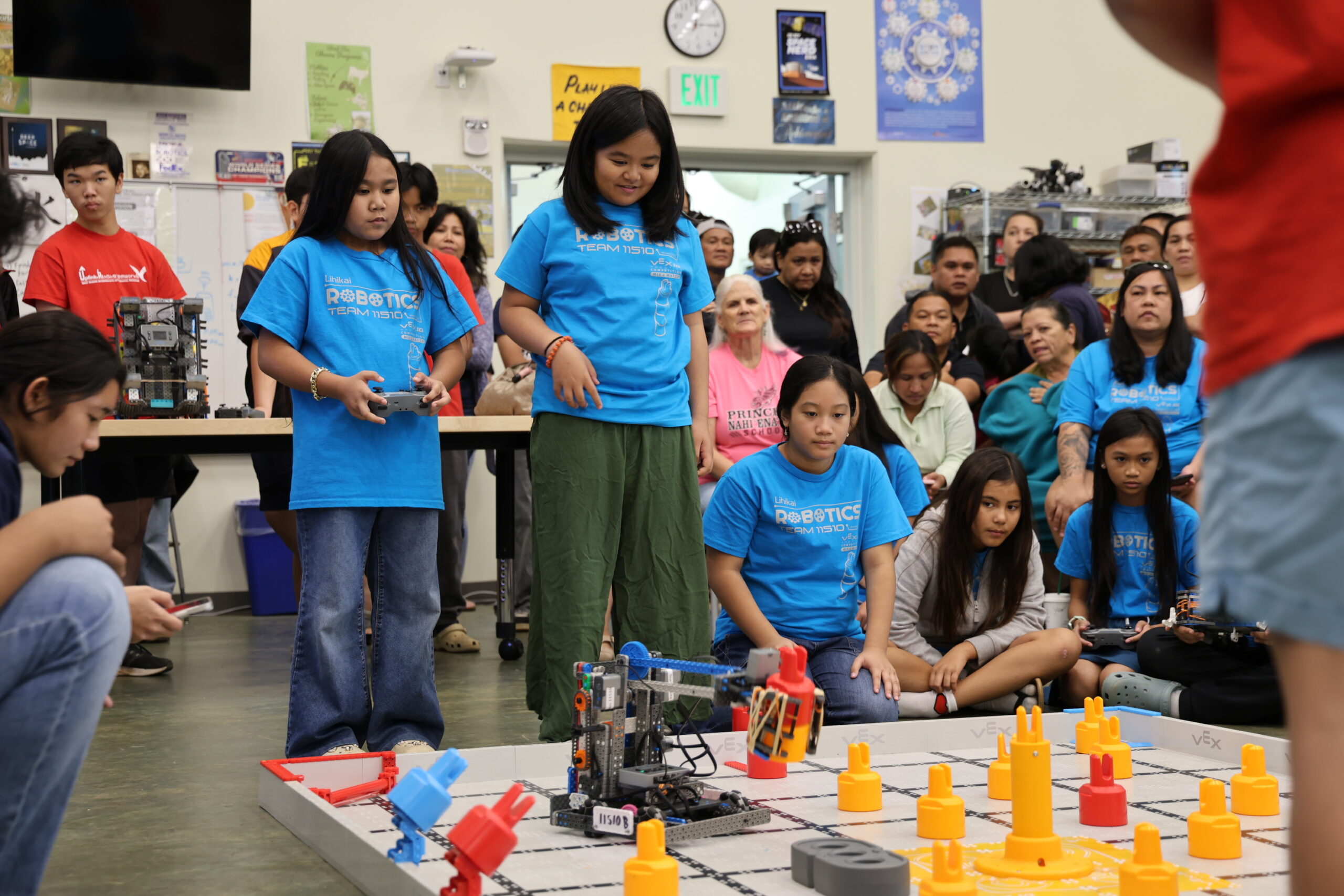
Imada’s STEM classroom was standing-room-only with parents, aunties and uncles lining the space around the small robotic competition arena to cheer on the students on championship day.
Imada uses an AI program called Perplexity to help his computer programming class. Perplexity is a chat generative pre-trained transformer program, or chatGPT. Imada said he chose Perplexity because “it doesn’t just give you answers to the questions. It also gives you the resources that it gathered that information from.”
Guiwa said students know all about AI and many use it, especially outside of the view of teachers.
“Currently, even in its infancy, I think that AI is widely debated on its ethics, whether it actually benefits a student,” Guiwa said. “There are even situations where educators are trying to minimize the use of AI, but it’s inevitable that students are going to find out about AI and use AI.”
Guiwa added: “I think that eventually, just as calculators were integrated into the education system, AI will be a tool for students.”
Imada said he is trying to stay ahead of the technology to help use it for the betterment of his students’ learning capabilities.
“In my class, especially for engineering, they need to explain where they got the information from,” Imada said. “So it should be from a bona fide science or engineering type website or project or data collection.”
Angel said while she knows AI is used by her robotics teammates, she does not use the technology in her role as a documenter, the person who keeps the team’s notebook on the development of their robot.
“So, when I started robotics in eighth grade, there was no use of AI because that really wasn’t a thing before,” Angel said. “So as AI became more popular, I did notice that more people started using it.”
Angel added AI can be a two-edged sword, with the rise of AI leading to a decline in literacy and critical thinking skills, especially for younger students.
“Now that AI can do everything for you, there’s students who don’t want to think anymore,” she said. “If they get an assignment, they’ll just put it straight through AI and have it do it for them. So that’s a bad thing.”
But, Angel said, some students put AI to good use.
“Rather than having AI do the homework for them or their assignments for them, they’ll ask it: ‘Oh help me create a study guide for me to study for this test,'” she said.
During championship day, the youngsters in the VEXIQ Robotics Championships were using AI programs to help develop their robots.
After interview sessions with judges where the teams showed and explained the notebooks that they kept while detailing their seasons that began in September and how their robots have developed, the teams took to the arena.
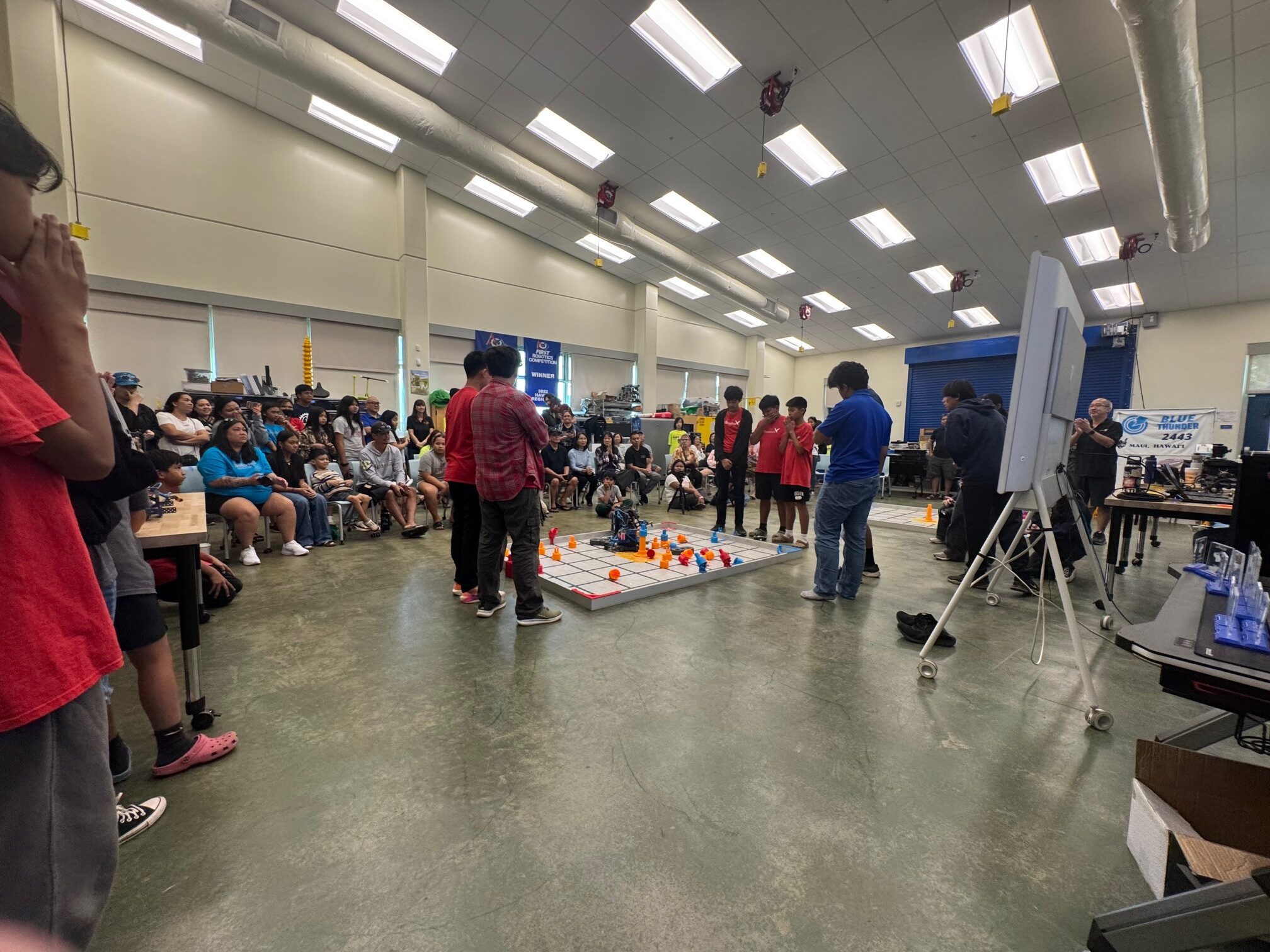
The “oohs” and “ahhs” from the crowd during the competition was proof how impressive the robots were and how seriously the students took the competition.
Team “drivers” used a hand-held remote to control and move the robots into position to pick up plastic “pins” that were stacked and then put into holes on a “beam.” The beam can then be stacked on to a tower. All of that happens in a one-minute timed session. Two teams compete at the same time.
The competitions are scored by judges who conduct the interview with the teams where the season-long notebooks are evaluated along with the knowledge displayed in the interview; drivers and programming also are scored to determine winners.
The Excellence Award, the top award for the season, went to team 10698D from Maui Waena Intermediate School made up of Jaysen Acoba, a 12-year-old seventh-grader who is the builder and driver; Jeshua Rabe, a 14-year-old eighth-grader who is the programmer; and Christine Ho, a 13-year-old seventh-grader who was the documenter.
The Teamwork Award went to a combined team of Acoba, Rabe, Ho and Tahlia Crispin, Kyle Takahara, Geo Cumangao, Breyten Higa and Maverick Garcia, all from Maui Waena.
Those eight students qualify for the Hawai‘i State Middle School VEXIQ Championship at Pearl City High School March 13-14. Three slots from Hawai‘i will be on the line there to advance to the world championships in St. Louis, Mo., April 28-30.
“The family and friends that come to support them shows these kids what they do matters,” Guiwa said. “And it does matter because they’re more prepared for their future after an event like this.”
Maui High junior Jeffrey Ho started robotics as a fourth-grader at Pukalani Elementary School and now is a builder for his high school team. Teams are made up of the “builders” who physically build the robots; “documenters” who detail the process in the notebook that is judged; and “programmers” who code the brains of the robots and often serve as the driver who controls the robot.
“One of the major factors that AI introduces is a quick R&D or research and development,” Ho said. “It really makes it so that we can take less time researching things because we can just put in a simple like paragraph or two prompt and right off the bat it’ll run through many sources and then it’ll give us information that we would need.”
As a builder, Ho uses a manual lathe machine in his automotive class to cut ultra-high-density plastic, tubing and aluminum by hand after an AI program has told them the needed dimensions. For more precise work, Ho uses a computer numerical control machine to shape other pieces of the robots that have to be precise, down to one-thousandth of an inch in some cases.
“So our accuracy, we try to get as perfect as possible, although sometimes it will get a little bit off because the machines are somewhat old,” Ho said.
Teachers also use AI, including Neill Nakamura, who has taught at Maui High for 24 years and now specializes in automotive and robotics. He uses AI to speed up the process of writing lesson plans and college letters of recommendation for his students.
“For me, it definitely takes away a lot of the, I guess I’ll call it the grunt work,” Nakamura said. “You just stick to the content and then you let AI kind of fill in the body for you.”
Nakamura emphasized that AI is not perfect: “Then you go through it and you re-edit, make sure that it’s saying what you need it to say.”
Imada said he is an old-school thinker and cautious when it comes to using AI.
“I’m too much of a Star Trek guy,” Imada said. “There was an episode that the satellite becomes self aware of what it is. It’s searching for its creator.
“The idea that as AI systems grow … humans will slowly get phased out of the process. That’s the scary part. We’re not there yet, but you can kind of see that happening. That’s why we have to stay on top of things.”