Three dead adult coconut rhinoceros beetles collected from detection traps in Waikapū, Maui
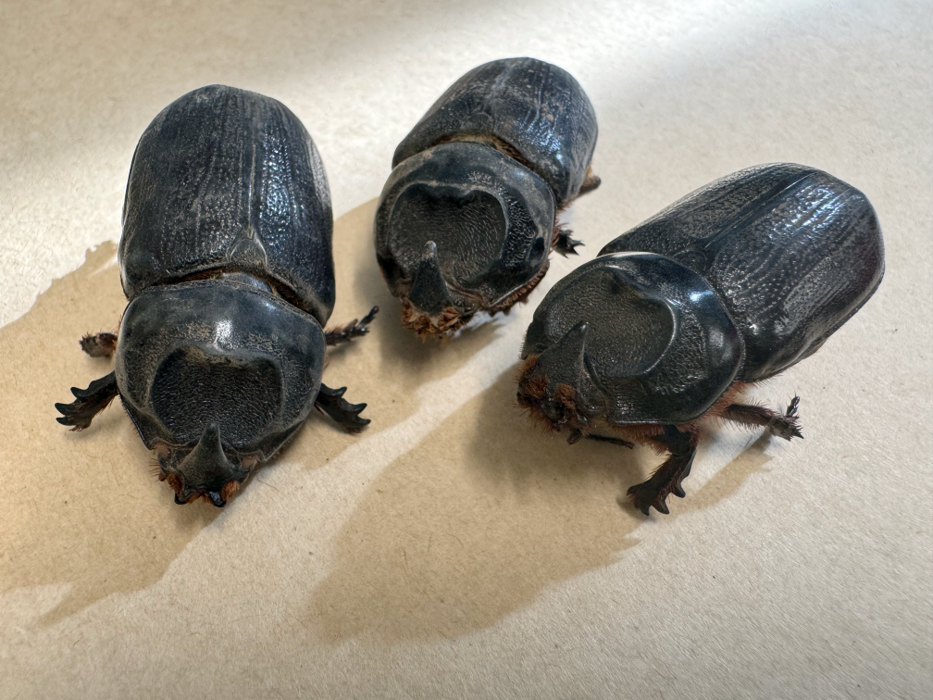
Three dead adult coconut rhinoceros beetles (CRB) were collected from two detection traps in Waikapū by staff from the Hawaiʻi Department of Agriculture and Biosecurity late Thursday afternoon on June 4, 2026.
No other CRB were detected in the remaining traps checked in the area. The dead CRB were sent to DAB’s taxonomist in Honolulu for official confirmation and were confirmed to be three dead female CRB. The traps where the CRB were found had previously been checked by DAB staff on May 15, 2026; no CRB were detected at that time.
On June 5, 2026, DAB staff immediately conducted surveys in the area looking for sites that may harbor CRB such as piles of green waste, compost, or decaying coconut material. Surveys for feeding damage on surrounding palms have also begun.
Since the prior detection of a dead CRB at Kahului Airport in early April, no live adult CRB or any CRB larvae have been detected on Maui. All response efforts are in coordination with the interagency Maui CRB Working Group involving DAB, Maui Invasive Species Committee, the County of Maui Departments of Agriculture and Department of Environmental Management, Division of Environmental Protection & Sustainability including statewide partners at CRB Response, the Hawai‘i Invasive Species Council and the Department of Land and Natural Resources.
DAB staff returned to the area on June 8, 2026 and collected two additional dead CRB from two detection traps. Residents, businesses and landowners in Maui are asked to check coconut palms or other large palm species for possible signs of CRB feeding damage and to identify and report piles of green waste that could harbor CRB. Residents should also be vigilant when purchasing or moving mulch, compost and soil products, as well as to avoid purchasing bags with damaged packaging or holes, as they could be infested with CRB.
Adult CRBs damage palm fronds as they bore into a palm to feed; however, it can take months before damage to palm fronds is visible. Because adult CRBs pose a direct threat to local food security, it is critical to detect CRBs as early as possible, should they be present elsewhere on Maui. With early detection, residents can avoid island wide infestation and prevent long-term economic and agricultural damage. Go to the CRB Response website at: https://www.crbhawaii.org/ to learn more about how to detect the signs of CRB damage and how to identify CRB life stages.
The Maui CRB Working Group urges Maui residents to do the following:
- Limit green waste movement as an extra protective measure.
- Check all compost piles and decaying coconut material for beetle larvae. CRB can be recognizable by their large size, up to 4 inches in length.
- Collect any suspected larvae in a completely sealed hard-sided container, such as a glass jar, with host material.
- Do not dispose of larvae until identification has been confirmed. The Oriental flower beetle is a widespread pest and has similar larvae.
- Photograph/video and report any feeding damage (appearing as V-shaped cuts on palm fronds) as soon as detected to 643PEST.org.
Feeding damage, visible as V-shaped cuts on palm fronds, can be photographed and reported to 643PEST.org. Reports can also be made by phone to the state’s toll free Pest Hotline at 808-643-PEST (7378).
Sponsored Content