

Hirono co-sponsors bill to protect federal language access services
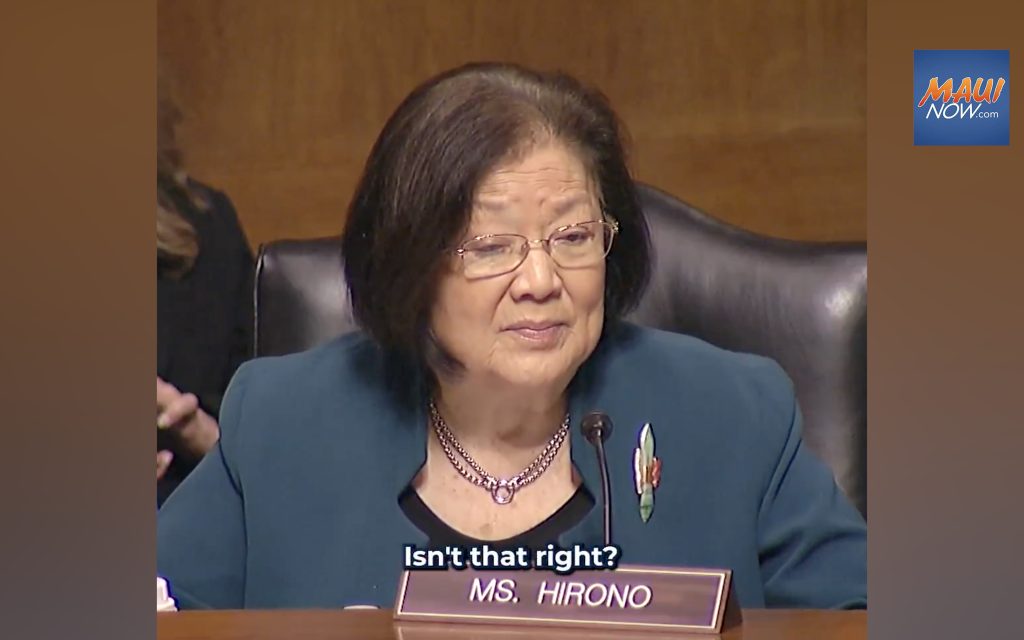
Hawaiʻi US Sen. Mazie Hirono has joined Sens. Andy Kim of New Jersey and Kirsten Gillibrand of New York in introducing legislation aimed at protecting language access requirements at federal agencies, a potentially impactful measure for Hawaiʻi’s large population of residents with limited English proficiency.
The bill, called the Language Access for All Act, would codify federal agencies’ obligations to provide translation and interpretation services. Its sponsors say it responds to Trump administration policy changes that have scaled back multilingual services across federal government.
In March 2025, President Donald Trump signed an executive order making English the official language of the United States. The order revoked a 25-year-old federal mandate requiring agencies and recipients of federal funding to provide meaningful language access to individuals with limited English proficiency. The US Department of Justice has since issued new guidance that reduces multilingual services in favor of English-language education and assimilation efforts, according to the bill’s sponsors.
Hirono said the policy shift is preventing Americans from accessing essential government services.
“In limiting multilingual access to federal resources, the Trump regime’s extreme anti-diversity ideology is preventing millions of American citizens from accessing critical services including small business loans, Social Security benefits, and Medicare coverage,” Hirono said.
The changes affect more than 25 million people nationwide with limited English proficiency, or about 8% of the US population, according to figures cited by the senators’ offices. Asian Americans have among the highest rates of limited English proficiency of any racial group, at 32%, the senators said. Native Hawaiians and Pacific Islanders also report significant language access needs, with 12% affected. Spanish speakers make up the largest share of non-English speakers in the country, and nearly 40% of that group told the US Census Bureau in its most recent survey that they speak English “less than very well.”
For Hawaiʻi, where Native Hawaiian, Pacific Islander and Asian American communities make up a substantial share of the population, the reported language access figures carry particular weight for residents seeking help from federal programs such as Social Security and Medicare.
The bill would require federal agencies to ensure people with limited English proficiency can meaningfully access agency programs and activities, including through translation and interpretation services. It would also establish a public complaint system to track barriers to access, require agencies to develop and publish language access plans on LEP.gov, and set technical standards covering agency communications, including artificial intelligence and automated language tools.
The legislation specifies that AI-assisted language services should not replace qualified human translators and interpreters, must comply with federal privacy requirements, and should be tested continuously for bias, discrimination and errors, according to the bill summary. It would also create an interagency language access working group and require each federal agency to designate a language access coordinator.
A companion bill was introduced in the US House of Representatives by Rep. Grace Meng of New York, chair of the Congressional Asian Pacific American Caucus, along with Chair Emerita Judy Chu of California and caucus members Dan Goldman of New York and Juan Vargas of California.
Hirono has represented Hawaiʻi in the US Senate and has focused on issues affecting immigrant and Asian American, Native Hawaiian and Pacific Islander communities. Earlier this year, a Hirono-sponsored resolution recognizing May as Asian American, Native Hawaiian and Pacific Islander Heritage Month passed the Senate by unanimous consent.
Last May, she introduced the All Students Count Act, which would promote instruction on Asian Pacific American history for high school students and teachers participating in the US Department of Education’s American History and Civics Academies programs.
Sponsored Content



_(1)_1787857947612.webp)