New interim rule restricts transportation of CRB host materials to Maui and Lānaʻi
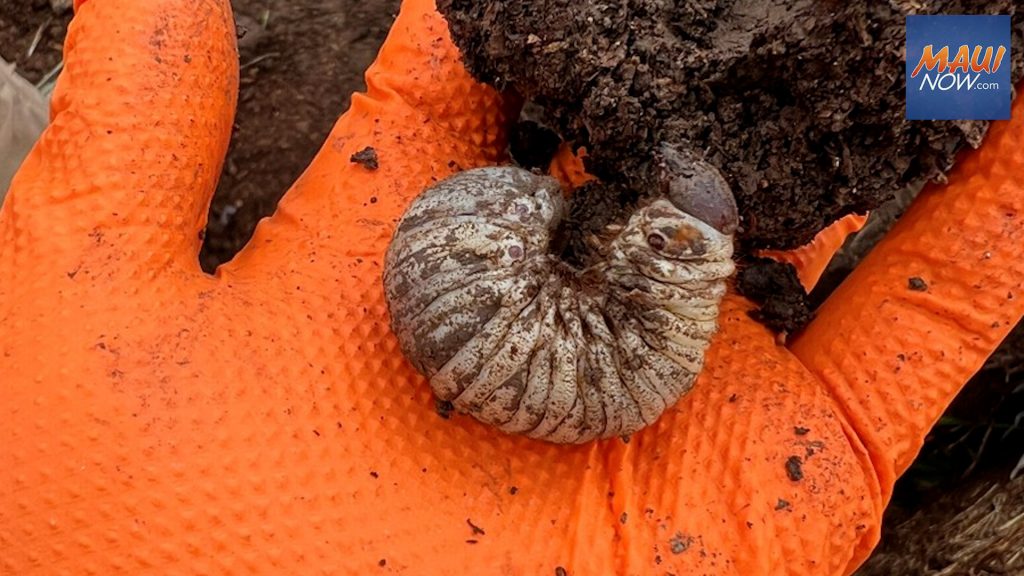
The Board of Agriculture and Biosecurity approved Interim Rule 26-2 on Tuesday, restricting the transportation of coconut rhinoceros beetle (CRB) host materials from any other area in the state to the islands of Maui and Lānaʻi.
Host material includes live plants of any size, if there are any organic materials attached to the roots; untreated decomposing plant material such as compost, wood, tree chips and untreated mulch; and plant propagation media and other items comprising decomposing organic plant material such as landscaping material or erosion control socks.
Interim Rule 26-2 also prohibits the transportation of coconut fruit to the islands of Maui and Lānaʻi.
Bareroot plants; CRB host material that is subjected to an approved treatment that kills all life stages of CRB and is transported in a CRB resistant container; and unused imported erosion control mats stored in approved enclosed facilities, may be transported to the islands of Maui and Lānaʻi after inspection by the Department of Agriculture and Biosecurity Plant Quarantine Branch (DAB PQB).
The interim rule goes into effect today, July 29, 2026.
Interim Rule 26-2 exempts:
- Fresh plant products intended for consumption, such as fruits, nuts, edible leaves, leaves used for cooking and spices (except coconut fruit).
- Plant products preserved from decay by treatment or intended use, such as lumber, woven hats, wooden posts, wood carvings and firewood.
- Seeds for planting; cut flowers and foliage for decoration, such as lei, floral bouquets, or arrangements; and rock, coral, gravel and sand, not mixed with any organic material.
- Plants grown in pots no greater than 2 inches in diameter, in media that is sterilized before use, grown entirely in a laboratory, transported within CRB-proof containers, subject to DAB inspection and approval before transport.
- Tissue cultured or other micro-propagated live plants in sterile media.
The new interim rule does not impose restrictions on CRB host materials moving between the islands of Maui and Lānaʻi.
More information about IR 26-2 is available by contacting DAB PQB Acting Plant Specialist, Techie Lancaster, by phone: 808-832-0566, or email: DAB.PQSPEC@hawaii.gov.
Expansion of designated CRB-Infested area in West Hawaiʻi Island
The Board of Agriculture and Biosecurity also approved a request to expand the designated coconut rhinoceros beetle (CRB), Oryctes rhinoceros, infested area in West Hawaiʻi Island to include the geographic area between Henry Street, Palani Road, and Queen Kaʻahumanu Highway, as shown below.

The request for the board’s designation to include the geographic area as an expanded CRB-infested area follows the initial designation of the CRB-infested area in West Hawaiʻi Island on March 24, 2026, pursuant to Interim Rule 26-1. The designation goes into effect today, July 29, 2026.
With the board expanding the CRB-infested area in West Hawaiʻi Island, all organizations, companies, or any other person who transport, generate, process, collect, sell, or grow CRB host materials in the expanded area must conduct these activities under a valid compliance agreement issued by the Department of Agriculture and Biosecurity.
As a prerequisite to obtaining a compliance agreement, completing a training session provided by the Big Island Invasive Species Committee (BIISC) is required.
To sign up for compliance agreement training, go to the BIISC website at https://www.biisc.org/crb-compliance-trainings/, click the link for a training session and fill out the required information. The training session should be approximately one hour and BIISC staff will coordinate directly with participants for scheduling. Upon completion of the training, BIISC staff will collect and submit to DAB a copy of the compliance agreement application verifying training completion.
Sponsored Content