 Hawai'i Journalism Initiative
Kahului Airport’s main runway built during World War II prioritized for first reconstruction project
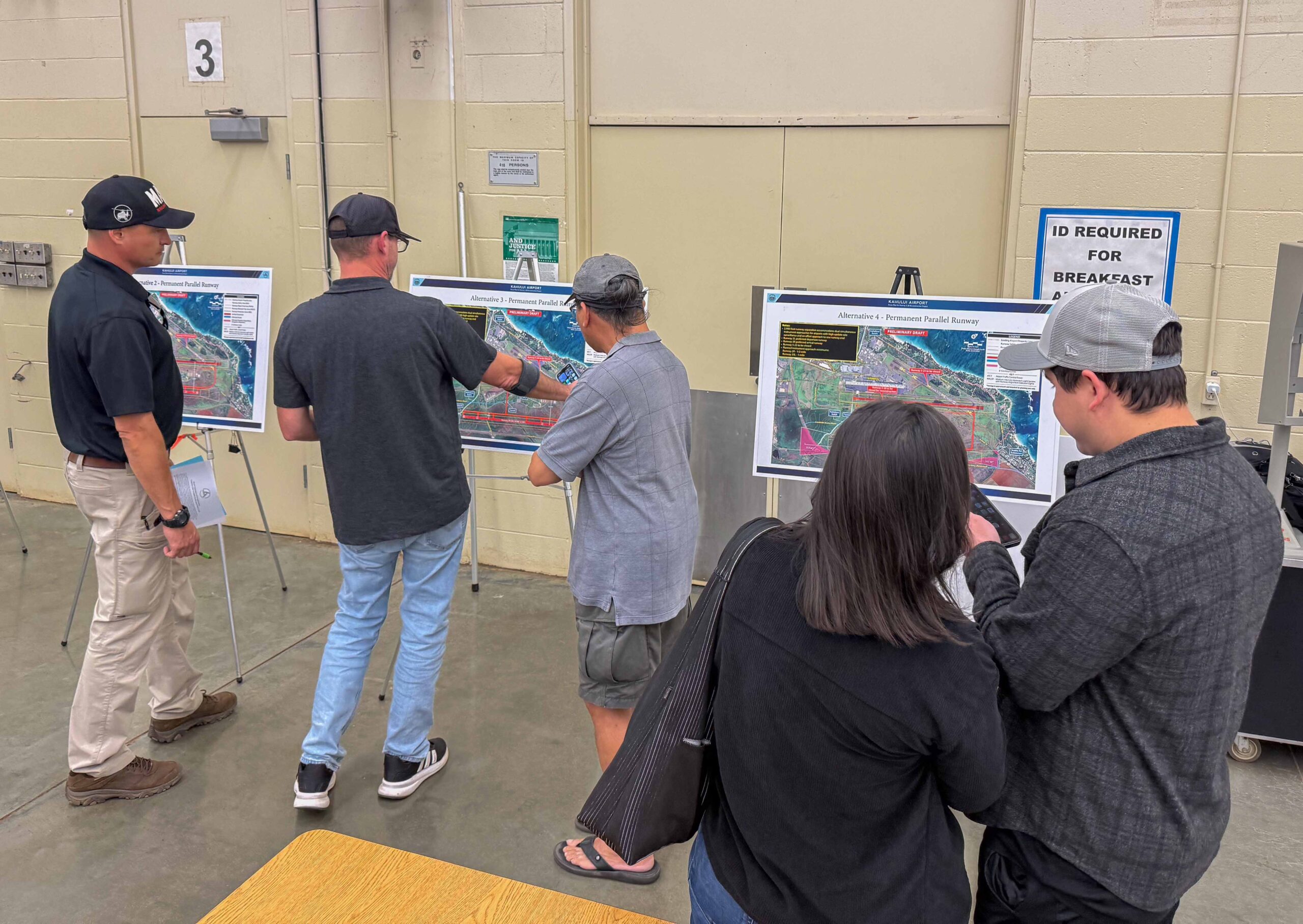
In 1942, months after the Japanese attacked Pearl Harbor, the U.S. Navy acquired 1,341 acres of sugar cane fields on Maui for an air station that could meet the demands of war.
After the war, the air station became the commercial Kahului Airport. Today, modern heavy jets and cargo planes are landing and taking off on the same runway — with its original foundation — that was quickly built for military aircraft used during World War II.
But Runway 2-20, the only one on Maui long enough to handle those large jets and cargo planes that arrive from the mainland and keep the island’s economy purring, has needed 12 major resurfacing projects over the years to stay functional.
“After 80 years of fixing and milling and filling … the cracks, it’s added useful life. But, we’re at the end of its useful life,” said Curt Otaguro, the Hawaiʻi Department of Transportation’s deputy director for airports. “It’s done.”
And, it’s no surprise. The state and the Federal Aviation Administration have known for more than a decade that the band-aid solutions were coming to an end, beginning with studies conducted in 2010 that contributed to the December 2016 Kahului Airport Master Plan Update.
Now, the only sound solution at Hawaiʻi’s second busiest airport is reconstructing Runway 2-20, Otaguro told about 50 people at a public meeting on Monday night at Maui High School.
“We need to rebuild this runway in a good way so that it lasts another 30 to 40 years,” he said.
The project won’t be cheap. To keep the airport operating during the nine to 12 months the actual reconstruction of Runway 2-20 is expected to take, the project will require building either a temporary or another permanent runway.
And while the price tag is not yet known, with four alternatives being considered, it will be in the hundreds of millions, Otaguro said. The state is expecting a good chunk of the funding will come from grants from the Federal Aviation Administration.
Out of nearly $7 billion in state airport projects, “this is one of the higher priority projects, because we’ve done all we can to repair it: layer, fix, dig, seal, layer some more, fix, seal, crack,” Otaguro said.
The project also won’t be completed quickly despite time being of the essence.
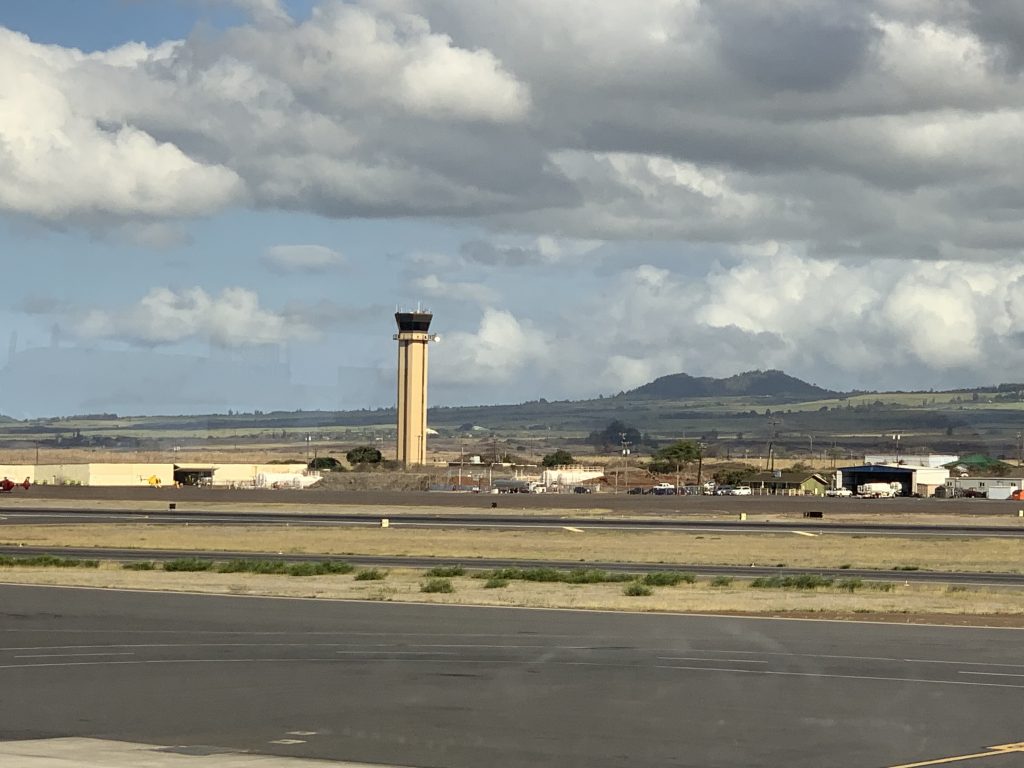
It likely will take years and possibly a decade to complete due to the complexity, need for an environmental impact statement, permitting, funding and a host of other issues, said project engineer Jonathan Limb of Stantec, a global company contracted by the Hawaiʻi Department of Transportation that operates all 15 commercial and general aviation airports in the state.
But Limb said while he does not have a “crystal ball” to say exactly how much life Runway 2-20 has left, it should be enough to last until the completion of either a temporary runway, which is alternative one, or a second permanent parallel runway, which are in alternatives 2, 3 and 4.
In 2024, an $11 to $12 million project to resurface about 5,000 feet of Runway 2-20 was completed, giving the runway another seven to 10 years of life, according to the state Department of Transportation at the time. Most of the work — which included milling, paving, crack sealing and new markings — was done at night to allow for daytime flights.
While Kahului now has two runways, the second one, 5-23, is 4,980 feet and only able to accommodate commuter aircraft and general aviation.
The preferred alternative will be determined over the next few months after more analysis, public input, cost benefit research and completion of the focus plan, which is being conducted by Coffman Associates, the prime airport consulting company contracted with the state DOT. The focus plan is expected to be completed by the end of the summer.
Whichever alternative is chosen, all runways, including the reconstructed Runway 2-20, will be at Runway 2-20’s current length of 6,998 feet (about 1.3 miles) and 150 feet wide (1 1/2 football fields). Alternatives presented years ago had called for lengthening the runway by more than 1,000 feet.
There also will be no additional capacity, no matter the chosen alternative, Otaguro said.
Last year Kahului Airport had 118,304 landings and takeoffs, accommodating 7.1 million passengers.
Here’s a look at the alternatives:
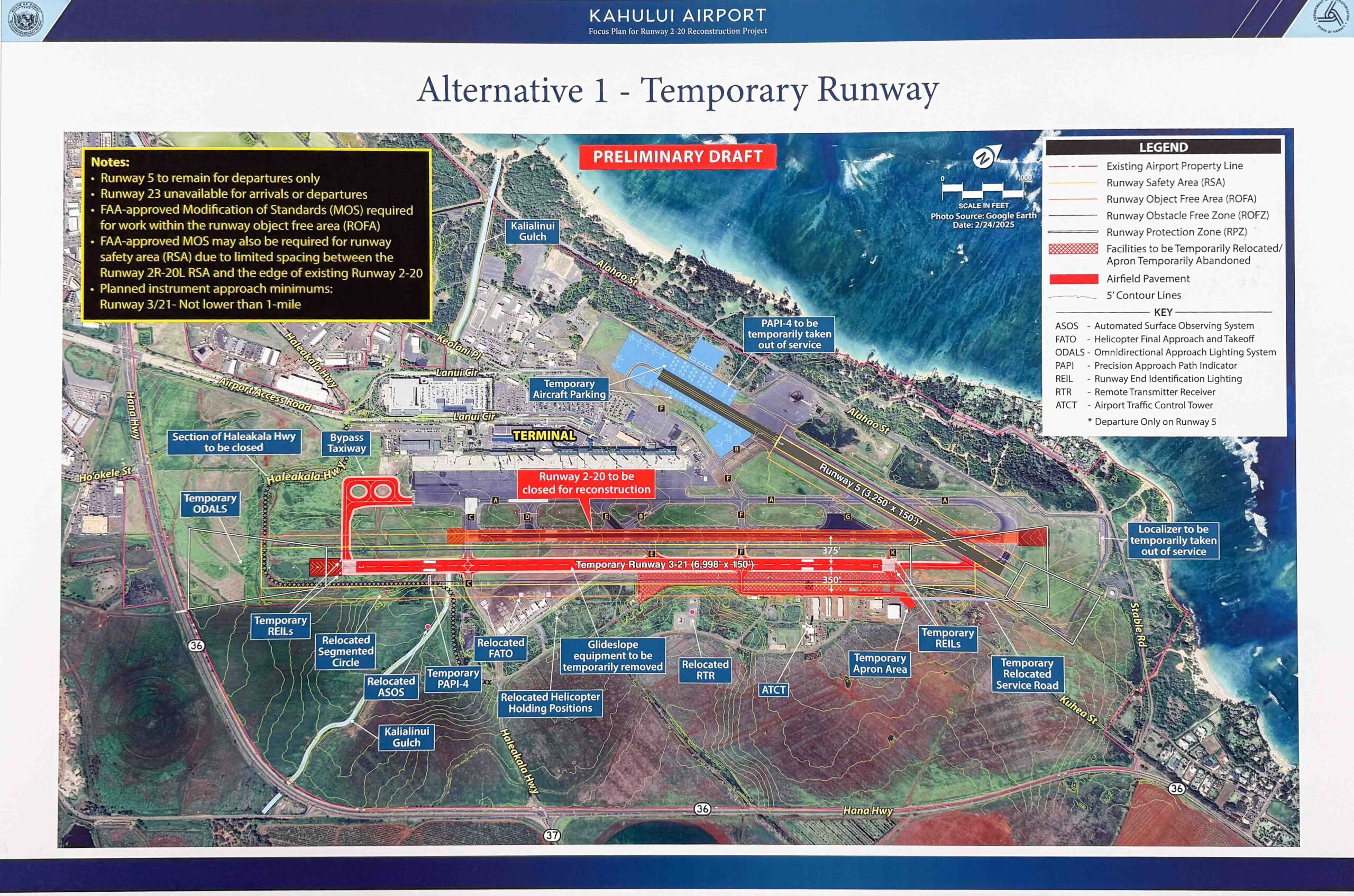
Alternative 1: This is the only alternative with a temporary runway. It would be built about 375 feet to the east, becoming the airport’s main runway while 2-20 is undergoing reconstruction.
“That is really in close proximity,” said Eric Pfeifer, senior planner with Coffman Associates.
Because of this proximity, it likely would require going through an FAA process to receive modifications to standards on how the airfield can operate.
Pfeifer added this alternative also would require relocating many things, including navigational aids, visual road aids and weather equipment.
“Once the existing runway is reconstructed and reopened, we’re going to have to move all these navigational aids back to their original location, and then the temporary runway will be closed,” Pfeifer said. “It could be that pavement could be maintained as taxiway pavement or serving these east side facilities, but that will be determined at that time.”
The temporary runway also would require relocating existing land-side facilities in the area, including tour operators and helicopter operators, and shortening Runway 5-23 to 3,250 feet. That would mean only departures on Runway 5 and no use of Runway 23. (Which runway number is used based on what direction an aircraft is landing or taking off).
The advantages of alternative 1 is it is the least expensive, and it will be contained in the existing airport property.
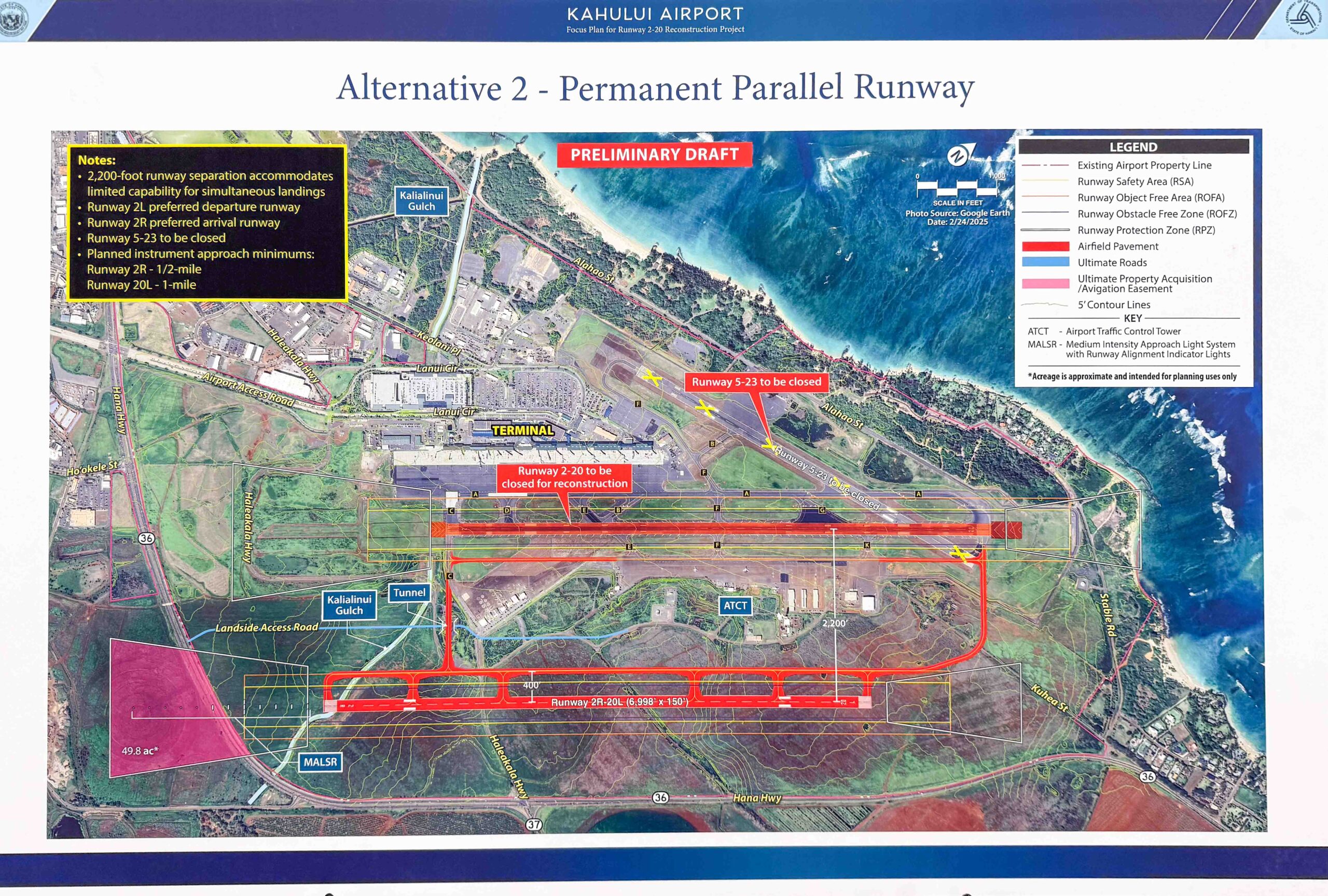
Alternatives 2, 3 and 4 all call for the building of a permanent parallel second runway. They also all are similar in how they are laid out, with the major difference the distances between the new runway and Runway 2-20.
When both are completed, Runway 2-20 would be the preferred one for departures and the new runway would be the preferred one for landings.
“So you’re not impacting the departure routes of the aircraft from the existing condition, but you are shifting the approach path slightly to the east,” Pfeifer said.
By having the departures on the new runway, it also would keep traffic from overflying Spreckelsville and creating a noise issue.
Due to the prevailing northeast trade winds, landing and departures would be in the same direction, heading northeast on Runway 2.
And with any of these three alternatives, Runway 5-23 would be permanently closed.
“Building a permanent parallel runway gives you the resiliency to where you are never going to have to worry about closing this airport to make sure you have a functioning runway,” Pfeifer said. “If you go the temporary runway route, you’re going to have to reconstruct that runway again at some point in the future.”
The parallel runways are being drawn up as far to the south as possible to keep the flights and safety areas as far away from the Spreckelsville community as possible, Pfeifer said.
“And certainly closing runway 5-23 should help as well, keeping additional flights from passing over that area,” he said.
Alternative 2: The permanent parallel runway would be about 2,200 feet to the east of the existing runway. This amount of separation provides adequate clearance so the tower and many of the existing landside facilities are not impacted.
But the runway protection zone would extend beyond the airport property boundary and require about 40 to 50 acres of now privately owned land to be protected by a navigation easement.
“So you’re not necessarily buying this property, but you are protecting the airspace by limiting the height and the types of facilities that could be constructed in this area,” Pfeifer said.
Hāna Highway can remain as is despite passing through the runway protection zone, but the Kalialinui Gulch extends in this area.
“So we would need to either reroute that or channel it in some way underneath the pavement, which is not a simple thing to do, but can be done,” Pfeifer said.
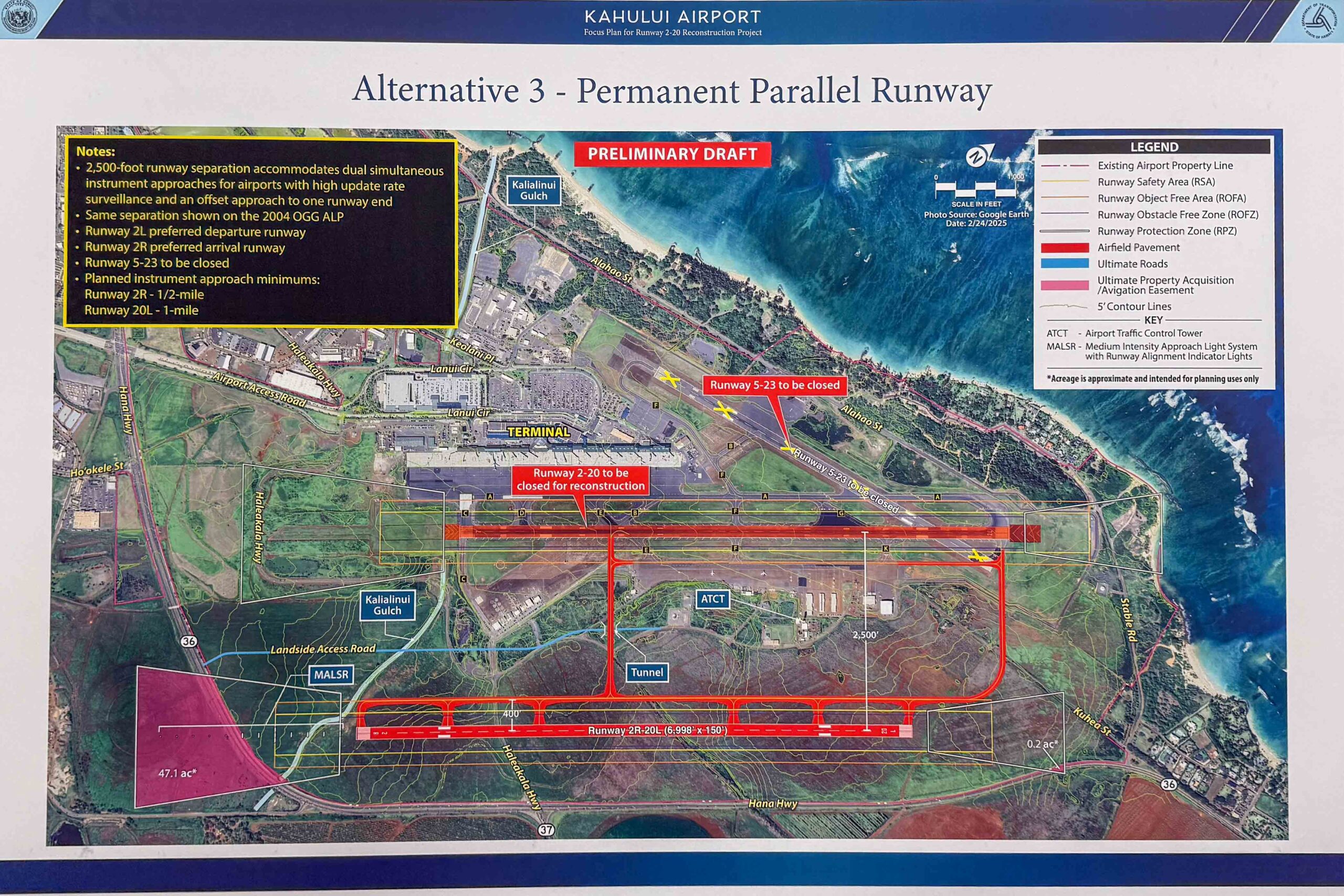
Alternative 3: The permanent parallel runway would be about 2,500 feet to the east of the existing runway.
The added cushion between runways builds in a lot of flexibility to the air traffic controllers to be able to safely route aircraft in and out of the airport.
It also would require a slightly smaller amount of property that is needed to be protected as part of that runway protection zone.
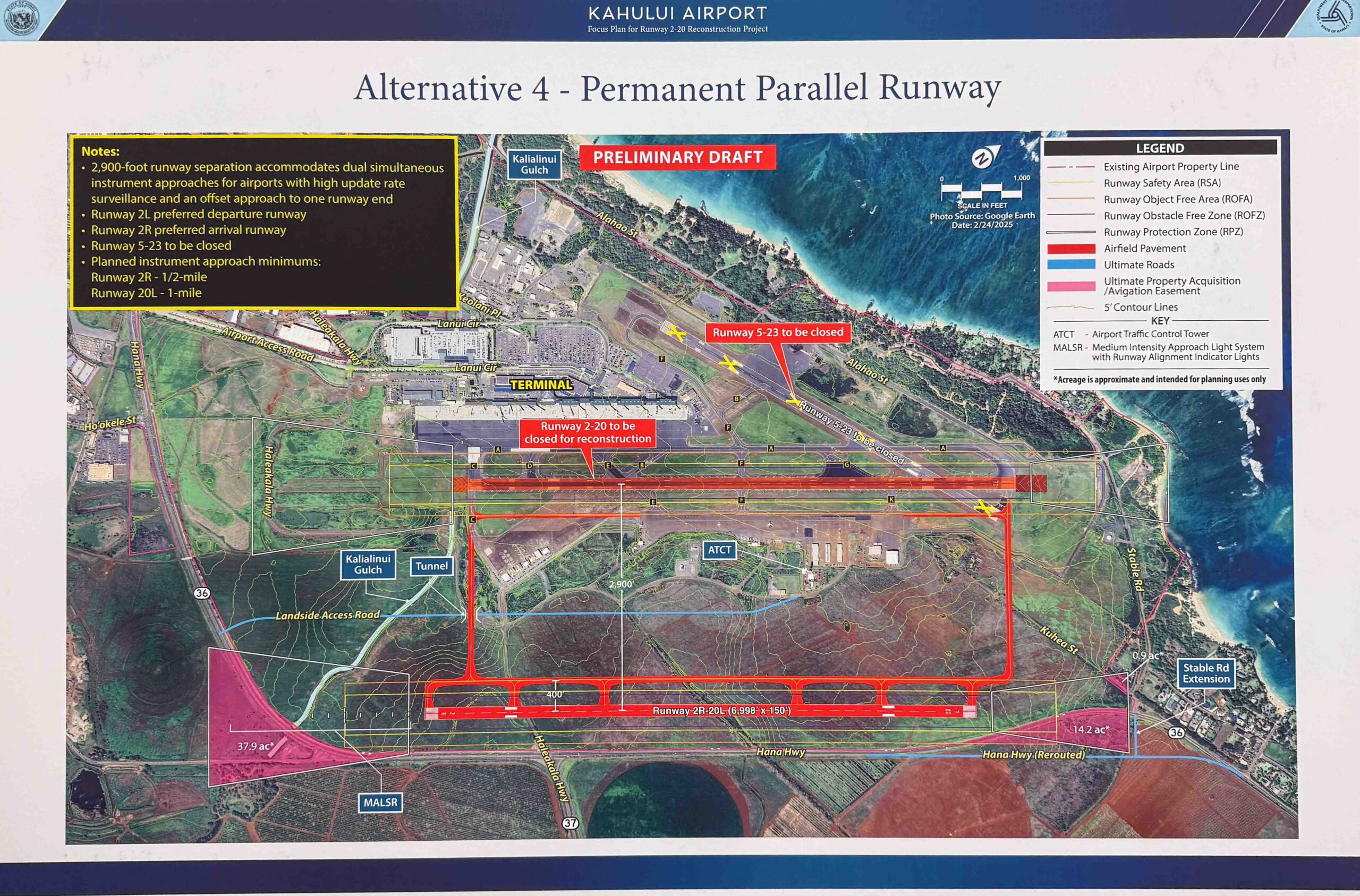
Alternative 4: The permanent parallel runway would be about 2,900 feet to the east of the existing runway, which is the maximum amount of separation that could be done without significantly impacting Hāna Highway.
This alternative would require rerouting a portion of the highway and would impact the largest amount of private property, but it also would entirely eliminate the gulch from being impacted.
During the question-and-answer phase of the meeting, the only major concern about the runway alternatives was expressed by Benson Malto of Shaka Flight School. He was not happy the plans call for eliminating the shorter runway used by general aviation.
“I would highly suggest that you keep 5-23 open if you can for flight training and … so we’re not constantly being held out over the ocean for 20 minutes waiting for the big birds to come in,” he said.
Matt Quick, a project manager with Coffman Associates, reiterated to Malto that the goal was not to add capacity for the airport, saying: “We’re trying not to build a massive facility replacement.”
“But growth is coming, especially with personal aircraft,” Malto said.
Otaguro later addressed the issue of capacity: “Hawaiʻi as a state has kind of plateaued. Weʻre getting less tourists, so we’re getting less planes, so less flights.”
During the focus plan process, the four alternatives will be reviewed, with a benefit cost analysis, and selection of a preferred alternative. Another public meeting will be held to present this information.
“Ultimately, we will get to our draft final and final approval stages where we submit to the FAA our preferred alternative,” Pfeifer said.
Monday’s meeting may seem like deja vu for some Maui residents. In 2019, the state Department of Transportation held a public meeting to provide public input, including about proposed alternatives, as it prepared an environmental assessment that was scheduled to be completed in 2020.
At the time, Tim Sakahara, a spokesman for the state Department of Transportation, said the exact cost was not known for the project, but that the department was budgeting $250 million, according to The Maui News.
The 2016 master plan called for extending the main runway from 6,995 to 8,530 feet and planned for a new 7,000-foot-long runway on the Haleakalā side of helicopter, tour and other general aviation facilities, as well as expansion and improvements to the terminal.
Now this focus plan will be part of a new updated airport master plan.
Otaguro said the state is confident this runway project will get off the ground.
“What we feel now is a lot of support from the FAA,” he said. “It’s taken years. But it’s all because of the leadership. It doesn’t happen overnight.”
That confidence stems from the FAA committing last year to do a Hawaiʻi Airspace Modernization Project, one of the first projects following the FAAʻs “Airspace Modernization Roadmap Strategy.”
“The last time that was done was over 50 years ago,” Otaguro said.
The FAA’s strategic plan calls for evaluating and modernizing the airspace infrastructure in the National Airspace System to prioritize projects that address the agency’s safety and efficiency mission.
Otaguro said the reconstruction of Runway 2-20 would meet that mission.
After the focus plan is completed, the new Kahului Airport Master Plan will be completed, which can take 18 to 24 months. Then the FAA would lead the environmental impact statement, which is about a two-year process.
Last is the design and construction of the runways, which has a lot of variables and can take many more years, said Limb, the project engineer.
The runway’s original foundation was 11 inches thick. After all the resurfacing projects, it currently is 18 inches thick.
Normally, resurfacing projects on runways need to be done only every 20 years, which would have meant just four such projects for Runway 2-20 instead of the 12 it has undergone.
“I think at the longest point, we got 16 years out of one project, but the average is 11 years to as short as three years, two years,” Limb said. “It shows that there’s a need to increase that structural thickness of that runway.”
So the reconstructed runway will have the layered asphalt system replaced with long-life concrete to 28.5 inches.
Limb explained one reason the runways at Kahului Airport need extra thickness is because of the relatively short length for the landing of large planes.
“They break hard,” he said. “And everybody who’s flown in knows that breaking hard. What that does is it puts friction on the runway. It’s just like running into a room with a rug on a slick concrete floor. It wants to push that rug across the floor, so it’s pushing that surface and causing these deformations.”
The Department of Transportation also is moving forward at Kahului Airport with an $83.5 million renovation of the ticket lobby, central building and baggage claim, a $269 million outbound baggage handling system replacement and a nearly $70 million upgrade to the South TSA Checkpoint. A $6 million fire alarm system upgrade is under construction.
Otaguro said he wishes he was at the Monday meeting to talk about the “beautiful terminals, new chairs and new TSA checkpoint, things that we see as passengers. But if the runway is not good, no more passengers because their planes can’t land.
“This is a block and tackle project. Nothing exciting other than safety.”