
 Hawai'i Journalism Initiative
As e-bikes grow in popularity, Maui County and state lawmakers try to curb dangerous riding
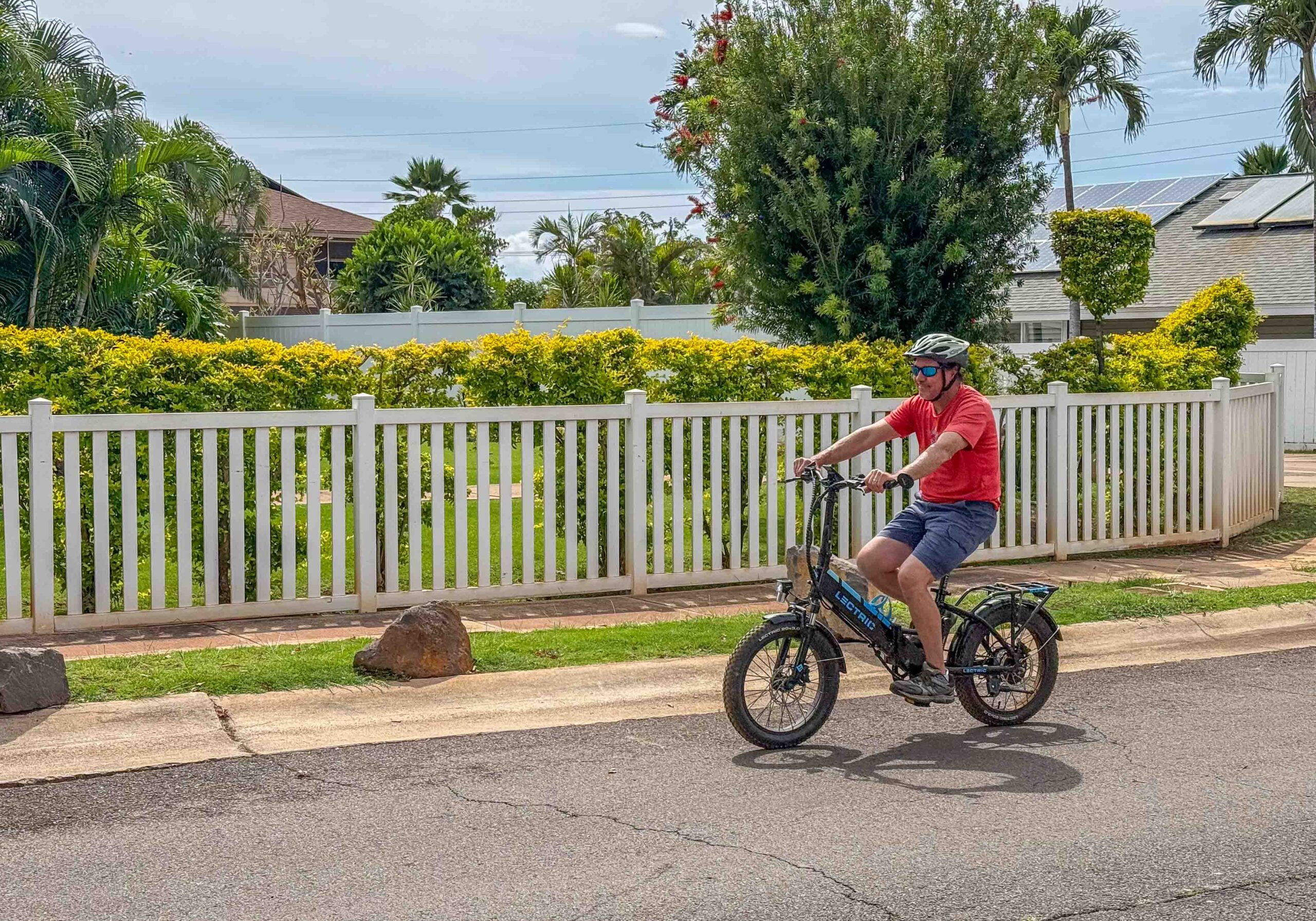
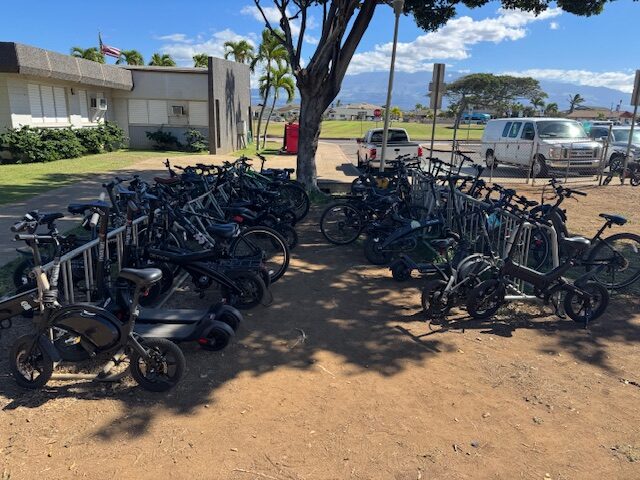
In Maui County’s public parks, riders on immensely popular electric bikes have started to cause “quite a few problems” for Department of Parks and Recreation staff.
“It’s the oftentimes unsupervised juveniles that are riding in an unsafe way on our walking paths or … doing destruction to fields,” Director Pat McCall said.
That’s why McCall and other county officials, including police, are supportive of a bill that would create stronger regulations for low-speed electric bikes in Maui County, especially for underage riders.
The measure, proposed by Maui County Council Member Yuki Lei Sugimura, aims to require helmets for kids under the age of 18 and restrict all riders from “exhibition driving” like wheelies and other stunts. And, there’s talk of potentially holding parents responsible.
“One thing that I think would help us with the enforcement is putting it on the parents, because we have multiple offenders,” Maui Police Department Lt. Grant Nakamura told council members Monday.
Nakamura explained that reckless riders can get their bikes impounded and “a slap on the wrist” in court, but once they get the bikes back, “we know they’re gonna be out doing it again.”
The proposal comes at a time when the state Department of Education has tried to crack down on e-bikes in schools and state lawmakers are also considering a bill to regulate e-bikes and prohibit unsafe riding in public roadways. House Bill 2021 passed third reading on Tuesday and is headed to the Senate.
Electric bikes have soared in popularity in recent years, with sales climbing from 50,000 e-bikes worth $88 million in 2017 to 491,000 e-bikes worth $788 million in 2023, according to bike industry experts.
E-bikes come in different classes based on speed (ranging from 20 mph for a Class 1 to 28 mph for a Class 3) and must be registered with the county but don’t require a license to ride. They’re different from electric motorcycles, which are not street legal.
Maui County Council Chair Alice Lee owns an e-bike. Council Member Nohe U‘u-Hodgins said her kids ride e-bikes.
“I hope nobody was complaining about me,” Lee quipped.
As they’ve popped up across the community, Sugimura said she’s heard residents complain about “disruption in their neighborhood.”
She said the bill she proposed was modeled after a measure passed on O‘ahu, where multiple accidents involving youth on e-bikes have served as a warning to Maui.
Maui County’s bill has three main goals:
- Requiring helmet use for riders under the age of 18, which means a properly fitted helmet with a chin strap that is designed specifically for bikes and meets state laws for testing and design.
- Defining safe riding conduct as keeping all wheels on the ground at all times, with the rider facing forward and seated in a normal riding position. Wheels are allowed to briefly lose contact with the ground due to road surface conditions or other circumstances beyond the operator’s control.
- Restricting any rider from exhibition driving, such as wheelies or stunts, on any public street or right-of-way, unless in a parade, tournament or other lawful activity. Standing or kneeling on the bicycle seat, riding on the handlebars or engaging in “any other maneuver that endangers the operator, passenger or the general public, or that demonstrates reckless or negligent operation of the bicycle” would also be prohibited.
Violations would lead to a fine of up to $200 for the first offense and up to $500 for every subsequent offense, county attorneys said.
The council’s Water and Infrastructure Committee deferred the bill Monday while it waits to see what state lawmakers will do.
McCall saw the bill as “a positive step towards getting some kind of regulation for this relatively new phenomenon in our community.”
He said public parks are the “perfect place” for a bike ride and noted that many kids and older residents use e-bikes to get to the parks to play sports or use the pool.
But, he said “we have a situation where technology has gotten ahead of the rules, laws, regulations, etc. … With the new technology available, whether it be pedal assist, or a throttle or whatnot, it gets them to speeds that are a little bit more dangerous, especially because they’re sustainable speeds.”
McCall said stopping reckless riding has become a “cat and mouse” game, to the point where some riders taunt parks staff, “and then as they are approached, they disappear through a hole in the fence. And it’s not like we’re going to be chasing them down the pathways with a Ford F-150.”
Police said “stricter consequences” are needed, suggesting citations or fines for parents. Nakamura said safety is “the biggest thing for us” when it comes to kids riding e-bikes.
“It might not be their fault, but they get into an accident, they get banged by a car, and there’s no taking that back, and that’s what we want to prevent,” he said.
But Council Member Gabe Johnson had concerns about punishing parents, saying he was more in favor of “a light touch versus a heavy hand.” He said more education on current bike laws and better infrastructure are the solutions, pointing out that transportation experts often talk about the need for more bike lanes while developers talk about cutting sidewalks from their projects because of costs.
“Instead of making more new rules, let’s look at just educating our folks,” said Johnson, adding that he was trying to be open-minded, but “I don’t like this bill.”
Council Member Kauanoe Batangan also supported the need for more education, noting that he’s talked to people who didn’t realize that riding e-motorcycles in parks is not allowed.
“They were just given a dirt bike for their birthday and thought they could go,” he said.
But, unlike Johnson, he thought “there might be a benefit to holding some of the parents accountable for the actions of their kids and would be interested in exploring that a little bit further.”
Lee Chamberlain, a member of the Maui Bicycling League, said Maui could follow the lead of California, where a new law that took effect in January allows parents to face responsibility for their minor children’s e-bike violations.
“Everything starts at home,” he said.
As a former bike shop owner who’s ordered many e-bikes to sell on Maui over the years, Chamberlain has watched the growing phenomenon firsthand. He said e-bikes are getting a bad rap because of electric motorcycles and dirt bikes, which are much more powerful and not designed to be ridden on the road. They have no headlights or brake lights, and are much quieter than gas-powered ones, making them hard to hear or see coming.
“They’re quiet and fast and dangerous,” said Chamberlain, who’s suffered his share of broken bones and a knee replacement while riding motorcycles or mopeds over the years. “The more speed you have, especially without protective gear, the more danger you have of hurting yourself dramatically.”
Kīhei resident and avid traditional bike rider Mike Moran also said the riders of low-speed electric bikes that he encounters are mostly commuters who aren’t causing the problem of “circus acts” on the road. It’s the high-speed ones, some of which can go faster than cars, that are weaving in and out of traffic and feel “omnipotent” because they can go off-road to evade police.
“Any action is something positive,” Moran said. “It would be so much better for our whole community if we had safe ways to cycle, whether motorized or not. Every bike on the road is one less car.”