 Hawai'i Journalism Initiative
Maui oceanfront condo damaged by 2025 flood did not survive 2026 storm. Owners association blames county inaction

As a Kona low storm approached on a January night in 2025, Susan Hungerford slept on the couch with one foot touching the ground at the vacation condo her family had owned for more than 50 years at Kīhei Kai.
With the South Maui complex facing the threat of flooding again, she thought: “If water comes in, it’ll wake me up and then we can get out of here. That is so stupid, I know.”
The septuagenarian woke at about 1 a.m. Her floor was dry, but the sidewalk outside the South Maui condo was swallowed into a hole, and she knew her condo could be next. The oceanfront A Building, with 16 units, was evacuated.
When that storm passed, her Unit 2 and three others closest to the water had partially collapsed but were salvageable, according to a structural engineer hired by the Kīhei Kai Oceanfront Condos Association of Apartment Owners.
But on March 13, after a frustrating year trying to repair the damage from the 2025 storm, another Kona low system led to a roaring river of flood water and mud ripping through Kīhei Kai. This time, the entire A Building collapsed — and demolition was the only option.

“The county is culpable in this mess,” association president Mike Conners said last week.
Conners, board member Hungerford and the association’s construction project manager, Josh Berlien, president of Berlien & Co., all say there are three reasons the county holds some liability:
- The county denied Kīhei Kai a permit to put in a permanent foundation in a timely manner after it issued a permit for an emergency repair.
- The county did not address its complaint that next-door neighbor Māʻalaea Surf Resort built unpermitted concrete perimeter walls and floodgates that diverted water onto Kīhei Kai’s property.
- The county failed to address the nearby poorly designed bridge across South Kīhei Road that also caused water to be diverted to Kīhei Kai and other neighboring properties instead of flowing to the ocean.
“All they wanted to do was put back what was destroyed by a flood event caused by a bridge and neighbor diversion,” Berlien said. “And the county still would not let us proceed.”
The county communications office declined requests last week to speak with anyone in the Planning or Public Works departments.
“Due to potential litigation involved in these properties, please submit a Uniform Information Practices Act for responses to these questions,” the communications department said.
Official requests were made this week to both county departments, but the county said in automated responses that it needs more time to respond.
The manager of Māʻalaea Surf Resort, reached by phone a week ago, said he could not speak about the perimeter wall or floodgates and would pass along the request for comment to the owners. No one from Māʻalaea Surf responded.
Kīhei Kai was built in 1970, one of the first oceanfront condos in South Maui. In 1974, when Hungerford was a junior in high school in Nebraska, her parents were part of a family partnership that bought Unit 2.

Over the next five decades, Kīhei Kai became a special family vacation spot, with the other owners of the 32-unit complex also becoming ʻohana. Hungerford said the place hosted weddings, funerals, the Yoachim family shrimp boil for Valentine’s Day, performances by Kawika Lum Ho of the Hula Grill, and the Kīhei Kai Olympics, organized by a couple from Washington.
The owners loved to blow conch shells and drink cocktails on the grassy lawn, with a view of Lānaʻi, Kahoʻolawe and the West Maui Mountains. All but one unit were rented out part of the years as fairly inexpensive vacation rentals.
For more than four decades, Hungerford said flooding was not a problem at the complex that is located at the juncture of North and South Kīhei roads.
“Kīhei Kai didn’t flood until they built that damn bridge, which is literally a dam,” Hungerford said. “We’ve had the 2021, ’23, ’25 and ’26 floods.”
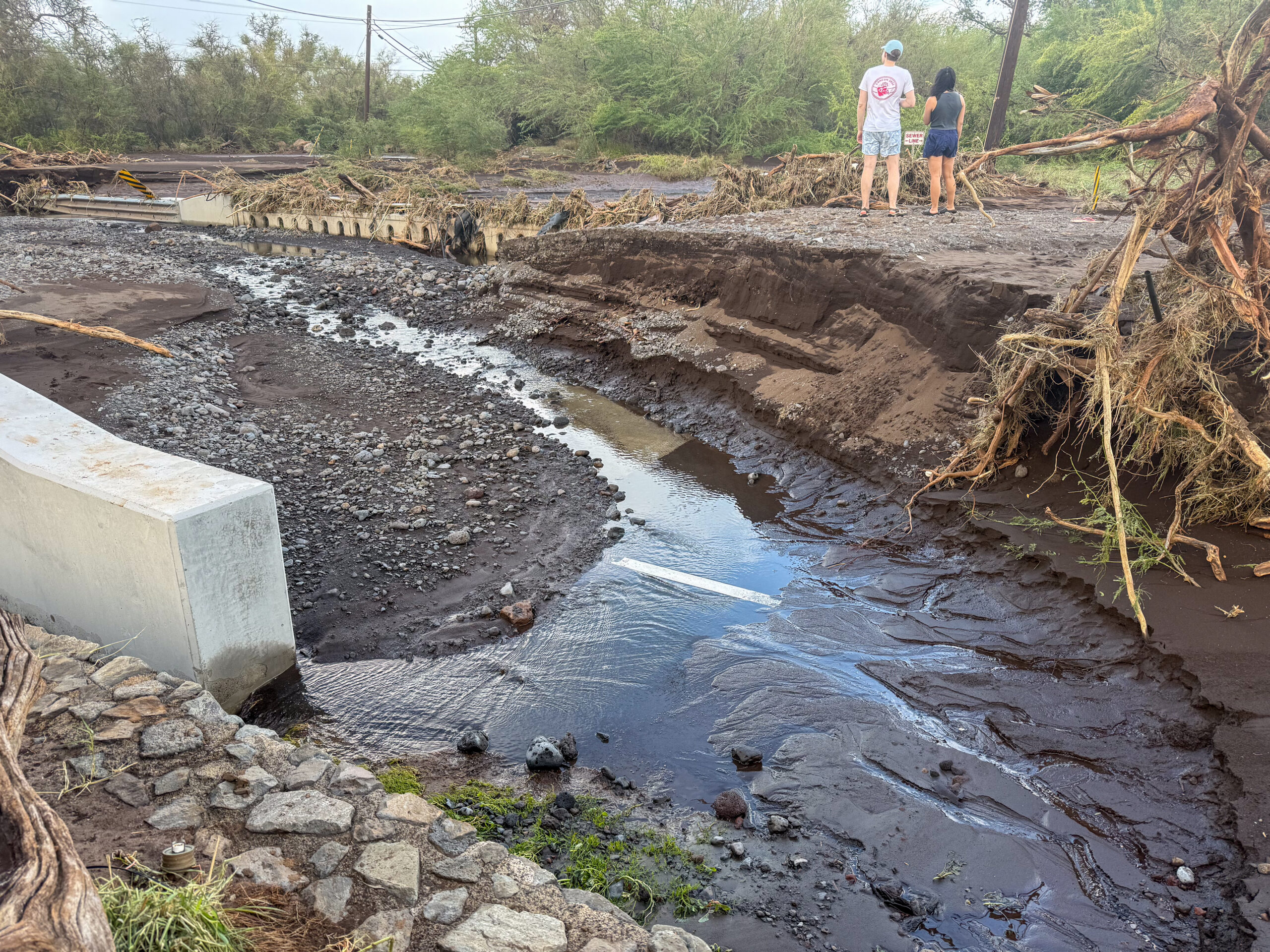
The bridge was rebuilt as part of the 2016 Kīhei Drainage Master Plan. It now has only two small culverts 10 feet wide and 3 feet high underneath it for all the rushing water that flows down the Waiakoa Stream. It also now has railings with small openings on each side.
The bridge design enables debris and mud to easily pile up during rainstorms, diverting water in both directions along the coastal road instead of flowing directly out to the ocean.
“The old bridge was low, but it didn’t have any railings on it so the water could flow right over the top,” Conners said. “All the debris and the crap and the logs and the sticks and the dead animals went zoom right out to the ocean. Quite frankly, it was messy, but there was no appreciable damage to their neighboring properties.”
Now, several entities in the area are regularly affected, including the Kīhei Canoe Club, the Kīhei Beach Condominiums and Kīhei Crossroads strip shopping center, which houses the ABC Store, Ululani’s Hawaiian Shave Ice, the Sugar Beach Bake Shop and Farmers’ Market Maui, and is for sale.
After being flooded multiple times, Kīhei Beach Condominiums on the south side of the bridge and Māʻalaea Surf Resort on the north side of the bridge both put up new perimeter walls and floodgates in the past couple of years.
Berlien & Co., representing the Kīhei Kai association, submitted an official complaint to the county Department of Public Works through SeeClickFix (request 19918031) about Māʻalaea Surf Resort, claiming the walls and floodgates diverted water from the eight-building, 5-acre complex that contributed to the damage of its four condos during the 2025 storm and would do so again in another flood if not addressed. The complaint also pointed out pumps installed inside the resort’s parking lot storm sewer that redirect water away from the property.
The issue was also brought up to the Planning Department multiple times, according to emails between Berlien Co. and the department.
“I understand them wanting to protect their property, but federally, you can’t protect your property at the detriment of your neighbor,” Hungerford said. “I do kind of see their point, but the county needs to do something.”
Hungerford said Kīhei Kai was going through the proper process to get a permit to put back an existing wall in front of its property that had been taken down to repave the parking lot two years earlier when the January 2025 flood hit.
“If we hadn’t asked permission, we would have had no problem. Right?” she said. “But Mike is a rule follower.”
Then after the 2025 flood hit, Conners said the county established a new requirement for walls within flood zones that was part of the county’s flood development permit. “Now, we’re screwed,” he said.
Then came the permitting problems for the damaged building.
After the January 2025 flood, members of the Kīhei Kai association met with Maui County coastal resources planner Jim Buika.
“He said you just need to knock this whole thing down, just knock it down and build one of those, and he pointed at the six-story cement thing next to us,” Hungerford said about Māʻalaea Surf Resort.
Conners said the county planners suggested multiple times for the association to demolish both buildings and construct a six-story condo with an elevator in the footprint of the B Building and parking lot. The building potentially could have 24 units with parking underneath.
“Of course, it would cost you $40 million to do it,” Conners said, and the owners like Kīhei Kai just the way it was. “We’re a unique property. … It had a real family atmosphere.”

On March 11, 2025, then-Planning Director Kate Blystone verbally approved a special management area emergency permit, which was officially approved three months later. It said: “The purpose of the emergency work is to allow safe entry into the structure. Once a reconstruction design is finalized by the structural engineers, the applicant will file for required permits.”
The condo association, which also includes eight units in the B Building, spent about $1 million for the work, with insurance picking up only about three-quarters of the cost, Conners said.
Berlien said it was an “engineering feat,” with horizontal stabilizations done through raker shoring, then vertical shoring towers installed “to actually push the building up like marine airbags were used to lift it,” and then shore posts put underneath.
But issues arose in August 2025 with tides and surf pushing water under the building. Berlien said in an email to the Planning Department that this problem was caused because temporary shoreline protection measures that had been asked for previously to complete the work safely were denied onsite by a county planner and the Sea Grant team, as only natural sand replenishment could be used.
Berlien also said in the email to the county that if the earth under the building and shoreline dunes had not washed away by the “county’s admittedly undersized bridge during the January rain event, we would not be in this pickle.”
Conners said after the temporary fix, architects, contractors and engineers made a plan to raise the four units back up to its previous level and put a new foundation under them, “and we were going to go about our happy way.”
But when the association tried to secure the required permit to do timely permanent repairs to the foundation before the next flood, the county denied it and instead mandated the association go through a lengthy major special management area process that would take a year or more, Conners said and emails with county officials confirm.
The SMA permit process has two options: the SMA minor for work less than $500,000 and an SMA major, which requires a lengthy public comment period.
“So we busted the work up and said, ‘OK, we’re going to apply for a permit for an SMA minor for the foundation work because it will be less than a half a million bucks,” Conners said. “And then we’ll apply for a major on the ultimate refinish of the buildings because they got pretty messed up.”
But the county said all the work had to be under an SMA major, Conners said.

The association members also had meetings with the county, in which the county proposed that Kīhei Kai take down the four units and the county might be willing to make a contribution towards the demolition in exchange for getting beach access through the property “so there was a public gain,” Conners said.
But the association agreed they were willing to apply for the SMA and go through all the rest of it before it repaired the building damage. “But at least just let us get the foundation in so the damn thing doesn’t float away,” Conners said.
“Now, I’m not sure that the whole thing wouldn’t have floated away anyway because of the erosion that took place,” Conners said. “We had 40 inches of water on the property. It was literally a raging river.”
The B Building survived, although the bottom four units were inundated with water. Workers have been remediating the damage before they can be renovated.
But Conners said the survival of Building B makes it more complicated for the association.
“I got eight people in the B building, myself included, whose units survived. And I don’t want to walk away from it,” he said. “But I got 16 people in the A building that are so (upset) that they would just as soon see the whole property dozed and we sue for a settlement on the value and sell the remaining lot. I don’t know.”

Hungerford and her husband had also purchased a second condo in the A Building. She said that while the mortgages were paid off, they lost a year of income on the condo that was damaged last year while paying $1,300 a month in condo fees, and now they have lost income on both, have no property to sell and must pay for the demolition.
She said the county also is losing out. For the 450-square-foot, one-bedroom Unit 2, she paid $9,000 in property taxes in 2025, which is confirmed by tax records. The county also will not get the taxes she and the other owners collected from the short-term renters.
Hungerford said she still can’t sleep all night since the terrifying ordeal in January 2025 when she woke up to “water up to our crotch rushing by us.”
She was not on Maui when the 2026 flood struck.
“This time I left on Tuesday and it started raining on Thursday,” Hungerford said. “So I’m so glad that I didn’t know it was the last time I would say goodbye to those people. Most of them we’ll never see again.”