


Maui Council to weigh $1.6 billion budget at Friday meeting
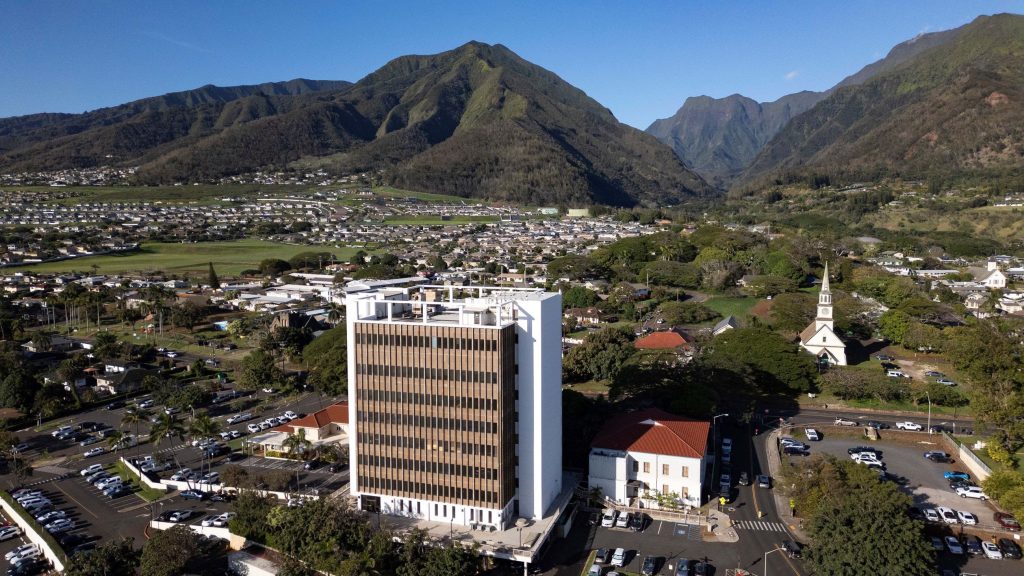
The Maui County Council will take up a $1.6 billion budget Friday morning, following a committee recommendation to trim Mayor Richard Bissen’s proposal by reducing capital improvement projects while still increasing funding for day-to-day operations.
The Budget, Finance and Economic Development Committee voted 9-0 on April 27 to cut about $8.4 million from the plan and reduce capital project spending by $20 million. The panel recommended boosting operating appropriations by about $11.6 million. The budget covers the fiscal year beginning July 1.
“Friday’s council meeting brings us one step closer to a balanced budget that reflects financial realities but continues to prioritize community needs,” said Council Chair Alice Lee.
Friday’s meeting serves as a public hearing on the budget package, which includes Bill 55, CD1 (2026) on the operating budget and Bill 56, CD1 (2026) on the capital program, Lee said. The Budget Committee’s recommendations are detailed in Committee Report 26-25.
A spending plan crafted amid a backdrop of crises
The committee’s report notes the lingering effects of the August 2023 Maui wildfires that killed 102 people and destroyed more than 2,000 dwellings, sweeping cuts in federal funding that began in 2025, and back-to-back Kona Low storms earlier this year that caused tens of millions of dollars in property damage countywide and an estimated more than $1 billion statewide. A federal disaster declaration issued April 7 made the county eligible for federal relief funding.
The committee also flagged economic uncertainty linked to the war in Iran, which the report says has driven fuel prices above $8 per gallon in some parts of Maui County. State economists have warned of significant impacts on Hawaiʻi’s tourism-dependent economy should the war continue.
“All of these major unanticipated events have caused considerable economic strain and emotional distress on Maui County’s residents,” the committee report says. “Extraordinary events like these wreak havoc on the County’s budget. The key to survival is fiscal responsibility—that is, appropriating the proper amount of funds necessary to provide core County services and meet the basic needs of County residents.”
The budget numbers
Bissen’s proposed budget estimated county revenue at approximately $1.616 billion, with about $1.245 billion for operations and $371 million for capital improvement projects. The committee recommended reducing the overall total to roughly $1.608 billion — a cut of $8,445,396, or about half a percent from the mayor’s proposal.
The committee’s recommendation shifts spending away from long-term infrastructure projects and toward current services. Committee members cited nearly $200 million in combined carryover savings projected across the fiscal 2026 and 2027 budgets as raising “profound concerns about potential overtaxation of County residents.”
Budget Director Lesley Milner said the administration views those carryover balances differently. She said more than 60% of the projected carryover savings stem from unanticipated additional revenues — including FEMA reimbursements, interest earnings on investments, and transient accommodations tax revenue and related penalties — “none of which are the result of overtaxation on residents.” Additional factors include savings from vacant positions and lower-than-expected costs.
Most of the capital project reductions were also initiated by the administration, Milner said, and do not raise significant operational concerns. The Department of Police, for example, rearranged its radio tower construction schedule after determining the poor condition of the Haleakalā tower required prioritizing design work in fiscal 2027, resulting in a $14,860,000 reduction. The Department of Water Supply separately shifted $12 million for an Upcountry well project to a revolving fund, reducing the CIP budget by that amount.
The committee report said members were “hesitant to alter real property tax rates and tiers, doing so only to meet critical budget priorities.” Nevertheless, the committee agreed with all of the mayor’s proposed rates and tier structures, except for the middle and highest tiers in the non-owner-occupied classification.
Property tax adjustments
As a result, most homeowners would see little change under the committee’s plan, while higher-value non-owner-occupied properties would face a heavier tax burden under a revised tier structure.
The committee kept rates for the non-owner-occupied classification — $6.25, $9, and $17 per $1,000 of assessed value for the lower, middle, and highest tiers — but restructured the middle tier from a range of $1,000,001 to $3,000,000 to a range of $1,000,001 to $2,500,000, with the highest tier lowered from above $3,000,000 to above $2,500,000.
That change alone is projected to generate an additional $5,668,013 in property tax revenue.
Milner said the administration was not consulted on the tier restructuring beyond providing valuation data. “At this point in the process, it is the Council’s purview to make policy decisions regarding Real Property Tax at which point it will come to the Administration for signature,” she said. “Once the rates have been finalized, the Administration will implement the changes.”
For owner-occupied properties, the committee accepted the mayor’s proposal to expand the lowest tier to cover homes valued at up to $1.5 million, up from $1.3 million, while keeping rates at $1.65 and $1.80 per $1,000 for the lowest and middle tiers. The highest owner-occupied tier rate drops to $5 per $1,000, down from $5.75.
The committee also accepted rate increases for timeshare properties, from $14.70 to $14.90 per $1,000, and for transient vacation rentals and short-term rental homes, with rates of $13, $15, and $17 per $1,000 across the three tiers. Rates for apartments, hotels and resorts, agricultural, conservation, commercial, and industrial properties remain unchanged from fiscal 2026.
The county’s net taxable real property valuation for fiscal 2027 dropped by about $550 million, or less than 1%, from fiscal 2026, to $83,177,789,400. That valuation is expected to generate roughly $660.4 million in property tax revenue.
Housing and disaster recovery
Housing and disaster mitigation emerged as top priorities. Major infrastructure investments include $111.6 million for the Waiale Road extension and $95 million for the Central Maui Regional Wastewater Reclamation Facility in Waikapū. Both are key to unlocking capacity for several major housing developments, including the 1,400-unit Waikapū Country Town development and projects by the Department of Hawaiian Home Lands.
Key housing grants include $25 million for the two phases of the Kaiahale ʻo Kahiluhilu project, $9 million for the Hoʻonani Village mixed-use development project, $6,595,272 to Habitat for Humanity Maui for affordable housing in Hāna, and $5 million for Kaiaulu O Lanaʻi. The committee also added two new capital improvement projects: $4.5 million to acquire transitional housing for domestic violence victims and $2.5 million toward a 32-unit Kīhei development known as Cove Park Village.
The committee noted that the Cove Park project’s asking price of $8.62 million includes approved building, grading, roadway and special management area permits as well as construction plans. “If acquired, the project would provide the County an opportunity to expedite housing units,” the report says. “The $2,500,000 appropriation allows the mayor to start negotiations to acquire the property.”
Milner said there is currently no acquisition timeline for either the Cove Park Village or the domestic violence transitional housing project. The relevant departments will need to review the proposed acquisitions and, if appropriate, begin negotiations with landowners, she said.
Key disaster recovery funding includes $6 million to Lahaina Community Land Trust to keep homes in community hands following the August 2023 wildfires, $3 million for Upcountry wildfire rebuild and mitigation and $18.4 million for Lahaina water infrastructure hazard mitigation. The committee also backed $27,060,152 in Federal Emergency Management Agency public assistance funding for the West Maui Senior Center and $4.25 million for a new Haʻikū Fire Station.
The West Maui Senior Center rebuild is currently in the professional services contracting phase, with the county having completed a qualifications-based selection process and now finalizing negotiations to advance the project into detailed design and permitting, Milner said. The project is also among 16 conditionally awarded Community Development Block Grant disaster recovery funds under the county’s Infrastructure and Public Facilities program.
The county’s Emergency Fund balance stands at $85,851,900 after authorizing a $32 million drawdown for Kona Low storm response in fiscal 2026. Milner said the administration targets an Emergency Fund balance of at least 20% of general fund operating revenues or expenditures, consistent with Government Finance Officers Association guidelines. Funds spent on wildfire and storm response “will be at least partially replenished through FEMA reimbursements,” she said.
Other major infrastructure
Other large capital items include $40,651,000 for the North-South Collector Road (Waipuilani to Kaonoulu streets) in Kīhei, $39.5 million for West Maui reliable capacity water projects, and $30 million for acquisition of Maui Land and Pineapple land and water system assets. The committee approved $9.5 million to retrofit 24 North Church St. in Wailuku, the future home of the Prosecuting Attorney’s Office — a figure that increased by $3.35 million after the building sustained storm damage following the mayor’s initial budget submission.
Milner said mid-cycle cost increases like that are typically addressed through budget amendment requests to the council, as has occurred in fiscal 2026 for two other projects. She said the administration is not currently aware of other ongoing projects significantly impacted by the recent storms.
The full budget package also authorizes $193,453,400 in general obligation bonds for public improvements. Milner said the administration is confident it can execute the majority of the capital program, noting that the countywide CIP coordinator worked closely with departments to set achievable project goals. New capital improvement projects will need additional review to determine execution timelines, she said.
On the broader question of federal funding, Milner said the county itself has not yet lost a significant amount directly, though it has seen some impact — including the shift of certain Department of Human Concerns positions from grant funding to county funding. “The largest impact at this time has been to the County’s nonprofit partners,” she said, adding that the county increased assistance to those organizations to help them maintain community services in the face of federal cuts.
Fees, services and community programs
The committee accepted proposed increases to sewer, water, refuse collection, and Planning Department fees. It backed new fees for County-operated electric vehicle charging stations and added a $1-per-minute idle fee kicking in 10 minutes after charging ends.
The committee expanded eligibility for a reduced monthly transit pass by removing an age restriction, allowing any student with a valid ID to ride fixed routes fare-free, and waived fees for use of county park facilities by the Lānaʻi Farmers Market.
Among social service appropriations, the committee supported $2.7 million for the Maui Humane Society’s animal sheltering program, $2 million for health outreach and wildfire exposure research, $1.5 million for the restoration of Kaʻahumanu Church in Wailuku, $1.2 million to Partners in Development Foundation for early childhood programs, $1 million to Hospice Maui, $700,000 to Maui AIDS Foundation and $550,000 to Pāʻia Youth Council, among others.
The committee added $10,000 to each of the nine council residency area funds, for a total of $90,000 above the mayor’s proposed $1,260,000.
Next steps
Council members could still amend the budget during Friday’s 10 a.m. meeting before a final vote next month. Milner said any amendment requests at Friday’s meeting will come from council members, and that if changes made during the budget process prove detrimental to county operations, the administration will submit budget amendment requests to the council during the fiscal year with an explanation of why changes are needed.
Public testimony will be accepted in person in the Council Chambers, online and in writing.
The council is also scheduled to hold a public hearing in the Council Chamber at 9 a.m. Friday on fuel tax rates and a separate hearing at 9:30 a.m. on motor vehicle weight tax rates.
Meetings are livestreamed on Akakū Channel 53, at MauiCounty.us and on the Council’s Facebook and YouTube pages. For more information, call the Office of Council Services at 808-270-7664.
The full council must pass the budget on second and final reading by June 10. The fiscal year begins July 1.
Sponsored Content