



 Hawai'i Journalism Initiative
For many sinkholes left by March storms on Maui County roads, cost and timeline for repairs unclear

Before a portion of a beach park and multiple roadways collapsed during two major storms in March, Maui County Public Works Director Jordan Molina had never seen so many sinkholes in the seven years he’d been with the department.
“We haven’t had this kind of prolonged rain since I’ve been here,” Molina told the Hawai‘i Journalism Initiative a week after the second Kona low storm. “It’s usually been one acute incident and then it blows through. It’s the first time it’s been a multi-week storm event.”
Two months later, Molina’s department continues to work on a long list of repairs that include multiple sinkholes still gaping on roadways throughout the county, blocked off by cones and forcing traffic to divert.
The costs and timeline to repair many of the sinkholes and collapsed roadways left by the storm are still unknown as the county seeks emergency federal funding.
Some projects are expected to take several months, including the repairs of a 150-foot collapsed section of busy South Kīhei Road. It has caused the shut down of two lanes of traffic next to Kama‘ole Beach Park II.
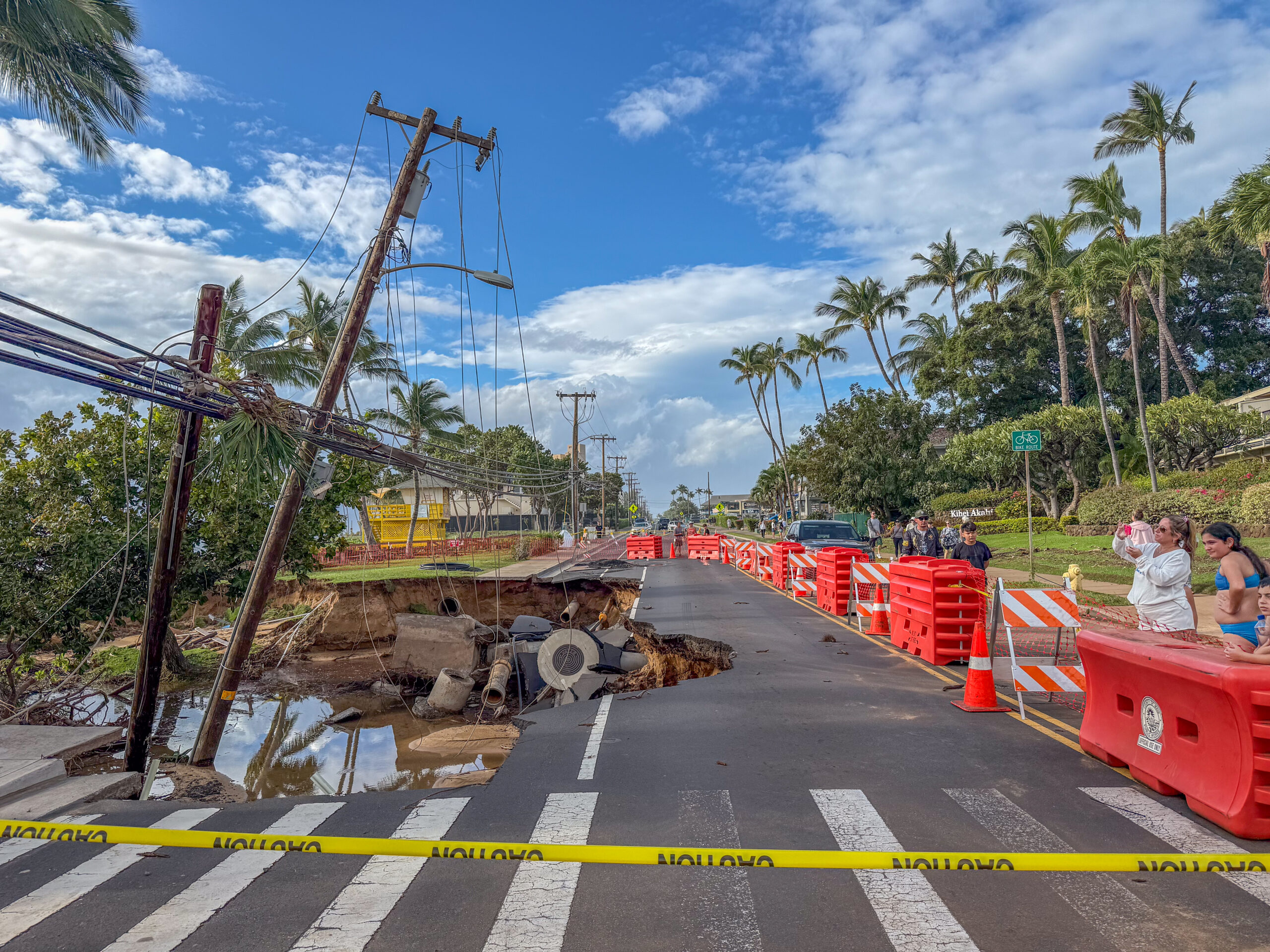
Mayor Richard Bissen said in a news release Monday that the county understands “how disruptive this closure has been for residents, businesses and everyone who relies on South Kīhei Road each day.”
“The damage from the Kona low impacted multiple infrastructure systems, requiring a more complex repair and redesign focused on long-term stability and resilience,” Bissen said. “Our administration is working urgently to not only restore the roadway, but improve it in a way that better withstands future storm events while also reducing the financial burden on Maui County taxpayers through emergency federal funding.”
Repairs to the road are expected to start on Monday and finish in the fall, which the county called “a conservative estimate.” P.B. Sullivan Construction is performing the work after landing an emergency purchase order from the county.
The Department of Public Works told the Hawai‘i Journalism Initiative on Monday that it did not have a final cost estimate on that project yet “due to the complexity of the repair and the use of federal funding.”
Work also finally moved forward to repair the large sinkhole and collapsed sidewalk along the shoulder of Kamehameha Avenue fronting Hawaiian Electric in Kahului. On Tuesday, construction crews could be seen filling in and resurfacing the pavement. The right-hand turn lane reopened for the first time since the storm in March, but the area is still enclosed by a barrier.

The county also did not have a cost estimate for that damage, which happened within “an active Federal Highway Administration project area.”
Hawaiian Electric told the Hawai‘i Journalism Initiative in March that the damage had not impacted its operations.
The storm also left sinkholes on Liloa Drive and other areas of the Kelawea Mauka Subdivision, which the county said it is “actively working” to repair. Those are expected to take several months to complete, and the county said it was still evaluating cost estimates.
Some sinkholes may not be fixed till next year, including the one on Kalohi Street in Kaunakakai that was one of several roadway sites damaged by the storm on Moloka‘i. The county said it expects to bid these projects by the end of the year and finish construction in the spring of 2027, “depending on federal review and procurement timelines.” The costs of those projects also are being assessed.

In addition to those sinkholes, there are also “storm-related sinkholes and damage in the Kaiwahine area of Kīhei, Waiehu Heights, Pohaku Street in Kahului, Papa Avenue near Maui High School, Ala Malama Avenue and Kikipua Street on Moloka‘i, as well as multiple roadway embankment erosion sites along South Kīhei Road, Lower Kula Road and Polipoli Road,” the department said.
The county is seeking federal funding for many of these projects, too, which could add “engineering, environmental review, procurement and compliance requirements that can extend project timelines,” the department added.
Molina said that the sinkholes were a result of “aging infrastructure” in old neighborhoods built around the late 1970s and early ‘80s where they used “corrugated metal drain lines” that eventually corroded in the salty air.
“So we’re just in that phase of the infrastructure life cycle of this widespread need for drain line replacements,” Molina said.
The county has been aware of the problem, and for the last few years, it has been trying to repair damaged areas around the county. However, “the storm beat us to it,” Molina said.

As for which areas were slated for work prior to the storm, the department said “repairs and upgrades to aging infrastructure are prioritized annually based on available funding, condition assessments and operational needs.”
Molina said the county now uses plastic more often for drain lines and also turns to concrete or aluminum at times, “which is also more corrosion resistant.”
“Better materials to ensure that those facilities don’t deteriorate on us as quickly,” Molina said.
On the newly expanded Pu‘unēnē Avenue, the Hawai‘i Department of Transportation has also turned to a solution to help drain heavy stormflows and keep the water from sitting on the road.
Director Ed Sniffen said “cells” were dug about 6 feet deep and planted with vegetation on both sides of the roadway “to get as much drainage as we can” in an area that often captures “significant amounts” of rainfall often. He said the “best test case” was the consecutive Kona low storms.
“After those Kona lows, we didn’t see any other ponding or flooding of this area, and it didn’t contribute to any flooding further on, so we knew it all worked out,” Sniffen told HJI during a dedication for the reopened roadway last month.
Sniffen said that was “absolutely” a result of the cells.

The newly laid roadway is also better at handling high volumes of water. Sniffen said the material they use is treated to bond the concrete and asphalt together better. Under the asphalt, there are layers of gravel that are compacted to about a foot and a half.
“When we construct our roadways, we always reconstruct full depth, so it’s not just resurfacing anything,” he said. “We also make sure that we use the best materials. … No longer are we putting in the old material that we used to before. It’s a better riding surface, it lasts a lot longer, it doesn’t dry out, and during storms it doesn’t scour.”
Older material didn’t adhere as well, and over the years, it dries out and cracks in the sun, leaving it susceptible to water seeping in and weakening the road, Sniffen explained.
“Water is the enemy to pavement,” he said. “If you can keep the water out, your pavement will last longer.”