Jobless rates remain steady in May
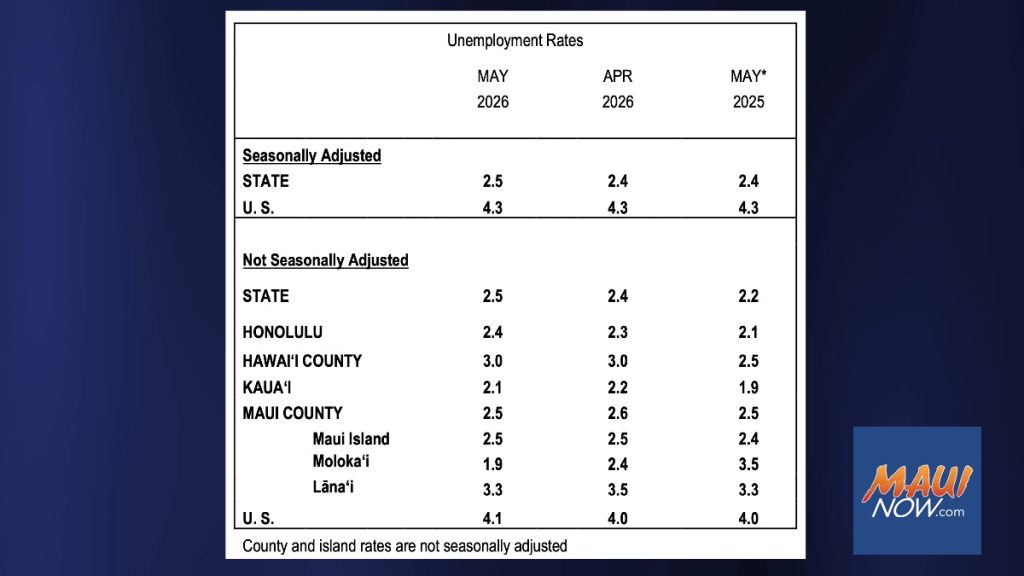
Hawai‘i’s seasonally adjusted unemployment rate rose a tenth of a percentage point to 2.5% in May, up from 2.4% a year earlier, according to data released today by the state Department of Business, Economic Development and Tourism.
The state had 672,100 employed residents and 17,450 unemployed in May, for a seasonally adjusted labor force of 689,600. Nationally, the unemployment rate held steady at 4.3% in May, the same as in March and April.
In Maui County, the not-seasonally adjusted unemployment rate was 2.5% in May, down slightly from 2.6% in April but unchanged from a year earlier in May 2025. Broken down by island, Maui island posted a 2.5% rate, unchanged from April. Moloka‘i’s rate dropped sharply to 1.9% from 2.4% the month before, while Lāna‘i’s rate slipped to 3.3% from 3.5%.
Other counties saw mixed results in May. Honolulu’s not-seasonally adjusted rate was 2.4%, up from 2.3% in April. Hawai‘i County held steady at 3.0%, while Kaua‘i’s rate improved to 2.1% from 2.2%. The statewide not-seasonally adjusted rate matched the seasonally adjusted figure at 2.5%, up from 2.4% in April.
On the jobs front, total nonfarm payroll employment statewide grew by 1,900 positions from April to May, driven largely by a 1,400-job increase in the leisure and hospitality sector, with food services and drinking places leading that growth. Professional and business services added 300 jobs, while trade, transportation and utilities and other services each gained 200. Government employment rose by 100 jobs, while private education and health services lost 300 positions. Construction, manufacturing, information and financial activities all held steady month over month.
Year over year, the state has added 4,000 nonfarm jobs, a 0.6% increase.
DBEDT officials noted that monthly data incorporates revised job-count figures reflecting historical corrections to seasonally adjusted data dating back to 2021, as part of an ongoing benchmarking process with the US Bureau of Labor Statistics. Statewide and county-level data from 2016 through 2025 were re-estimated to reflect updated population controls.
The department also reported alternative measures of labor underutilization for the 11 months ending March 2026, excluding October 2025 due to the federal government shutdown. Hawai‘i’s broadest measure of underutilization, U-6 — which includes unemployed workers, marginally attached workers and those working part-time for economic reasons — averaged 6.2% over that period, compared with 8.1% nationally.
Sponsored Content