 Hawai'i Journalism Initiative
Who should vote in Office of Hawaiian Affairs races? Some say it’s everyone’s kuleana

In the 14 years that Carmen “Hulu” Lindsey has served as Maui’s trustee for the Office of Hawaiian Affairs, she has often noticed the hundreds of thousands of blank votes that pile up in OHA races.
“We’re not happy about it, but it is what it is,” Lindsey said. “You cannot force people to vote for a category that they don’t want to vote for.”
In the 2024 general election, for example, there were more blank votes than votes cast for the winning candidate in two of the three OHA contests.
In the 2022 general election, in the race for OHA at-large trustee that included a prominent radio host and the son of Hawai‘i’s former governor, the 509,353 blank votes, or 40.5% of all votes cast, was more than the votes for the top three finishers combined.
Lindsey and other political observers say the reluctance to vote for OHA is a complicated mix of Native Hawaiians who don’t want to participate in an American election system, non-Hawaiians who feel like it’s not their place to choose the agency’s leaders, and voters who simply don’t know what OHA does.
OHA was born at a pivotal time in modern Hawaiian history, when a resurgence of Hawaiian culture and a flurry of activism drove an effort to “right past wrongs suffered by Native Hawaiians for over 100 years,” according to the organization’s account of its founding.
Created in 1978 during the state’s Constitutional Convention, OHA was set up to be funded by income from land taken during the 1893 illegal overthrow of the Hawaiian Kingdom. At the time of OHA’s founding, only Hawaiians were allowed to vote for the organization’s trustees.
But then a Hawai‘i resident named Harold Rice, who was born in the islands but did not have Hawaiian ancestry, sued then-Gov. Ben Cayetano, claiming this violated the Constitution by creating a race-based voting qualification. In 2000, the U.S. Supreme Court voted 7-2 in favor of Rice, opening OHA trustee voting to the general public.
Colin Moore, a political analyst, University of Hawai‘i professor and director of the Matsunaga Institute for Peace and Conflict Resolution, said the Rice v. Cayetano case created a “contradictory” system where “OHA represents and acts for a particular community, but its board is selected by a statewide electorate.”
“It doesn’t really make any sense,” Moore said.
In a state of nearly 1.5 million people, Native Hawaiians made up 21.8% of the total population in 2020, with 317,497 people identifying as Hawaiian in combination with other races, according to U.S. Census data.
Honolulu County had the highest population of Native Hawaiians in the state with 200,455 (19.7% of the total population), followed by Hawai‘i County at 59,320 (29.6% of the total population), Maui County at 39,617 (24% of the total population) and Kaua‘i County at 18,096 (24.7% of the total population).
The debate over who should vote for OHA races is a “sensitive” subject, Lindsey said. Some think only Hawaiians should vote, believing “that we should be taking care of our own problems, our own people.” Some Hawaiians don’t want to vote for OHA at all, preferring sovereignty and the restoration of the Hawaiian Kingdom. Others “don’t understand what OHA is all about, and maybe they don’t want to poke their nose into a category that they don’t feel that it’s their kuleana (responsibility) to do.”
“So there’s quite a few reasons why they’re not voting,” she said.

Lindsey, who is being challenged for her seat by Lahaina resident Ke‘eaumoku Kapu in the November general election, firmly believes that everyone regardless of ancestry should vote in OHA races because everyone should care about what happens to Native Hawaiians.
“After all, we’re the Indigenous people of these islands,” she said. “So it should be everybody’s desire to help us improve ourselves, improve our conditions.”
Because Hawai‘i doesn’t really conduct exit polling — something that’s even harder now that voting is done by mail — Moore said it’s hard to know the demographics of people who are voting in OHA races.
Makalika Naholowa‘a, the executive director of the Native Hawaiian Legal Corporation, a nonprofit public interest law firm, said that when OHA was created, it was meant to be an institution “governed by Native Hawaiians, elected by Native Hawaiians and dedicated to the betterment of Native Hawaiians.”
OHA’s founding was driven by the recognition that Native Hawaiians had already “endured tremendous losses” due to colonization, with a serious decline in population and “a clear indication of community harm and community trauma” that multiple studies on health and well-being show have continued to this day, Naholowa‘a pointed out.
But, as generations have gone by, many people think that “Native Hawaiians must have recovered, and that’s just not true.”
“There’s never been a true period of recovery and healing for Native Hawaiians,” Naholowa‘a said. “Every program, every carve out in the law is hard-fought and frequently attacked and requires defense. And that’s part of why my organization exists. So the reason for OHA was well-grounded in need and history at the time and continues to be true today.”

Photo courtesy: Native Hawaiian Legal Corporation
Naholowa‘a said her law firm doesn’t have a stance on who should vote for OHA races, but she said that “voting kuleana is like any other kuleana.”
“Kuleana means privilege and duty. So now that we all hold the right to vote for OHA trustees, we all share the responsibility to do so thoughtfully and carefully,” Naholowa‘a said. “Voters should get informed about OHA’s mission. They should understand the duties of its trustees and they should do their very best to select the candidates most fit to serve.”
Naholowa‘a noted that the debate is “probably the most difficult within Native Hawaiian community because some people hold the view that voting is, in a way, acquiescing to being a part of a political identity they didn’t choose.”
She said she understands the ethical question of whether non-Hawaiian voters should weigh in on OHA, but “I’m more hesitant to tell Hawaiians whether they should vote or not, to be quite honest.”
Faced with consistent low turnout, OHA has been trying to cultivate a “more positive” view of the agency and get people to understand its mission, Lindsey said.
OHA’s current priorities include improving educational pathways, health outcomes, quality housing and economic stability for Native Hawaiians, according to Mana i Mauli Ola, OHA’s 15-year strategic plan for 2020-2035. The plan is based on three foundations of ‘ohana (family), mo‘omeheu (culture) and ‘āina (land and water).
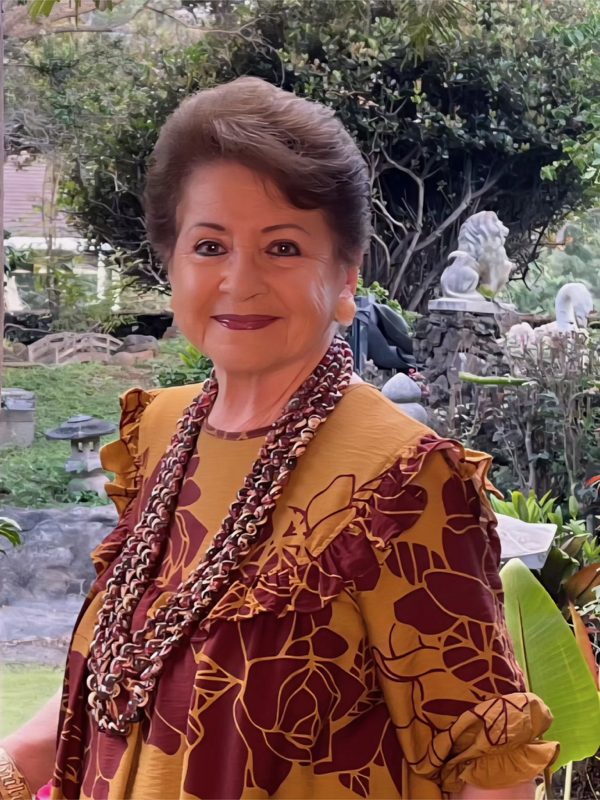
Courtesy photo
“Whatever we take care of, the State of Hawai‘i doesn’t have to, so we take a lot of burdens off of the state by taking care of our people with different programs,” Lindsey said.
Lindsey believes OHA’s work is “even more important” at a time when programs geared toward Native Hawaiians, including Kamehameha Schools and the Department of Hawaiian Home Lands, are facing lawsuits over claims of racial discrimination against non-Hawaiians. Lindsey shakes her head over the legal challenges questioning the benefits set aside for Hawaiians when historically, “everything we have was stolen.”
That heavy history potentially weighs on the minds of non-Hawaiian voters who choose not to cast a ballot in OHA races.
Moore said he is in the category of people who aren’t Hawaiian and don’t vote for OHA on principle because they believe that Hawaiians should choose their own representatives.
Those who aren’t Hawaiian but vote in OHA races may be driven by the fact that OHA has a public impact as a semi-autonomous state agency that has a lot of assets and is active at the state Legislature, Moore pointed out.
Whether that means the larger public has a duty to vote for OHA or whether it should still remain a decision solely for Hawaiians, Moore said, “I don’t think that there is a clear answer to that question.”
“Certainly, it’s not an answer that I can give,” he said. “But I mean, I would say that people who are going to vote for OHA have a responsibility to make a serious effort to understand OHA’s trust responsibilities, the major concerns of Native Hawaiian beneficiaries, and take the time to understand the candidates.”
And while that’s something voters should do for every race, he noted, “OHA is doubly complicated for all the reasons we’ve spoken of.”
“I don’t know how many people actually wrestle with this question,” Moore said. “Mainly, there’s just a lot of confusion about it.”
For people who do want to support Native Hawaiian causes whether they vote in OHA races or not, Naholowa‘a pointed out that OHA introduces a legislative package every year, and residents can take the time to learn about those bills, submit their comments and support the mission of uplifting the Native Hawaiian community. They can also keep tabs on Hawaiian stories and issues in OHA’s monthly free newspaper, “Ka Wai Ola.”
Questionnaires for the 2026 trustee candidates are currently available on the publication’s website.
“Be educated regularly, not just when it’s time to do voting,” Naholowa‘a said.