 Hawai'i Journalism Initiative
New vision, ancient roots: How Maui County’s ʻŌiwi Resources Department is putting Hawaiian ancestral knowledge to work

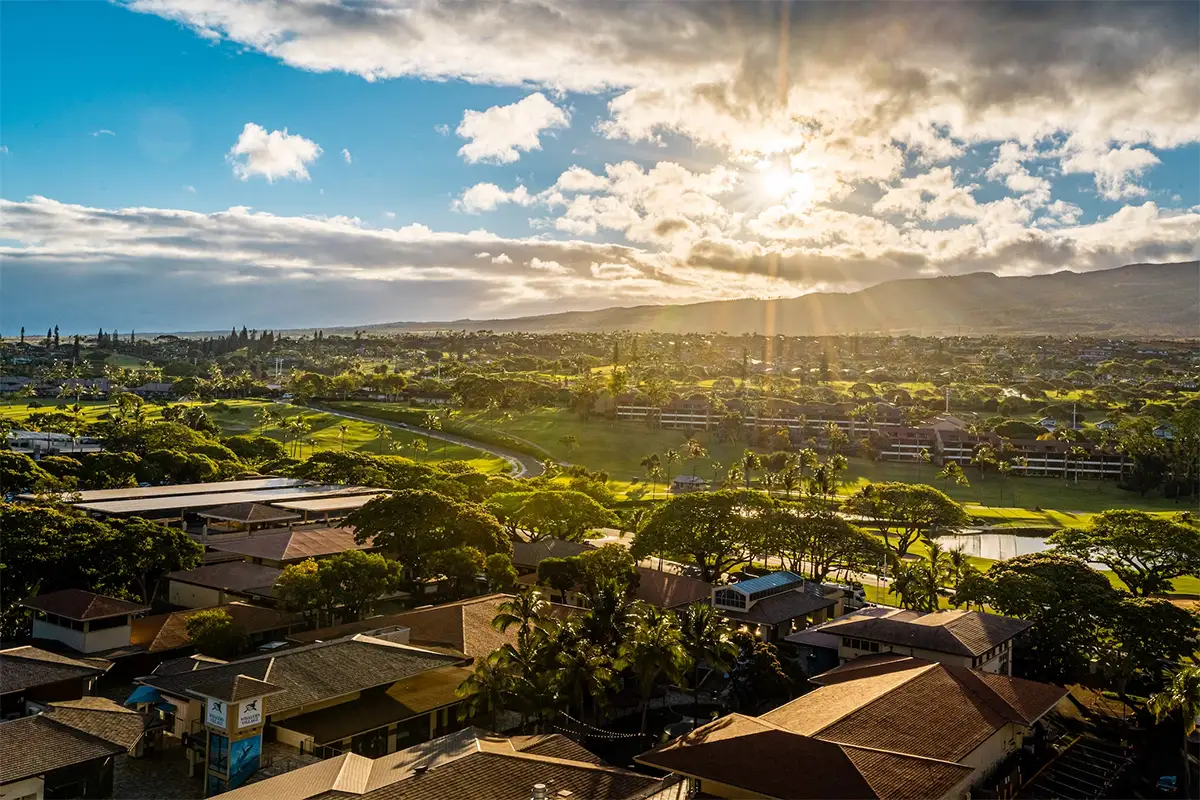
At Luaʻehu, the site of the historic Lahaina Royal Complex, the recovery from the 2023 wildfires unexpectedly came from a long-abandoned source.
When modern pump systems failed after the fires, the ancient, buried waterways that once threaded through the old royal seat of the Hawaiian Kingdom began returning on their own — flowing again through channels that had been paved over for generations.
To Kaponoʻai Molitau, director of Maui County’s two-year-old Department of ʻŌiwi Resources, that wasn’t a malfunction. It was hōʻailona — an ancestral symbol.
“Old areas that were once viable waterways … are now returning,” Molitau said. “And those to me are Hawaiian symbols that say if we take a moment to listen, if we take a moment to observe … you’ll find your answers that you need. The ancestors are right there.”
But sometimes, he added: “We all get in our own way of progress … that we don’t take the time to actually observe what’s right there in front of us.”
Mayor Richard Bissen sees the same recovery in similar terms.
“The recovery of Lahaina is about more than rebuilding structures,” Bissen said through his communications team. “It is also about restoring what gives Lahaina its identity, its spirit and its sense of place. Mokuʻula and Loko o Mokuhinia are sacred places with deep cultural and historical significance, and their restoration represents an opportunity to reconnect with that part of our history while helping guide Lahaina’s future.
“When we care for places that hold profound meaning, we also create space for healing, education and cultural renewal.”

Historically celebrated as ʻāina momona — a land of abundance defined by freshwater wetlands, fishponds and royal residences — Luaʻehu served as the historical capital of the Hawaiian Kingdom.
Following the fires, the Department of ʻŌiwi Resources has developed a multi-generational Master Plan for the complex in partnership with the G70 design firm, a community-led process that Molitau said “rewrites narratives of our history, not cover it up … but making sure that the places and the area have a voice for themselves.”
That also means listening to the voices who know the area best, Bissen added.
“The Lahaina Royal Complex Master Plan is being led through community engagement and guided by cultural practitioners, lineal descendants and those with deep connections to Lahaina,” he said. “Their voices are essential because this work belongs to the community.”

It is, in miniature, the working theory behind Maui County’s newest department: that ancestral knowledge isn’t just heritage to be honored, but a working input for present-day policy.
The shift began on July 1, 2024, with the formal launch of the Department of ʻŌiwi Resources approved by Maui County voters in 2022. ʻŌiwi means native of the land or “Indigenous person” in Hawaiian language. The new department brought more than a policy change. It also was a public reclamation of the land’s mother tongue, and the knowledge encoded within it.
This knowledge matters most to Maui County Council Member Keani Rawlins-Fernandez, a driving legislative force behind both the bilingual mandate and the new county department. For her, restoring the language was never only about representation — it was about bringing back access to information the county had spent a century failing to use.
In ʻŌlelo Hawaiʻi, she said, place names double as instructions passed down by people who paid close attention to the land for generations. For example, Wailuku, the county seat itself, means destructive freshwater — a warning, embedded in the name, to build carefully near its waterways.
The suppression this reverses dates to 1896, when the Republic of Hawaiʻi banned ʻŌlelo Hawaiʻi as a language of instruction in schools — a policy that triggered a sharp, sustained decline in native speakers over the following decades.

Bissen, who is Native Hawaiian and can speak ʻŌlelo Hawaiʻi, has cast the reversal in similarly foundational terms. When he introduced his proposed fiscal year 2026 budget in March 2025, he emphasized that the budget and vision centered “around our kahua — the very foundation that reminds us to care for our people, protect our ʻāina, respect our culture and honor our history.”
Staying true to that commitment, he added, the budget message would be formally delivered to the county clerk in both English and ʻŌlelo Hawaiʻi — the first time in Maui’s history a mayor’s budget message had been delivered bilingually.
In 2024, the Maui County Council also began releasing bilingual agendas, and other county agencies like the three island planning commissions also produce agendas in both languages.
For Rawlins-Fernandez, who also is Native Hawaiian and holds the Molokaʻi seat on the council, the mandate’s significance is not symbolic. It is structural, the point where system, culture and ancestral knowledge are meant to meet and function together.
“It’s no longer up to individuals,” she said. “It’s now a charter mandate that we operate this way. So now it’s structural. It’s required.”
She recalled that in her parents’ generation, speaking Hawaiian in school could get a child beaten — a memory that makes the charter amendment Maui County voters approved in 2022 a personal victory as much as a legislative one.
Two years since the department’s launch, its work amounts to more than a symbolic gesture toward cultural inclusion. Molitau described it as a permanent seat at the table for Native Hawaiian perspective in county decision-making, and a working test of whether ancestral knowledge can function as policy — not just heritage.
“I don’t consider that risky,” Molitau said. “I consider that brave.”

That test has, at times, meant showing up in crisis. Most recently, the department sent a team to Hawaiʻi island to help secure Nāʻālehu Cemetery, where displaced iwi kūpuna needed to be recovered and documented before an approaching storm.
Working alongside Hawaiʻi island archaeologists and cultural practitioners, the team helped respectfully recover, document and secure the remains — the kind of cross-island, on-call work that has become routine as storms and king tides continue to displace burials on Maui.
Ground-floor reality: Translating a bilingual bureaucracy
While the bilingual mandate was forged in the County Council chambers, its daily implementation relies on the work of translators like Nalani Fujihara, the Hawaiian language communications specialist for the Office of Council Services.
Her task is to translate the mechanics of local government — bills, agendas, testimony — into a language that had never had to describe them before.
Fujihara isn’t working alone. The department has translated more than 100 boards and commissions agendas and run 10 cultural sensitivity, Hawaiian culture and language courses for county employees, plus monthly language lessons for county secretaries — the unglamorous, agenda-by-agenda work that makes the mandate more than ceremonial.
She works from a lexicon built in part by kumu Cody Pueo Pata, translating not by inventing new words but by describing what English compresses into one. A “violation,” for instance, becomes a description of the act of violating — a verb, not a noun.
“We’re just describing that it’s being violated,” she said.
Fujihara is a non-native speaker, who cultivated her love for the language through hula and formal education. Her job represents a profound cultural responsibility, one that required her to overcome her personal barrier of “not measuring up” to native speakers, she said.
“For people like me, who grew up with it later, it’s definitely still possible to learn and to understand, but it was something we had to learn later on,” she said.

In the years since she started the job, Fujihara has watched demand for the service grow, opening new opportunities for the language elsewhere. But she also measures the work’s success in the representation it provides. Seeing their mother tongue treated with equal weight on official county stationery validates its modern use for future generations, especially those in Hawaiian immersion schools, she said.
“Just being able to see Hawaiian language … integrated into the government space gives them a sense of pride, and I think it shows that Hawaiian language can be integrated into these official spaces,” she said.
Decentralized stewardship: Grassroots healing and land restoration
While the bilingual government transition has shaped county operations from the top down, the Department of ʻŌiwi Resources is simultaneously driving a grassroots cultural renaissance from the bottom up through its $450,000 Kahe Wai Ola (“flow of living water”) grant program.
The program relies on a decentralized stewardship model that empowers local community nonprofits to serve as primary caretakers of the lands, resources and narratives they know best, Molitau said.
The grants are organized across three divisions:
Kīpuka: “ʻŌiwi Strongholds” that are named for the pocket of older, undisturbed land that survives inside a newer lava flow, used here as a metaphor for lands of concentrated cultural and ecological importance.
Kumuwaiola: “ʻŌiwi Resources” that are literally “source of living water,” preserving life-sustaining eco-cultural landscapes.
Pai Ka Leo: “ʻŌiwi Voices” that are raising the voice, reinvigorating Hawaiian language use in government and public life.
Across all three, this year’s inaugural grants are turning ancestral wisdom into active, community-led programs.
In Hāna, this reignited ancestral wisdom is pulling turkey berry out of the ground by hand.
Ke Ao Hāliʻi is a community land trust formed in 2017 after a threatened land sale galvanized the community to buy the parcel itself. The organization’s core mission is to hold the land title in perpetuity, returning the community to a reciprocal relationship (pilina) with the soil that once fed their ancestors, said Sunnie Makua, vice chair of the trust’s board.
This year, the nonprofit received $41,095 under the Kīpuka division of the grant program. The funding helped expand the organization’s work on native plant restoration, increase its māla (food garden) and remove invasive plants across a 3-acre plot. For Makua, the work is deeply personal. Her father was born and raised on the very lands the community has successfully reclaimed.
“We have a strong belief and a core understanding that this relationship that we talk about is essential to the restoration of the relationship with people and place,” she said.
But the funding hasn’t just expanded the land. It also is expanding the hearts and minds of the community, too.
Every Tuesday, Ke Ao Hāliʻi hosts “Canoe Days,” bringing staff and the community together to learn the traditional names and ancestral uses of these plants. The organization trains its local, Hāna-raised staff in the practice of kilo (keen observation of the surroundings), tracking weather patterns, tides and seasonal blooms. They begin each day with specifically designed chants, asking the land for permission while calling the original names of the places forward to awaken ancestral memory.
“I’ve seen the light bulbs go off, the naʻau (heart and mind) wake up within these young people. And they’re like, ‘I’m starting to get it, I understand now why it’s so important to go to these places to understand and observe … and then come back and process it together.’”
To Makua, this direct funding represents a revolutionary shift in municipal governance — one that supports grassroots movements directly and trims bureaucratic red tape. Her ultimate message for Maui’s cultural future is simple: “We can’t stop.”
Reclaiming the right to tell the story
While Ke Ao Hāliʻi restores pilina to the land, the Archive for Health, Arts, and Spirit (AHAS) is restoring the reciprocal relationship to Maui’s narratives, under the department’s Pai Ka Leo (ʻŌiwi Voices) division.
A $25,000 grant funds AHAS’s “Collective Pilina Theater: Local Voices on Stage,” a project that treats storytelling not as programming but as a tool for collective healing in the wake of the August 2023 Lahaina wildfires.
For co-founder Hōkū Pavao, that starts with rejecting how Western theater is staged in the first place.
“A Western style form of theater … says the people come to the theater,” she said. “And in the indigenous mindset is we take it to them. We build the relationships.”
In practice, that means seven community readings held directly in the spaces the stories are about — including a play written in response to the fires by kānaka ʻōiwi sisters Mahea and Noelani Ahia, drawing on Noelani’s own frontline experience with the Maui Medic Healers Hui.

To keep the work accountable to the communities it depicts, the production relies on what Pavao calls indigenous dramaturgy: cultural kumu (teacher) and consultants who decide, community by community, what stays in and what doesn’t.
“They get to tell us which pieces have to come out,” she said, “and which pieces can stay.”
The funding itself does more than cover a budget line, Pavao added.
In a state where the cost of living forces many practitioners into two and three jobs just to stay afloat, it buys something scarcer: time.
“Money is energy,” she said. “It’s just an exchange of energy.”
And because the grants come from county leaders who already share an indigenous worldview, that time doesn’t come with the tax of having to justify it.

“You don’t have to extra explain when you say you are going to mālama ʻāina,” she said. “That barrier being taken down is immeasurable.”
AHAS co-founder Moira Pirsch, who is not Native Hawaiian, said the department’s grant-making follows the same logic of less transaction and more relationship.
“Structurally, they’ve been able to infuse an indigenous spirit in it,” she said of the county’s process. It’s that model, grassroots and relational rather than top-down, that Pirsch said could travel well past Maui and be a template that other counties and other states might study.
A model for others
Even within Maui County, the model keeps expanding. The department recently opened a satellite office on Molokaʻi and added a second ʻāina advocate there, extending its reach to a community that has often felt distant from decisions made in Wailuku.
Other jurisdictions are watching the experiment closely. When Honolulu’s charter commission solicited public input last year, the single most-requested change was a department just like Maui County’s — proof, Rawlins-Fernandez said, that “if they can make it happen there, then we can make it happen here also.”
For Molitau, success is not measured by replication elsewhere. It’s generational. He often returns to something his makua hānai (adoptive parent), the late kumu hula John Keola Lake, told him growing up. Lake said to look at Hawaiʻi through his eyes — through the eyes of the people who came from this ʻāina, and the ancestors before them.

It’s advice Molitau has carried into a department built, in large part, to institutionalize exactly that kind of looking. He extends the same expectation to everyone on the island, resident or not.
“You have a responsibility to the land that you’re on,” he said, “to the people, to the air that you breathe, to the water that you drink” — a shared kuleana (responsibility) that doesn’t discriminate by how long someone’s family has been here.
The ultimate measure of the department’s success belongs to the future.
“What does that legacy look like in the next seven generations from now?” he said. “My future descendants will go back and look at what we did. What were our responsibilities, and did we take care of them? I would hate to leave the space worse off than I found it.”