


Pacific-Wide Tsunami Readiness Exercise Conducted
By Wendy Osher
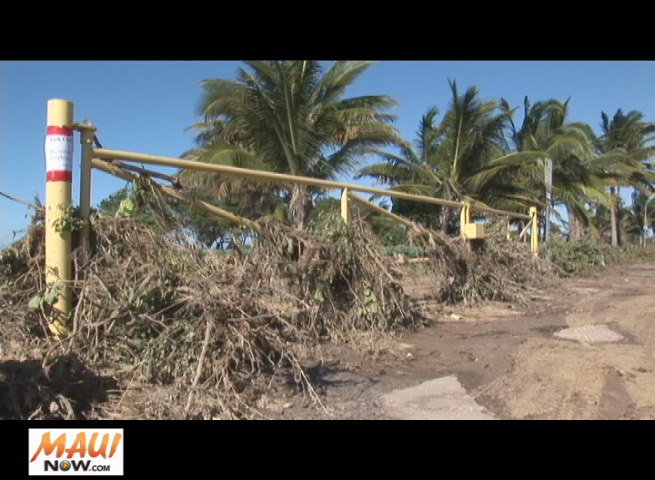
Debris pushed by the power of tsunami surges became wedged in park gates and pushed over the perimeter fence at the Kanaha Wildlife Sanctuary following the March 2011 tsunami, generated by an earthquake in Japan. Photo by Wendy Osher.
The tsunami warning centers in Ewa Beach, Hawaii, and Palmer, Alaska, are participating in a Pacific-wide tsunami test Nov. 9-‐10, 2011.
The test is aimed at helping to strengthen the region’s tsunami preparedness and response capabilities.
Along with the United States, 36 Pacific Rim countries are taking part in “PacWave11,” a mock tsunami exercise organized by the United Nations Educational, Scientific and Cultural Organization.
The exercise takes place as 21 APEC member nations are meeting in Honolulu, Hawaii, to discuss important Pacific issues, including large-scale natural disaster mitigation.
NOAA officials say about 75% of the world’s earthquakes and tsunamis occur in the Pacific Ocean.
On average, the Pacific has a tsunami every year, with a major Pacific-wide tsunami occurring a few times each century. Three destructive and deadly tsunamis have occurred in the Pacific in the last three years.
“The tsunamis that occurred in the Samoan Islands, Chile and Japan in 2009, 2010 and 2011 respectively, demonstrate that tsunamis can occur anywhere, at any time with great loss of life and tremendous devastation,” said Laura Kong, director of NOAA’s International Tsunami Information Center.
“This important exercise will help countries improve their tsunami preparedness and response capabilities,” she said.
This is the third international tsunami warning exercise, the first two having occurred in 2006 and 2008.
*** Supporting information courtesy NOAA.
Sponsored Content




Subscribe to our Newsletter
Comments