VIDEO: Kahului Runway Rehab Options Aired
[flashvideo file=http://www.youtube.com/watch?v=3O_bAibxMDU /] By Wendy Osher
A standing room only crowd gathered at the Pomaikai Elementary School Cafeteria on Maui for an evening meeting on Monday to discuss runway rehabilitation options at the Kahului Airport.
Hawaii Department of Transportation officials laid out three potential options, the most popular of which would require an Environmental Impact Statement and cost the most, but would avoid aircraft landing restrictions for incoming wide body flights.

Image Courtesy Hawaii State Department of Transportation.
Visitor industry officials, hotel employees, and business owners, were among those who said other options resulting in aircraft restrictions would pose devastating consequences for the business sector and the community as a whole.
Maui Mayor Alan Arakawa offered similar comments saying,”One of the things that we were very concerned about was closing down to air traffic coming through. We don’t want the runway to be stopping traffic even for a three week period.”
“We prefer Option 3, which would be keeping the runway open,” said Arakawa, whose comments drew applause and support from many in attendance.

A meeting hosted by the Hawaii Department of Transportation attracted hundreds of people who came to hear plans for runway rehabilitation, as well as voice opinions on potential solutions. Photo by Wendy Osher.
The three potential options floated at the meeting included:
- Option 1: would involve the repair of runway 2-20; result in no wide body aircraft landings for 8-10 weeks; cost an estimated $34-$47 million; and would require no additional runway extension.
- Option 2: would require the 2,000-foot extension of runway 5-23; cost an estimated $66-$48 million; would require an EIS; call for a consolidated rental car facility; and would result in no wide body aircraft landings for three weeks.
- Option 3: would require additional runway extensions 2,000-feet to Runway 5-23, and the 1,600-foot extension of runway 2-20; cost an estimated $110-$134 million; would require an EIS; call for a consolidated rental car facility; and would result in no aircraft landing restrictions.
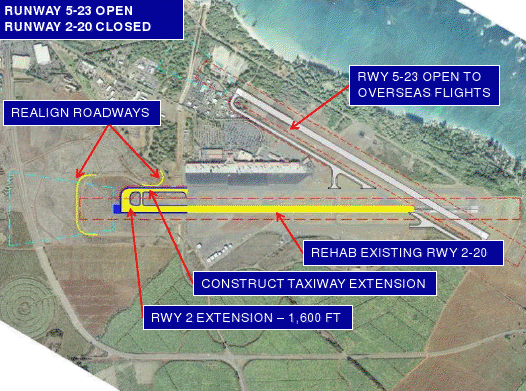
The DOT's Option 3 is the most expensive, but would result in the least amount of impact for incoming air traffic. Graphic courtesy Hawaii Department of Transportation.
“This isn’t a new problem,” said DOT Communications Chief Dan Meisenzahl, who said Runway 2-20 demonstrates increased asphalt deterioration
“A slow, but steady rise in these stresses has resulted in an increase in the presence of foreign object debris or FOD, which has the ability to severely damage aircraft. It can be sucked up into an engine and FOD prevention is one of the top safety priorities for the FAA,” said Meisenzahl.
Department officials say the situation is something that they are very aware of and have been checking the runway daily with routine maintenance conducted when there is the least amount of impact on travelers.
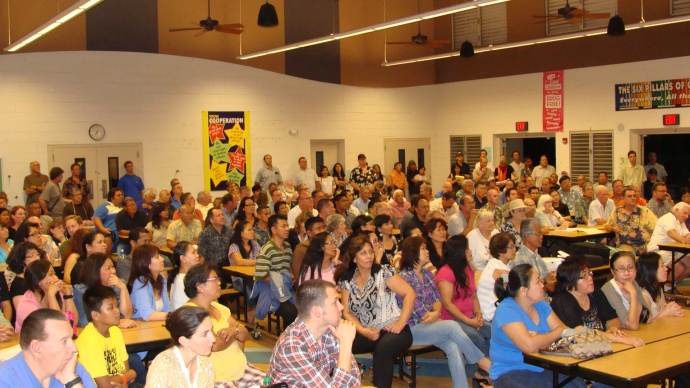
A standing room only crowd attended an evening meeting hosted by the Department of Transportation to discuss rehabilitation options for the Kahului Airport runway.Photo by Wendy Osher.
The Federal Aviation Administration issued a statement recently saying that while maintenance projects could not be considered for federal funds, a more permanent solution would potentially be eligible depending on availability of funds. All options would seek 75% FAA funding, and require 25% user fees.
Runway 2-20 was originally constructed in 1942 by the military as an 8-inch cinder-based layer with an additional 3-inch upper layer of Hot Mix Asphalt Concrete. Since it was constructed, DOT officials say there have been five subsequent asphalt overlays, and a partial overlay as recently as 2006.
The end result is a transition from the original 3-inches of asphalt 7 decades ago, to 16-18 inches today.
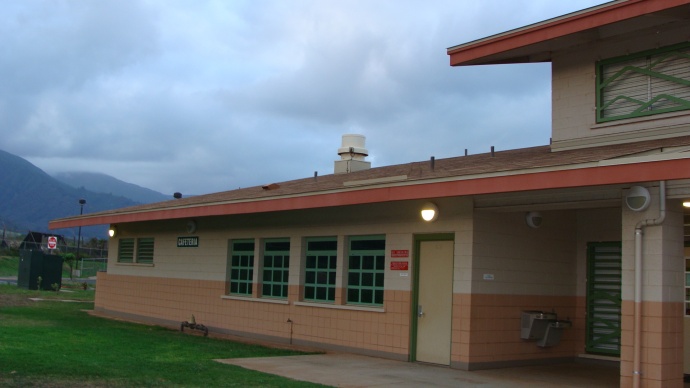
The DOT meeting was hosted at the Pomaikai Elementary School Cafeteria in Central Maui. Photo by Wendy Osher.
There were more than 2.6 million airline passengers to Maui in 2010, with roughly 1.4 million of them coming from direct overseas arrivals. Of the travelers that came, they spent an average of $35 million per week, according to the Hawaii Tourism Authority.
If none of those travelers came to Maui for a 10 week period, as outlined in Option 1, the potential loss could be $350 million. If 50% of them still came, via other destinations through Honolulu or the Big Island, it would still result in a loss of $175 million, according to state DOT officials.
“What we really wanted to do is go out and approach all of the stakeholders and get it out to the public before we started the (EIS) process,” said Meisenzahl. “Our top priority is to make sure that this happens. In a way, we just want runway 2-20 fixed; so whatever it will take to do it, that’s what we’re willing to do , and examine all options and listen to all opinions that are out there,” he said.
Click here to vote for which runway option you prefer, or to propose your own.
[flashvideo file=http://www.youtube.com/watch?v=DXlCC6T4u0s /]
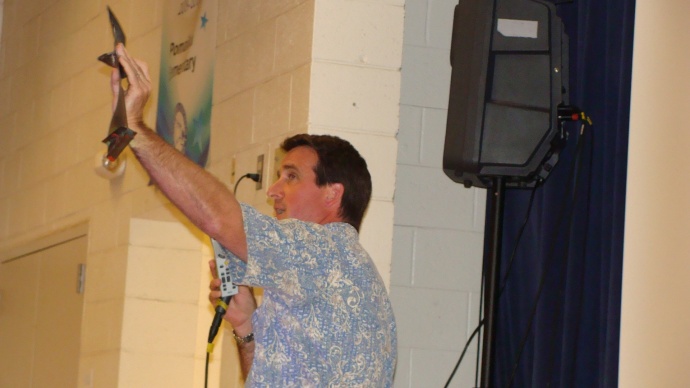
Dan Meisenzahl Chief of Communications State Department of Transportation holds a piece of a blade struck by FOD. Photo by Wendy Osher.
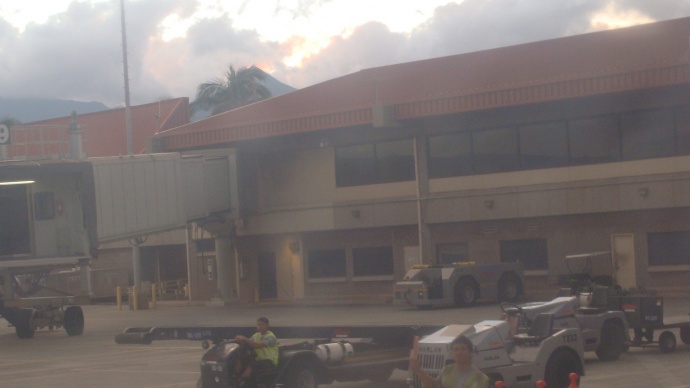
Kahului Airport. Photo by Wendy Osher.
Sponsored Content