

A History of Wailuku’s Planning, Mismanagement
By Susan Halas
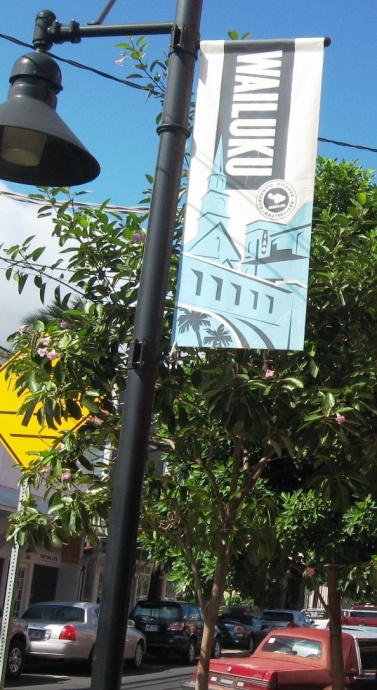
Wailuku Town has been the subject of intense planning efforts and many public dollars have been spent. Susan Halas photo.
For the last decade Wailuku has been the focus of an intense ongoing planning effort. The beautification, upgrading, revitalization, economic stimulus to the town has been much debated. Before discussing what Wailuku might become, let’s review the status of Wailuku now.
Wailuku is the County Seat
Wailuku is Maui’s county seat. It’s the home of the County Building; nine stories high and filled with public offices and their workers. There’s One Main Plaza, another mid-rise office building, with many county and federal government tenants.
Wailuku is the home of the state courts, other state offices and their workers. It also has many medical offices, professional services and banks. Many non-profit organizations are based in Wailuku. It has two active theater groups, and a historic theater. It has a big new community clinic and a new multi-story senior housing project.
Wailuku still has a few shops and restaurants, but not many. The main feature of Market Street is a row of pawn shops, pay-day loans, second-hand merchants, cash-for-gold buyers and similar operations. Many of these all have different store fronts but most are under the same management.
Almost all the daytime population is composed of office workers or visitors to these offices. Most of them go home by 5 p.m.
Wailuku is a Pleasant Place to Live
After the office workers go home Wailuku is a pleasant place to live. The residents are an interesting mix. Many are of Japanese ancestry and have lived here several generations. There is a Jodo Mission on Central Avenue and a variety of other Buddhist organizations. Other people live in the area because they like the weather, the convenient location, the old-style homes and the reasonable prices.
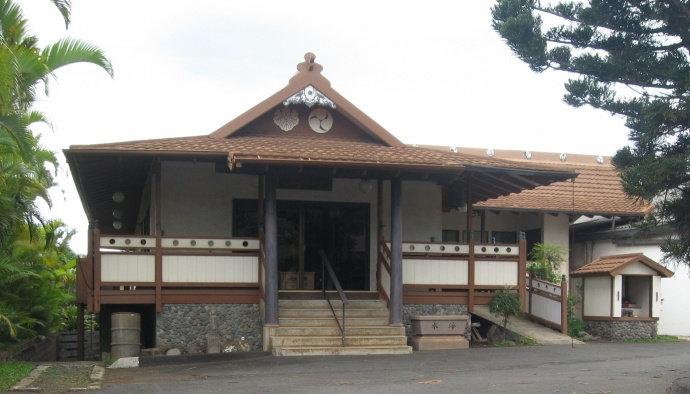
Wailuku has a large Buddhist community. Susan Halas photo.
The homes in the area are mixed in with businesses. They are mostly from the 1930s, 40s and 50s built in the old-plantation-style. Many of these buildings are over 50 years old. They have a vintage charm of an earlier period. Some are well-maintained and some are falling down or gone-to-seed.
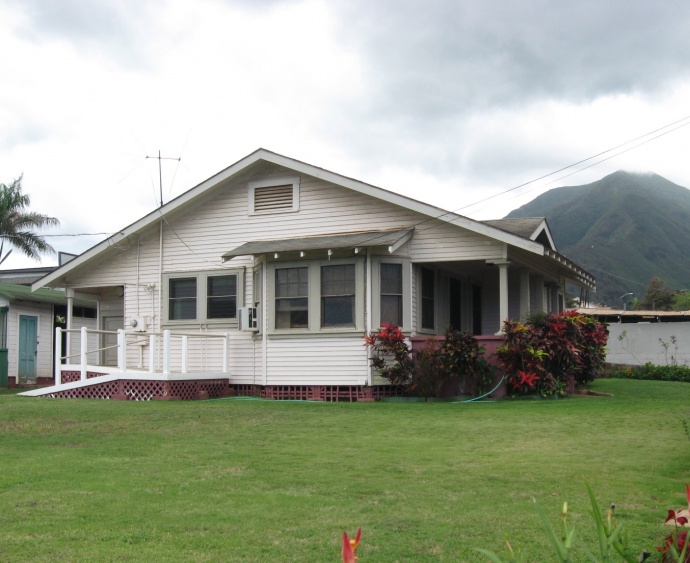
There are some charming older homes left in the heart of town. Susan Halas photo.
The Core of Wailuku is Small
Wailuku is small. The heart of the town is only about 68 acres. That area runs from High Street down to below Central Avenue and from Wells Street to a little past Vineyard. It has a pan-handle that sticks out along Market Street and runs into Happy Valley ending just beyond the old TK Supermarket. This is the area that has been targeted for revitalization.
Renewal Efforts Have a Long History
In the middle of the 20th century the prevailing view of urban renewal was to bulldoze whatever was there down to bare dirt, and start all over again with building that were new, modern and up-to-code.
Not surprisingly, Wailuku, though already sliding from its glory days as the bustling hub of the island in the 1920s, 1930s and 1940s, resisted being wiped off the face of the earth.
Instead the leadership began a renewal effort, to save what was good, and make it easier for those people who lived and worked in Wailuku to have a better shot at success. Though this effort began in the last quarter of the 20th century, it did not really gain speed until the beginning of the 21st century.
The Wailuku Redevelopment Area & Maui Redevelopment Agency (MRA)
At that time the Wailuku Redevelopment Area was created. It is made up of those core 68 acres and a variety of land use designations. At the same time an oversight board known as the Maui Redevelopment Agency (MRA) was set up to supervise planning and development in the town. The board has five unpaid members. They are appointed by the mayor. The MRA was given many broad powers in an ordinance passed by the County Council.
In the first years of the new century, with the conceptual planning and zoning in place, anyone who wanted to make changes could now go before the board and discuss their plans. The MRA would either give a go-ahead, hold it back, or add requirements that had to be met before the improvement or changes could be made.

Other property in the area is in need of repair. Susan Halas photo.
The MRA was put in place to make it easier for Wailuku property owners, especially those with small and non-conforming property, to make improvements. It was hoped that by forming a local board, where residents could go directly with their concerns, action would be speedy and things would move along in the right direction.
But what really happened was that the composition of the board changed frequently, as did its staff and the perception of the mission. There were also frequent changes in administration as a variety of mayors cycled in and out of office. The ones to really take advantage of the new legislation were non-profit organizations.
Lots of Non-Profits Moved to Wailuku
Between 2000 and 2012 a great many non-profit organizations moved to Wailuku. During this period Ooka Market, once a large grocery store, closed and reappeared as a large low-income health clinic. The Ooka Market parking lot disappeared and was reincarnated as a multi-story senior housing complex.
Several mental health organizations bought or operated facilities in the town. Maui Economic Development (MEO) bought the Old Cabebe Store to be remodeled and used as a half-way house for newly released felons. These new uses were in addition to the non-profits Wailuku already had, such as an AIDs housing complex, an adjacent not-for-profit Weinberg Center, to name a few. Many were located in blocks that formerly had been for business use.
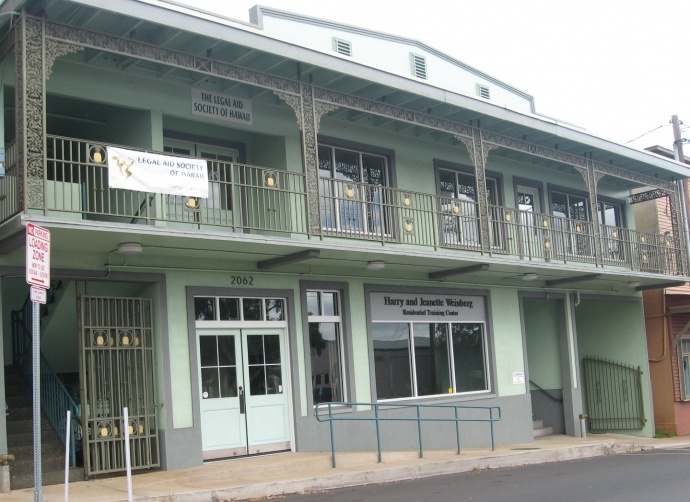
MEO bought and rehabilitated the old Cabebe Store. It plans a half-way house for those recently released from prison. Susan Halas photo.
What these new non-profits had in common was that they asked for, and received, waivers when they wanted to make improvements. For many of these organizations the MRA waived parking and infra-structure requirements.
These waivers piled up on top of waivers that had already been given to commercial structures like Main Street Promenade – which asked for and got a waiver for over 70 parking stalls and other smaller new buildings which asked for and got more exceptions.
This all put increasing pressure on the large central parking county lot in the heart of town. As time went along, parking became a bigger and bigger concern.
Lots of Public Money Spent on Wailuku
Many uses in Wailuku were subsidized by public funds. Maui On Stage which operates the Iao Theater, owned by the county, received an inexpensive and favorable long-term lease. When the Pono Building was built next door to it on Market Street, that structure was also heavily subsidized by public money.
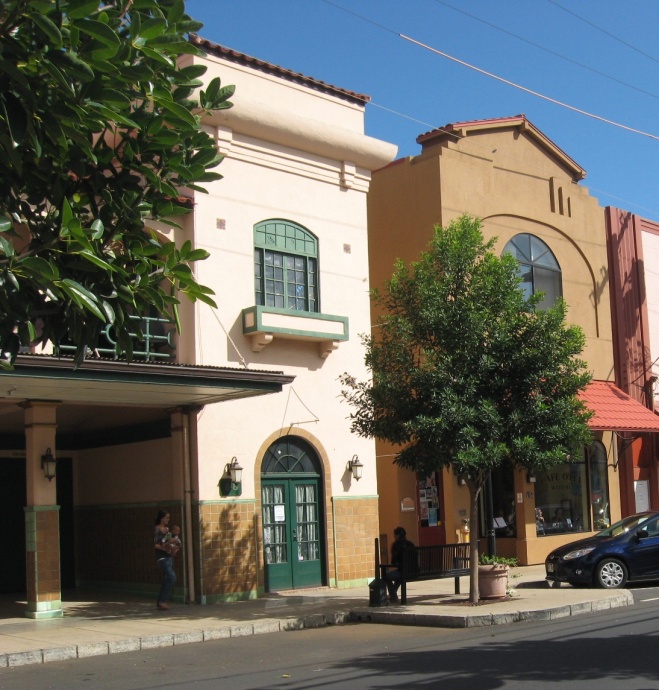
The Iao Theater (left) and the Pono Building (right) have both received substantial public subsidies. Susan Halas photo.
Not surprisingly it took longer than expected to be completed. It cost more than anticipated to keep it running. Unfortunately it also took away parking from its commercial neighbors.
The intent of the non-profits and the MRA was good. But the cumulative effect of more than ten years of making exceptions was to eliminate practically all the wiggle-room for any other kind of activity, particularly economic activity in Wailuku.
What happened was the business side of Wailuku languished, except for the previously mentioned office workers and pawn shops and patrons of the low-income clinic and low-income senior housing. These became more numerous, but they had little money to spend, or at least not in a way that added vitality to the town.
Real Business Moved Out
At the same time larger serious commercial development migrated just down the road toward Waikapu. Presently, a well-financed large scale commercial development is filling up at the Wailuku end of Maui Lani. This property is being sold fee-simple. It has a “village-mixed use” zoning. Across the street a new Kehalani shopping center at the intersection of Kuhikahi and Waiale Drive has broken ground. The businesses that go in there will lease their commercial units.
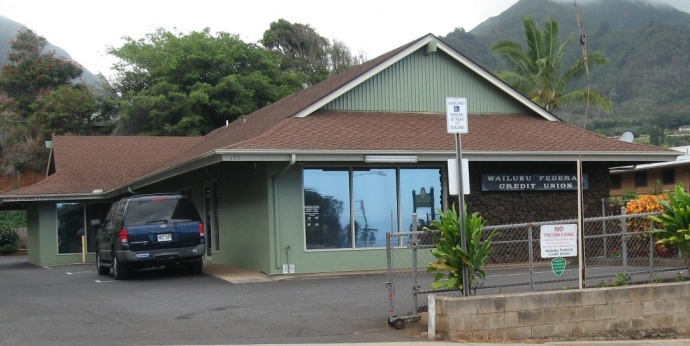
The Wailuku Federal Credit Union plans to move to the commercial area of Maui Lani. Susan Halas photo.
What these developments have in common is they are spacious, code compliant and closer to the area’s new population centers located on slopes of the West Maui Mountains. This area includes Wailuku Heights, Kehalani and many other middle-income and upscale subdivisions. The new commercial developments anticipate nearby residents will find it convenient to shop and do business closer to home.
Those two commercial areas are under construction now. In Maui Lani, there will be a new gas station, supermarket, hardware store, multiple doctors and professional offices, a large beverage wholesaler, a church, a credit union and cable station headquarters, to name a few. All of these entities have purchased land fee-simple and expect to be moving into these spaces within the next two to five years. There are many new owners now and many more to come.
They have voted with their feet. They didn’t move to Wailuku, right next door, because Wailuku was not what they needed. Wailuku was too small, too congested and it became too complicated and too difficult to make money or expand in Wailuku.
Back to the MRA
Let’s go back to the MRA. Over the years the board gave waivers to most of the non-profits, but it put obstacles, sometimes insurmountable obstacles, in the path of small business owners.

The community clinic and the senior housing got waivers, but not the owner of the small adjacent lot which is now for sale. Susan Halas photo.
A small local bakery in business for many years in Wailuku bought a vacant lot, right between the clinic and the senior housing. But it found it could not possibly comply with the road widening and other improvements the MRA board required. The old bakery is still going. Today that lot is on the market.
A local accountant tried to build a little extension to her office, only a few hundred square feet. After a number of years and tens of thousands of dollars in expense, she gave up. She couldn’t get it through the MRA.
Another local merchant jumped the gun. He went ahead and made improvements to his older wood frame building and with good reason. There was an earthquake and if he didn’t act right away he thought the whole thing might collapse.
He made emergency repairs and then went to on to make more extensive structural repairs and improvements. But, he neglected to file for the proper permits. Though he did file after-the-fact, there were some serious financial consequences for him. He was slapped with about $250,000 in retroactive fines by the county.
This man and his wife had been in Wailuku for decades. They felt tremendously stressed by the magnitude of the proposed punishment. In the end it the fine were reduced to $10,000, but he also paid another $10,000 to an attorney to represent him in the dispute. A severe penalty that came out of his own pocket was his reward for making real improvements to the neighborhood.
Old Timer Not Happy
When Maui Now talked to him this week he was not a happy man. He was disgusted.
Why, he asked, was he forced to deal with people who were employed by his tax dollars who were so hostile to his interests? Why when times were so hard, did the government agencies make it harder?
What about this proposed parking lot, it seemed extremely costly – wasn’t there a cheaper way to get more parking and get it now? He was struggling to survive. How did any of this help him?
Why, he asked, were the planners sitting in deluxe ocean-view offices and thinking about 20 years from now, when the real issues are about what’s happening today? Aren’t there things we could do right now, he wondered.
Where the Money Went
He also mentioned some of the things that public money has paid for in Wailuku:

Hundreds of thousands of dollars have been spent on plans a proposed new parking structure estimated to cost $15 million to build. Susan Halas photo.
* The county received a $1.2 million USDA grant for preparing plans a related for a multi-story parking garage that is projected to cost $15 million dollars. This structure, if built, would add only a scant 200 stalls to the 200+ stalls that already exist. According to the Planning Department source though not all of that money has been spent, hundreds of thousands of dollars have already gone out in preparing plans.
* About $68,000 has been spent in the last two years for a sole-source non-bid contract for a company named PUMA to come to Wailuku from Colorado and work on updating the Wailuku plan. Was there nobody in Hawaii qualified to do this work?
* In the last few weeks Wailuku has had a very broad reaching planning review called reWailuku. It included an exhibit, displays, workshops headed by county planners and a number of out-of-town experts. It cost some money, but a lot was donated.
* Then there was a county-financed parking study that cost thousands of dollars more. It was a concise, accurate evaluation of what the parking needs are and how the situation could be improved. It disappeared without a trace and few of the recommendations have been adopted.
The Market Street Improvements
The money the merchant listed was small change compared to the millions it cost to redo Market Street; which again took longer than expected and cost more than planned.
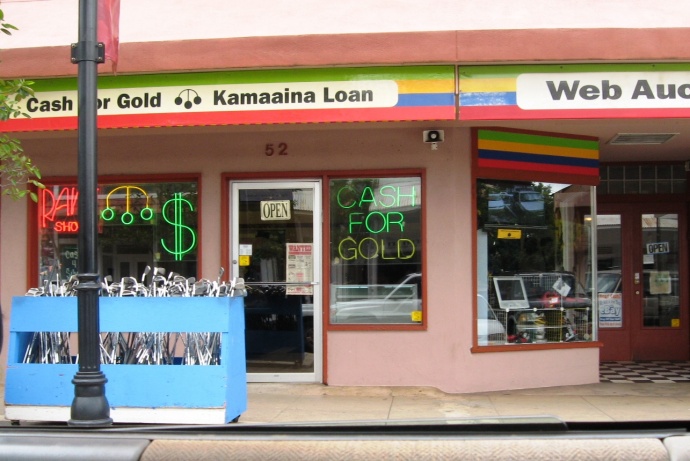
Wailuku has America's beautified strip of pawn shops and pay day loan offices. Susan Halas photo.
Actually these improvements weren’t high on anyone’s agenda, but somehow the money was there and public funds were spent for “traffic calming” devices” and fancy curb stones.
The new improvements made Market Street very narrow. Little platforms with trees growing on them extended into the street and made it hard to park. Quite a bit of existing parking was eliminated in the name of beautification.
It became it a nightmare to come into Wailuku from Waihee or to go out of Wailuku via Happy Valley.
But only the people who used the street saw it that way. The MRA spent more public money on glossy PR to brag about the new look and trumpeted that similar “improvements” were on the way for the rest of town. Those improvements, they said, would make Wailuku a happy, busy place fully of happy busy people eating at happy busy little restaurants and sitting in cute little benches under lollypop trees.
It’s Not Just the MRA
Lurking in the wings is the the yet-to-be revealed impact of the new County General Plan. It is hard to predict what the impact it will have on Wailuku. This long delayed bigger plan was paid for with public funds. It has taken longer and cost more than anticipated. No one yet fully comprehends what’s in it.
Wailuku Main Street – Questions about money?
If there weren’t already enough players and behind the scenes complications, there is also the Wailuku Main Street Association. This non-profit group has been active in Wailuku for many years. It was recently in the news for declining to answer questions about how it spent the public funds it received.
Wailuku Main Street has received substantial county money year after year to assist with Wailuku planning. The report said it has over $300,000 in reserves in the bank but the organization refuses to release its financials. They claim that what it does with that money is “confidential.”
Yet More Players and Expenses
The MRA, Wailuku Main Street and the County Planning Department, outside planners and experts aren’t the only players. There’s also the Wailuku Community Association, made up of the folks who host the First Friday town party which brings many people to Wailuku for a monthly street fair. This venture has also been underwritten by a stream of public dollars.
And while we’re speaking of public dollars spent in and on Wailuku, one of the biggest expenses seems to be the rent the county pays for office space. Maui long ago outgrew the County Building.
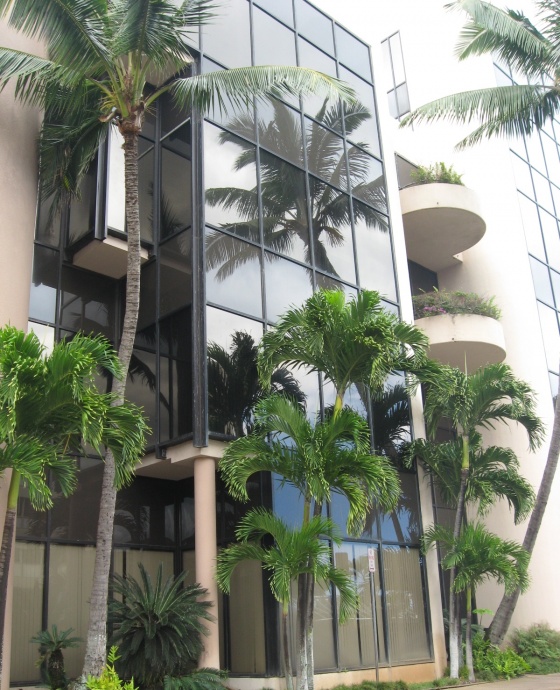
One Main Plaza, a luxury building with high rents is home to many County of Maui offices. Susan Halas photo.
Within the last ten years the county had an opportunity to buy One Main Plaza, but passed it up. Instead it rents many units in the upscale building while the rest of the community is in austerity mode.
This summary doesn’t count the hip-pocket plans of the many landowners, speculator investors, and pipe-dreamers who project that one day Wailuku will be full of trendy little shops, boutiques, eateries, wine bars and ice cream shops. Its streets will be bursting with happy pedestrians bustling about day and night. All of this will happen when Wailuku “revitalizes.”
Business Improvement District Assessments Coming Next
What the busy folks at the MRA are talking about now is a “business improvement district” to be laid over the top of it all. This is a plan to place special assessments on the few businesses that are left in town to pay for the lavish upgrades envisioned by these lofty planners. They think that adding a yet greater financial burden to the private sector will restore Wailuku’s economic vitality.
But the truth is there’s not very much business left and there are not very many who want to move in. Certainly even fewer who want to deal with the close quarters politics involved in the present situation.
Can the Mayor Help?
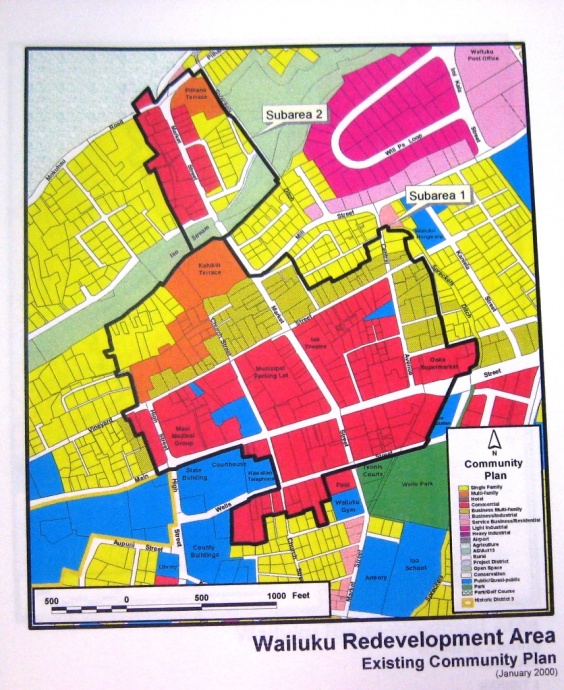
The boundaries of the Wailuku Redevelopment area are marked in black. Susan Halas photo.
The current mayor seems to have a better grasp of reality than some of Maui’s prior leaders.
For example: When the people of Paia asked for more help with parking, he helped. What they got wasn’t glitzy, but it was fast. Almost overnight a 100 car gravel lot opened near the Paia Post Office. It really helps.
When Paia asked that the by-pass be open all the time, not just at peak hours, the change was made right away. It didn’t cost a lot of money, but it helped.
The mayor listened and he acted.
This might be the time for the people in Wailuku to forget the planning districts, boards and associations. It might be the time to ignore all the other players and have a more direct conversation with the mayor.
Wailuku is exhausted. It takes endless time and energy to follow the steam of planners and their plans. It takes even more time and it’s even more difficult to figure out where the money spent on the plans and planners is going and has gone.
Simple Goals
Wailuku has simple goals. It hopes for more tangible outcomes like fixing the sidewalks, adding maintenance to the existing parking lots, keeping an eye on the size and location of the floating vagrant population. It wants more parking. It hopes that someone will do what they did in Paia; use some of the empty nearby lots for parking.
The county built a new little police sub-station on Market Street. People in Wailuku hope some day the police will use it.
These are not big, bold, exciting projects. But they are all things Wailuku hopes will happen soon.
Perhaps the mayor can bring it back to earth. Perhaps there is still a way produce plans that have more contact with reality, and that includes the ability to pay for them.
A little practical leadership right about now would go a long way.
Sponsored Content