MISC: Ramie moth still threatens native plants, but natural predators offer hope
By Serene Gunnison / Maui Invasive Species Committee staff
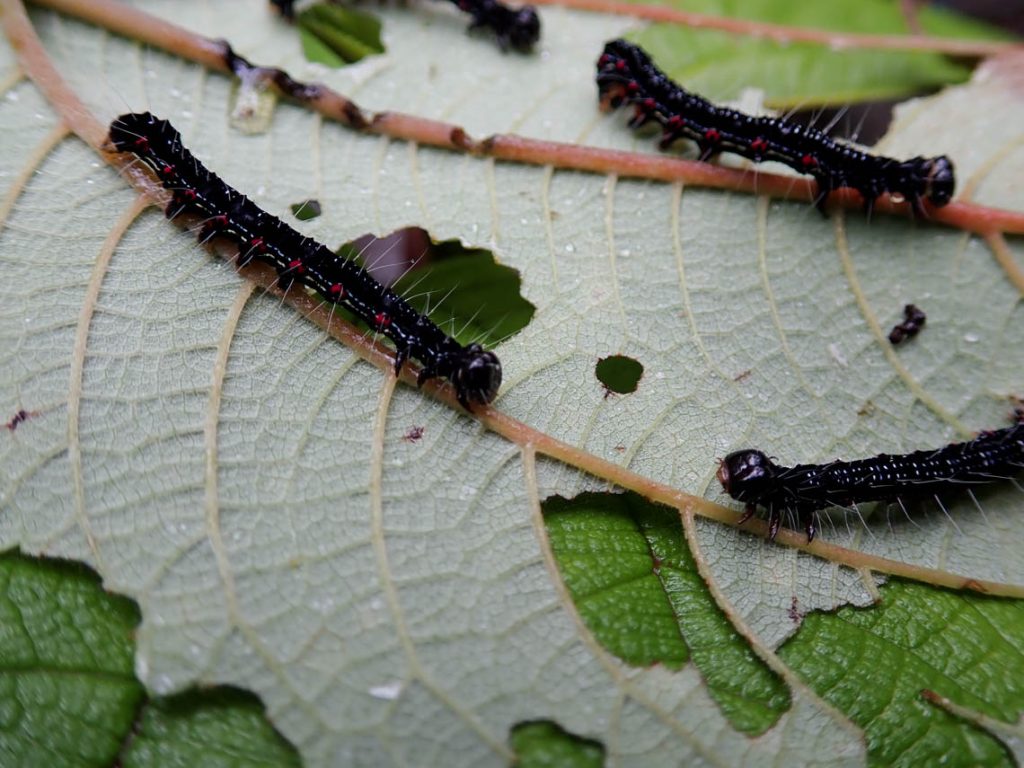
In 2018, an invertebrate biologist discovered an unfamiliar black caterpillar feeding on a māmaki plant in Olowalu Valley. Experts confirmed the caterpillar was ramie moth, a species native to Southeast Asia that aggressively feeds on plants in the nettle family, like māmaki. The biologist’s sighting marked the first confirmation of ramie moth in Hawaiʻi and the US.
Soon, a flood of reports from around Maui indicated that the pest was already too widespread to control. Ramie moth was later detected on Hawaiʻi Island in 2020 and Oʻahu in 2024.
Initially, experts feared that ramie moth could devastate māmaki and other native nettle populations, putting a valuable cultural and environmental resource at risk. However, while the moth remains a threat, new research suggests that natural enemies may be lessening the impact on Maui and the other Hawaiian Islands.
When a new pest arrives to the islands, it takes time to understand how it may interact with the environment. Hawaiʻi’s ecosystems are unlike anywhere else on earth. New pests are suddenly sharing space with species they’ve never encountered before.
Predicting how a new species will behave in the islands takes research, monitoring, and time. Michelle Au, an entomologist with the College of Tropical Agriculture and Human Resilience (CTAHR) at UH Mānoa, has been studying ramie moth since its arrival to Maui with a focus on parasitism and predation rates in Hawaiʻi for the last three years.
“The bulk of my research is just trying to understand what predators and parasitoids are impacting the population, and seeing if it’s the right kind of mortality, these key mortality factors, that will actually control the population,” says Au. Her findings show something encouraging: predators and parasitoids already present in Hawaiʻi seem to be controlling the ramie moth population.
According to Au, birds and parasitoids are the primary natural enemies of ramie moth larvae. Parasitoids affect most life stages of the moth, from egg to third instar larvae.
“Egg parasitism is quite high,” says Au, roughly 50-60% in some areas. “Then there’s larval parasitism. There’s one larval parasitoid we’ve been finding… it’ll lay eggs on the caterpillars which feed and develop, eventually killing the ramie moth caterpillar host.” If the larvae escape parasitoids, they may become a tasty treat for birds.
While Au’s research is hopeful, ramie moth is still spreading, and it’s still a threat to māmaki.
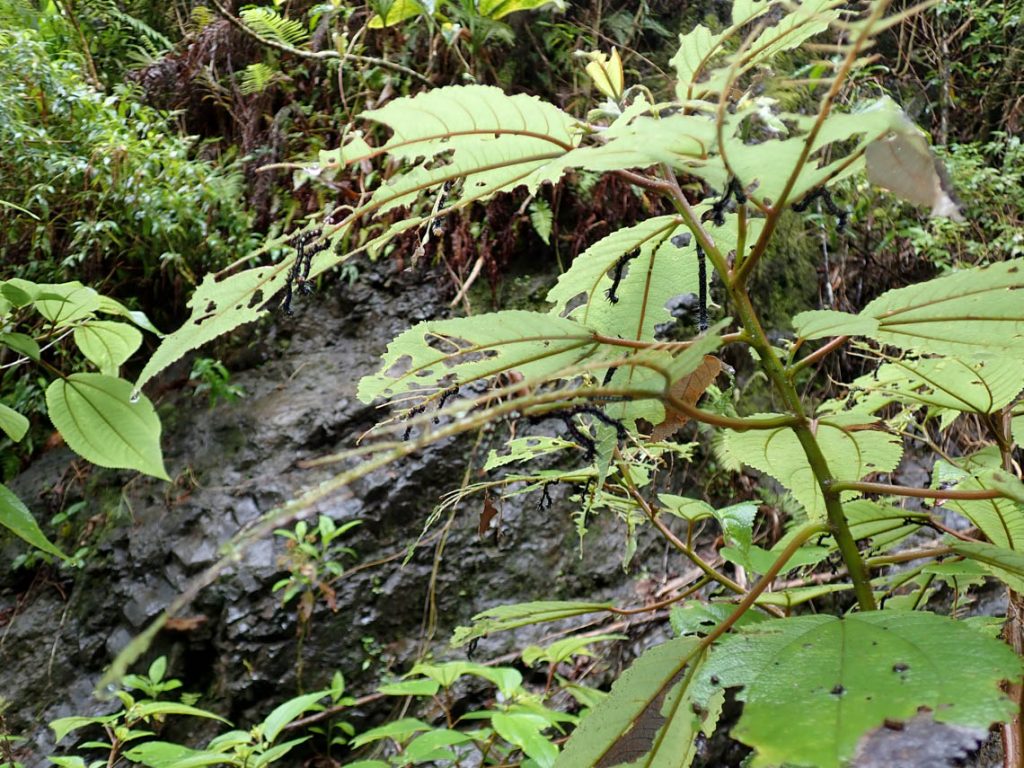
“[Ramie moth] will kill smaller plants, especially if it’s a young tree,” says Au. “If it completely defoliates the leaf, the tree may die.”
Māmaki is a valuable cultural resource, prized for its medicinal and textile uses. It also supports a variety of native insects, including the happy-faced spider and pulelehua (Kamehameha) butterfly.
Māmaki isn’t the only species affected by ramie: the pest also feeds on other native nettle species such as ōpuhe and endangered maʻoloa.
While ramie moth’s impacts aren’t as devastating as originally thought, scientists like Au still face a myriad of challenges in understanding how the pest behaves in Hawaiʻi. “It seems like as [ramie moth] spread, the biology is changing,” says Au, explaining that the moth’s expansion and season on Oʻahu differs from Maui and Hawaiʻi Island. “If it gets to Kauaʻi, it may have a different biology. There’s still a lot we don’t know.”
Ramie moth is just one of the latest pest insects to establish in Hawaiʻi. Its arrival underscores the importance of biosecurity in the islands. About 20 new insects establish in the islands each year. New pests may impact agriculture, recreation, or, like ramie moth, cultural and environmental resources. Some have little impact on the environment, while others become major pests, like coconut rhinoceros beetles and little fire ants. Preventing arrival and interisland spread provides the greatest benefit.
On Maui, Au encourages residents to stay alert and report sightings of ramie moth. Scientists like Au rely on public reports and live specimens for research. However, don’t confuse endemic pulelehua butterfly larvae with ramie moth. View the Hawaiʻi Invasive Species Council’s ramie moth resources or the CTAHR ramie moth extension website for more information and identification tips.
You can also email Michelle Au directly at ipmlab@hawaii.edu. To prevent further spread, avoid moving plant material, especially māmaki, inter-island. If ramie moth is seen anywhere on Maui, report it at 643pest.org or call 643PEST.
Editor’s note: This is part of a monthly series of articles created by the Maui Invasive Species Committee to highlight issues surrounding invasive species in the Maui community.
Sponsored Content