

Lahaina Community Land Trust fights second disaster of gentrification
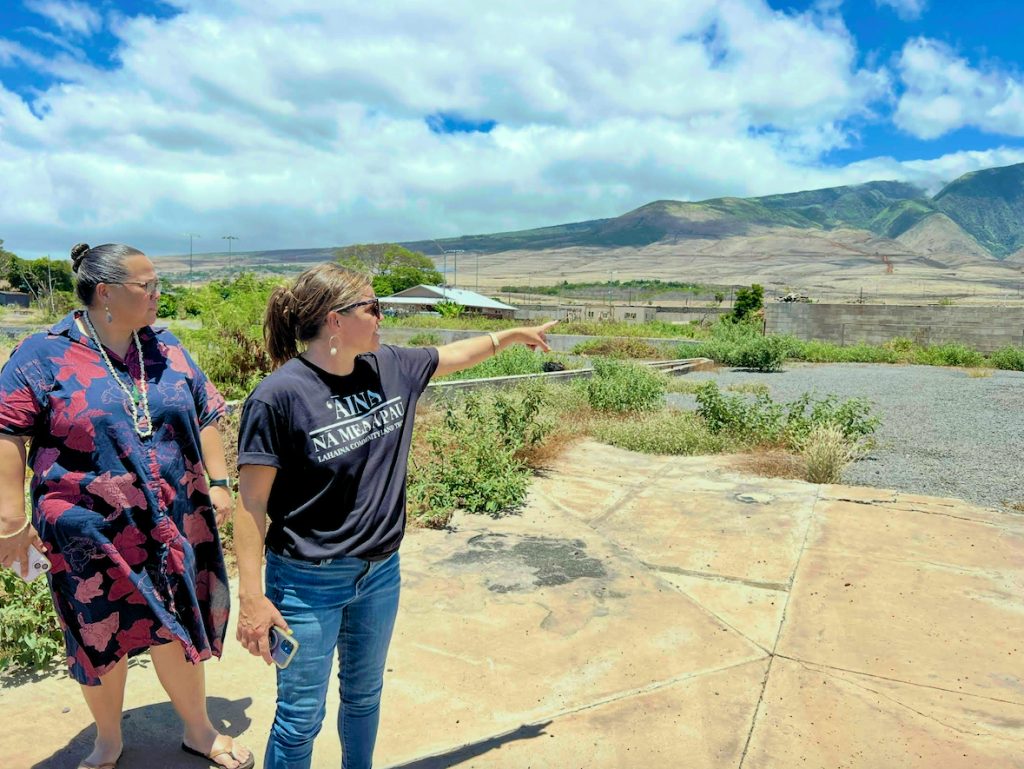
Just two years after the devastating wildfires, the Lahaina Community Land Trust is fighting what it calls a ‘second disaster’: the loss of a local community with deep generational roots to post-fire gentrification. The group announced Thursday it has secured 13 parcels of land, paving the way for up to 34 new housing units to be built and kept in local hands.
“Speculators and investors wasted no time,” said Carolyn Auweloa, the land trust’s director of operations. “Almost immediately after the fire – sometimes even before families could make their way to an emergency shelter – calls and text messages were being received from people offering to buy land.”
“As horrific as the fire was, the next one, the one they call post-disaster gentrification had the potential to be even worse because that’s the one that really threatens to destroy our communities and change our place forever,” she said.
The wildfire killed at least 102 people and destroyed more than 2,000 structures. And, it left in its wake a new, hostile economic environment for longtime Lahaina residents, and they were then “being preyed upon by those very same economic interests,” Auweloa said.
The Lahaina Community Land Trust mobilized behind the West Maui community “in their most vulnerable moment.”
“It was in that place of pain and loss and anger and despair that this community rallied together,” she said. And, the message was clear: “No, not here. Not this time. Not now. This is not going to happen here.”
Auweloa said it’s well-documented that gentrification follows massive disasters, like the “textbook example” of Hurricane Katrina that left 1,392 dead and an estimated $125 billion in damage to New Orleans and surrounding areas in August 2005.
Similar disasters wreaked havoc in areas of Texas and Florida that were struck by storms and floods, she said.
What’s been observed is that pre-disaster communities bear little resemblance to post-disaster communities 10 years later. “There’s not hardly a trace of them anymore,” Auweloa said.
Like a second-wave tsunami, a wave of outside investment sweeps in after a disaster, she said. “We’ve learned that folks that are in the real estate investment world actually see disasters as an opportunity to get in and to get land cheap. And, they do that. These types of real estate investors are usually not living within the community, but they’re outside wealth that comes in and purchases the land with the purpose of investing their wealth and increasing their wealth. It leads to development of second homes, luxury homes.”
A strategy to keep land in community ownership
The Lahaina group’s main strategy is to create a community land trust, a model used across the country to preserve affordable housing for local residents. This trust acquires land through donations, purchases or planned giving. Then, it leases the land to residents for a minimal fee, ensuring the land remains permanently in the community’s hands.
Noelle Bali is the trust’s program manager for Kaluaʻehu, a voluntary contribution program modeled after the Sogorea Te’ Land Trust, which is led by urban indigenous women from the East Bay area of San Francisco.
The program is a “regenerative tourism” initiative in which a fraction of business income in Lahaina is shared with the community, Bali said, and it’s used to keep the Lahaina ʻohana home. The Lahaina Land Trust offers financial expertise and long-term stewardship of protecting local land ownership, she said.
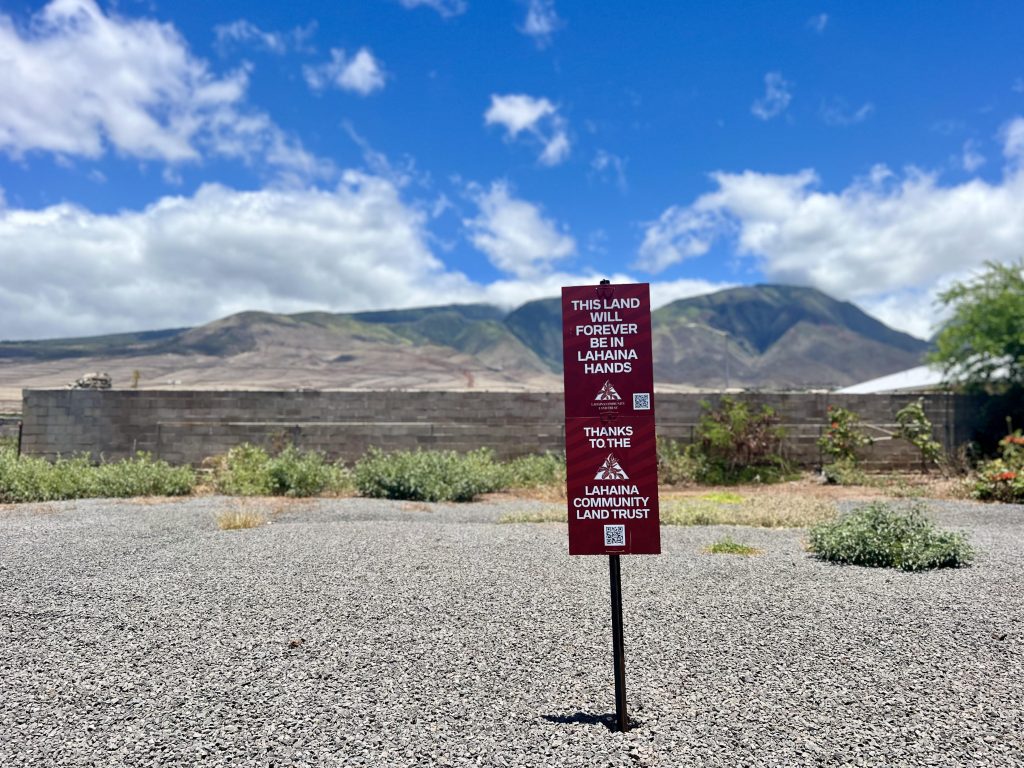
The organization is already making progress. The 13 secured properties were acquired through a variety of methods, including a donation from Maui County and direct sales from families. In three cases, the land trust partnered with families to prevent their land from being lost to foreclosure. The group plans to develop the land to its maximum potential to meet Lahaina’s urgent housing needs.
Funding and financial goals
The Lahaina Land Trust has $24 million for housing, with $11 million coming from Maui County. The county has also set aside $10 million for the organization to acquire lands for managed retreat from rising sea levels and for cultural/open space. There’s also a $3.25 million line of credit from private funders.
The nonprofit’s total goal is to have $200 million available to protect 20% of Lahaina’s housing stock in perpetuity.
Bridging the insurance gap
In a separate but related effort, the land trust also announced the establishment of its “Keep Lahaina Home Insurance Gap Program.” This initiative helps families rebuild their homes when their insurance payouts are insufficient to cover the full cost.
Ten families so far are being assisted by the program funded by a mix of public and private dollars. This includes $3.5 million from Maui County’s Affordable Housing Fund, $1 million in private donations, and a portion of the $6 million in general funds the trust received from Maui County this year.

Resale and residency requirements secure community’s future
To ensure these efforts have a lasting impact, the land trust is implementing specific requirements for all homes in its programs. All properties must remain owner-occupied, with exceptions made for unique situations like kūpuna needing prolonged medical care elsewhere or a family working off-island temporarily.
The resale of these homes is carefully managed to ensure they remain affordable. The future sale price is based on the pre-fire market value (less any grant funding), with a managed appreciation of just 1.5% annually. This prevents speculation and keeps homeownership within reach of working families.
In the event a home is sold or passed on, the land trust has the first opportunity to purchase the property and bring it into its portfolio. If the trust declines, the home is then offered to a pool of qualified buyers. This process prioritizes families displaced by the fires and those with deep ties to Lahaina, including those who are part of the diaspora looking to return. While there isn’t a strict legal residency requirement, the focus is on maintaining the community’s unique generational and cultural connections to the land.
Despite these deed restrictions, the properties, whether in the Keep Lahaina Home program or on Lahaina Community Land Trust land, are renewable and inheritable just like any other property.
A perpetually affordable future
The land trust affirms its determination not to let locally owned land be taken from longtime residents. It’s the nonprofit’s kuleana — responsibility — to protect Lahaina wildfire survivors, their families, their culture and their place.
“At the heart of the Community Land Trust model is the commitment to ensure that our ʻāina and homes are protected for our community members in perpetuity,” the trust said in a statement. “With every single dollar we invest in a home today, we want to ensure that the home will become a permanent community asset — and will be affordable for our children, and our children’s children.”
Whereas typical subsidized housing often only requires homes to remain affordable for five to 10 years before they can be sold at market rates, the land trust’s perpetual affordability model preserves the investment of taxpayers’ funds, ensuring that a one-time subsidy creates a lasting benefit for the community, much like other long-term infrastructure, according to the land trust.
“Our kuleana goes beyond putting people back into homes,” said Mikey Burke, president of land trust’s board of directors and a wildfire survivor. “We’re safeguarding a legacy for our keiki and mo‘opuna – so they can thrive in the same place their kūpuna called home, and where roots run deep.”
The land trust welcomes anyone who wants to support its efforts by learning about partnerships and ways to give at lahainacommunitylandtrust.org.
Sponsored Content