Update: Episode 31 of Kīlauea’s eruption at Halemaʻumaʻu Crater ends after 12 hours
Update:
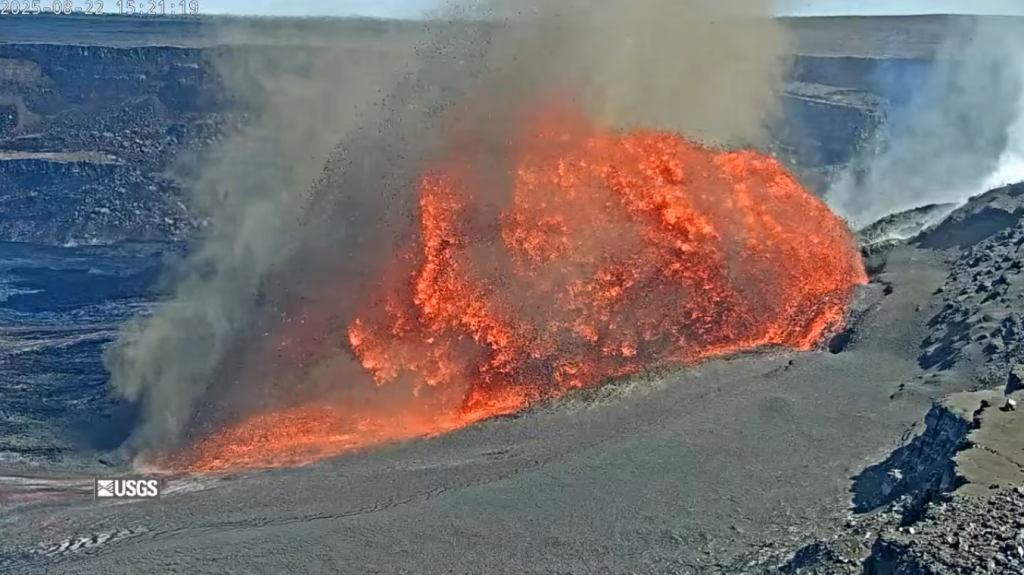
Episode 31 of the ongoing Halemaʻumaʻu eruption ended abruptly at 2:52 a.m. HST on Aug. 23 after 12.6 hours of continuous fountaining, according to the Hawaiian Volcano Observatory.
The north vent stopped erupting at approximately 2:52 a.m. HST marking the end of episode 31. The south and intermediate vents stopped erupting earlier at approximately 12:40 a.m. and 2:46 a.m. HST.
Lava fountains from the north vent reached up to 325 feet and sustained this height during most of this episode. Fountains from the south and intermediate vents remained small, less than 33 feet for most of the time, but the intermediate vent fountains increased to 60-100 ft by the evening of Aug. 22, the HVO reports.
Approximately 10,900,000 cubic yards of lava were erupted at an average of 240 cubic yards per second during the fountaining phase, according to the HVO. Scientists report that lava flows from this episode covered more than 75% of the floor of Halemaʻumaʻu within the southern part of Kaluapele (Kīlauea caldera) and may continue to exhibit slow movement or incandescence as they cool and solidify over the coming days.
Previous Post:
Episode 31 of the ongoing Halemaʻumaʻu eruption at Kīlauea Volcano began Thursday, Aug. 22, 2025, at 2:04 p.m. HST, according to the Hawaiian Volcano Observatory. Lava is currently fountaining from the north vent within Halemaʻumaʻu crater.
Previous episodes have produced lava fountains over 1,000 feet (300 meters) high and eruptive plumes reaching 20,000 feet (6,000 meters) above ground level. Northeasterly winds of 15-20 mph (8 m/s) may carry volcanic gas and material to the south and southwest of the summit.
All eruptive activity remains confined to Halemaʻumaʻu crater inside Hawai‘i Volcanoes National Park. Commercial airports on Hawai‘i Island are not affected by this activity.
Episode 31 was preceded by continuous spatter in the north vent that began at approximately 8:30 a.m. and continued to increase in intensity until 11:45 a.m., when precursory lava overflows began. Fountaining the north vent began at 2:04 p.m., and arcuate fountain approximately 100 feet (30 meters) high is feeding multiple lava streams at 2:15 p.m. HST.
Inflationary tilt reached just over 22 microradians since the end of the last episode. Seismic tremor began increasing and tilt at UWD switched from inflationary to deflationary at about 2 p.m., about the same time lava flows began erupting onto the crater floor.
Most episodes of Halemaʻumaʻu lava fountaining since Dec. 23, 2024, have continued for around a day or less and have been separated by pauses in eruptive activity lasting generally at least several days. A timeline of eruptive episodes since Dec. 23, 2024, can be found here.
Three Kīlauea summit livestream videos that show eruptive lava fountains are available here: V1cam, V2cam, V3cam. KPcam and MKcam provide views of the plume height for aviation purposes.
Hazard Analysis
This episodic eruption is occurring within a closed area of Hawai’i Volcanoes National Park. High levels of volcanic gas—primarily water vapor (H2O), carbon dioxide (CO2) and sulfur dioxide (SO2)—are one hazard of concern, as this hazard can have far-reaching effects downwind.
As SO2 is continuously released from the summit during an eruption, it will react in the atmosphere to create the visible haze known as vog (volcanic smog) downwind of Kīlauea. SO2 and vog may cause respiratory and other problems at high concentrations. Further information on vog can be found at https://vog.ivhhn.org/
Pele’s hair, ash, pumice and other volcanic glass may fall within 1–2 miles (1–3 km) of the vent. Lighter particles can travel farther depending on wind.
The public is reminded to stay out of the closed crater area due to hazards including high volcanic gas concentrations, Pele’s hair, rockfalls and unstable terrain.
Kīlauea remains at Volcano Alert Level: WATCH and Aviation Color Code: ORANGE.
No changes have been detected in the East Rift Zone or Southwest Rift Zone.
HVO continues to closely monitor Kīlauea. Regularly scheduled daily updates are posted on the HVO website at https://www.usgs.gov/volcanoes/kilauea/volcano-updates.
Sponsored Content