



 Hawai'i Journalism Initiative
Owners mulling legal action if Maui County’s short-term rental bill passes. Could it stand up in court?
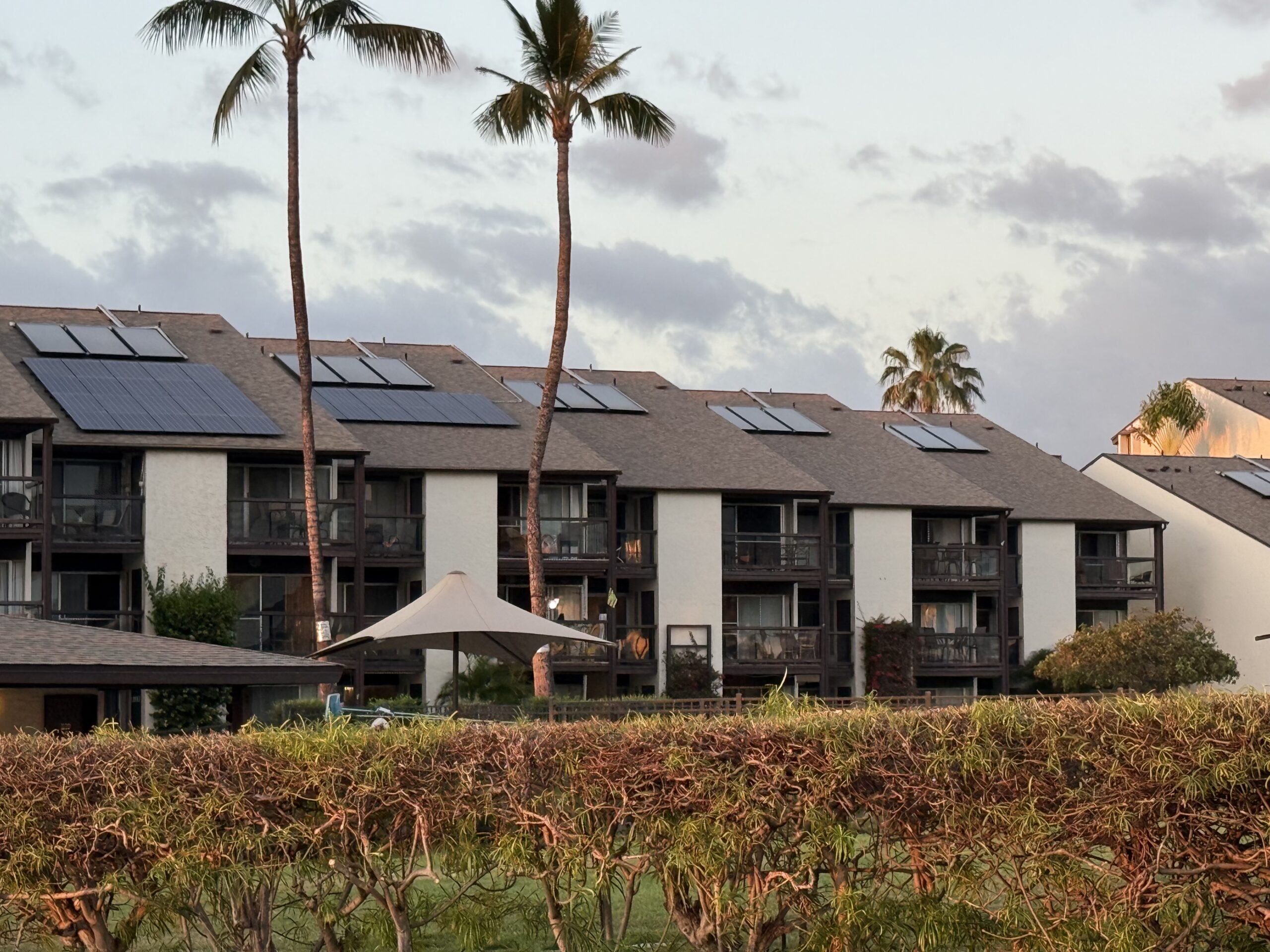
At about 70 condo complexes where short-term rentals could become illegal under a proposed bill before the Maui County Council, property owners have been watching, waiting and talking with their lawyers.
“We’re waiting to see if it does pass, and if it does, along with our attorney, we’ll take a look at it,” said Cindy Bulger, president of the board at the 188-unit Hale Kamaole in Kīhei. “I can’t say that we’ve made any final decision. I think we really want to review our options before we make a decision on that.”
HJI Weekly Newsletter
Get more stories like these delivered straight to your inbox. Sign up for the Hawai‘i Journalism Initiative's weekly newsletter:
At the 296-unit Wailea Ekahi, also in South Maui, Board President Lynn Peabody expects the impacts of the bill to lead to legal challenges.
“Speaking only on behalf of Wailea Ekahi owners, we will certainly evaluate the potential impacts of Bill 9 and explore our courses of action, legal and otherwise,” Peabody said.
They’re among the condo owners and condo associations weighing their options should the county pass a bill to phase out more than 7,000 short-term rentals in apartment districts, which was proposed by Mayor Richard Bissen in May 2024 and recommended by a Maui County Council committee in a 6-3 vote in July after days of impassioned testimony both for and against it.
If Bill 9 passes the full council, it will be one of the state’s biggest short-term rental overhauls since 2022, when Honolulu County’s attempt to regulate short-term rentals was blocked by a court ruling. That ruling prompted state lawmakers to pass a bill in 2024 to make clear the counties’ power over short-term rental operations.
Maui County attorneys believe Bill 9 can hold up in court, but they’ve been careful not to reveal their strategies should they wind up in a legal battle.
“Our office has thoroughly reviewed Bill 9 and is confident that it complies with state law, the federal and state constitutions, and is squarely within Council’s authority,” the Department of Corporation Counsel said in a statement to the Hawai‘i Journalism Initiative last month.
Spurred by the loss of thousands of homes and apartments following the 2023 wildfires, Maui County became the latest major destination trying to boost its long-term housing supply by cutting down on the short-term rental market. Despite a year of uncertainty over Bill 9, Maui County continues to have the largest short-term rental supply of all four counties both in terms of available nights as well as inventory, with an estimated 10,666 units, making up about 14.8% of its total housing stock, according to the 2025 Hawai‘i Housing Factbook.
In other places with abundant vacation rentals such as San Francisco, New York City and Barcelona, different versions of restrictions or bans have been tried, often with legal backlash.
In April 2022, the Honolulu City Council passed a bill that raised the required minimum stay for short-term rentals from 30 days to 90 days in most residential zones, with the change set to take effect in six months. That sparked a lawsuit from the Hawai‘i Legal Short-Term Rental Alliance, which claimed the bill wasn’t constitutional and would take away their property rights.
A federal judge blocked the ordinance before it could be enforced in October 2022. The judge said state law prevented the city from passing laws that prohibited properties from continuing lawful uses.
Last year, state lawmakers passed a bill that clarified the counties’ authority to control the time, place, manner and duration of land uses, particularly short-term rentals. The day before Gov. Josh Green signed it into law, Bissen announced Maui County’s proposal to phase out vacation rentals in apartment districts.
Supporters of the bill say it will free up thousands of potential long-term rentals on an island where many people are still displaced by the 2023 wildfires. Opponents say it will deal a major blow to Maui’s tourism-reliant economy and result in job loss.
A University of Hawai‘i Economic Research Organization report reflected both points of view, finding that the policy could add more than 6,000 units to the long-term housing stock but cut property and business tax revenues by a combined $75 million each year.

Cal Chipchase, partner at the Honolulu-based law firm Cades Schutte and chair of the Real Estate Disputes Group, said the takeaway from Honolulu’s case was the counties’ need for clear authorization to change or phase out existing property uses.
“I think that the (State) Legislature and the counties took that lesson to heart,” said Chipchase, a litigator who has taught courses on real property and land use at the University of Hawai‘i William S. Richardson School of Law for nearly 20 years.
Even with the changes, Chipchase acknowledged “there’s legal risk associated with any measure that a council passes, particularly when you’re phasing out uses that have been historically on the books for many, many years.”
If the bill passes, he said he expects lawsuits to follow.
Greg Kugle of the law firm Damon Key Leong Kupchak Hastert was certain of the risk, saying in a statement to the Hawaiʻi Journalism Initiative: “The County of Maui will be sued if it passes the unconstitutional Bill 9.”
“The U.S. and Hawaii constitutions prevent counties from taking private property without just compensation,” said Kugle, who represented the Hawaiʻi Legal Short-Term Rental Alliance against the City and County of Honolulu. “Bill 9 has no mechanism for payment of just compensation to landowners making it constitutionally suspect.”
At Wailea Ekahi, Peabody says the goal of providing more housing for Maui residents is “commendable,” but she worries there is not a clear solution for the impacts on owners and Maui’s financial structure.
“Stepping back from the bill and spending time better considering how to deal with the ramifications of its passage would serve Maui well, and in all likelihood, help minimize the related legal challenges,” Peabody said.
Condos in apartment districts on Maui have had the right to operate short-term rentals for decades under a series of legal protections and a key legal opinion in 2001 by Deputy Corporation Counsel Richard Minatoya. This opinion primarily grandfathered in short-term rentals in Maui’s apartment zones that had been operating as vacation rentals before March of 1991, becoming known as the Minatoya List.
The bill exclusively applies to condos on this list.
The Maui Vacation Rental Association said in testimony to the council’s Housing and Land Use Committee in July that removing short-term rentals in apartment districts “would create a significant legal risk and undermine the integrity of the County’s own historical land use decisions.”
Caitlin Miller, executive director of the association, told the Hawai‘i Journalism Initiative via email: “As an advocacy organization, we can’t speak to the legality of Bill 9, but we do expect it will face legal challenges if passed.”
“Ultimately, the courts will have to weigh long-standing property rights and codified uses against the County’s authority. Maui is also operating under a different framework than Honolulu was in 2022, but it will be up to the courts to decide,” Miller said.
County attorneys and council officials have been careful about what they say publicly about the bill.
David Raatz, director of the Office of Council Services, said most of the discussions over the legality of the bill happened at two executive sessions during the council committee meetings in July.
“We’re not at liberty to disclose what is discussed in executive sessions,” said Raatz, who served as a county legislative attorney for nearly two decades.
Kristin Tarnstrom is among the county attorneys that has spent the last year reviewing the bill and poring over related laws and legal precedents.
“Our consensus is that it is legally sound, defensible, and within the rights of the County Council to do it,” said Tarnstrom, who has 11 years of experience with the Department of Corporation Counsel, including 10 on the litigation side.
Because the county “can’t anticipate exactly what the lawsuits will look like,” the best way it can prepare is to ensure that it’s as “legally sound as possible,” she said.
She declined to comment on the reasons she believed it was defensible, because “it just gets sticky from a litigation standpoint for us to talk about any strategy.”
Wailuku attorney Lance Collins said he thinks the bill is constitutional. He explained that private property owners are protected by the Fifth Amendment, which requires the federal government to pay compensation if it takes private property for a public use.
That can either mean an actual physical “taking” or regulations that limit how the property can be used and denies the owner “all economically beneficial or productive use of the land,” Collins said in a June 30 analysis done at the request of the Maui Tomorrow Foundation.
Courts use a three-part test to decide if the government is taking something from a property owner based on a 1978 case in New York City, Collins explained. The Penn Central Transportation Company, which owned Grand Central Terminal, wanted to build a multistory office building above the train station, but because the terminal was a historical landmark, the city rejected the proposal. Penn Central sued, alleging the city took away its rights above the terminal without compensating the company. The Supreme Court ruled in favor of the city.
In cases like these, Collins said, three main factors come into play: the economic impact on the property owner, the extent to which the regulation interfered with the owner’s expectations at the time it invested in the property, and the character of the government action, Collins said.
If short-term rental owners sue Maui County, Collins thinks they may argue that Bill 9 would result in economic loss and impact the expectations they had when they bought the unit. And while he acknowledged that converting short-term rentals to long-term rentals could make it less profitable, it wouldn’t take away all of the economic benefit to owners.
“One of the costs of business … is that regulation changes,” Collins told the Hawai‘i Journalism Initiative. “You don’t have a legitimate claim of entitlement to run your business the way you want to forever without any changes.”
Giving people a few years to get a return on their investment and minimize their losses “significantly strengthens” the county’s position, Collins said.
Collins pointed out that government has the right to change its regulations, especially if they can show it’s for public benefit.
“If somebody’s investment could basically stop the government from regulating … that would grind government to a halt,” Collins said.
Matt Jachowski, executive assistant to Mayor Bissen, said that the median owner of a Bill 9 short-term rental bought their property in August 2016. At the time, the median price of a condo was $420,000, according to Realtors Association of Maui data. Even if Bill 9 passes and they’re no longer allowed to operate, they’ve still had years to get a return on their investment and will have an adjustment period as well, he said.
As of June, vacation rentals in Maui County were going for an average daily rate of $464 in June, tied for the highest among the state’s counties, according to state tourism data.
“Any investment comes with risk, right? And in particular when you’re looking at short-term rentals, a major form of risk is regulatory risk … and that’s not unique to Maui County,” Jachowski said.
Chipchase said the adjustment period is likely something the courts would look at if there were lawsuits.
He said it was “smart” of the council to extend the bill’s original timeframe, which at the time it was announced in May 2024 set a deadline of July 2025 for West Maui properties and Jan. 1, 2026 for all other areas. In his experience on land use cases, Chipchase said, “I always looked at five years, if done correctly, as being a reasonable period.” Anything less could be risky, he added.
Under the current version of the bill, properties in West Maui, where the housing crisis is seen as even more dire after the fires, would have three years, until Dec. 31, 2028 to adjust, while properties in all other areas would have five years, until Dec. 31, 2030.
Chipchase said he thinks it’s possible to defend a bill like Maui County’s with the phaseout of uses over a period of time.
“But I think there’s risk and I think it’s very important that it be done correctly in terms of the time allowed and in terms of the justification for the phaseout as well as its scope,” he said.
Chipchase emphasized that he was commenting solely on the legal merits of the bill and not on the pros or cons of the policy. He declined to comment on whether he was representing any clients with interest in the bill, saying that “whatever final decision the county makes on the bill, I have many clients who will be affected by it.”
The bill was originally set for a first reading with the full council next month but Raatz said Friday that the schedule is now in flux and there was no hard date set yet.