FAA study: Kahului Airport relatively low-risk for runway safety; more incidents reported at Honolulu

A new study on runway safety at US airports shows that Kahului Airport had no high-risk runway incursions between 2021 and 2024. All 11 of the airport’s recorded runway incursions during that four-year period were classified as lower-risk events.
According to data available from the Federal Aviation Administration for the Kahului Airport runway incursions: Three in 2021 involved ground vehicles and pedestrians. Two in 2022 were operational incidents one with air traffic control and one “pilot deviation.” One in 2023 was classified as a “pilot deviation.” Four in 2024 were operational incidents (2) and vehicle or pedestrian incursions (2).
An official with the Hawaiʻi Department of Transportation said it was studying the incursion data, but did not have an immediate comment.
Mike LaFirenza, chief executive of Lattice Publishing, which provides research-driven news content, said that Kahului Airport is classified as a “medium hub,” meaning that it serves a substantial mix of commercial and general aviation traffic.
“But isn’t as busy as Honolulu,” he said. “Its layout is simpler than some major airports, but that can actually create its own challenges when it comes to runway incursions. Pilots may be less familiar with the environment if they fly in less often, and the mix of commercial jets and smaller general aviation aircraft can complicate runway operations. Even at lower volumes, the variety of traffic types and pilot experience levels can increase the chance of incursions.”
The FAA runs the control tower, and Hawaii Department of Transportation oversees the airport itself, LaFirenza said. “They work together on safety procedures and operations, but the details of that coordination are something they would need to address.”
The report on runway incursions nationwide was conducted by the company Upgraded Points using data from the Federal Aviation Administration’s Aviation Safety Information Analysis and Sharing System. The analysis studied runway incursions at more than 400 US airports. Runway incursions occur when an aircraft, vehicle or person enters a runway without clearance.
According to the FAA, these incidents are categorized by severity. Category A incursions are serious incidents where a collision was narrowly avoided, while Category B incursions have significant collision potential. All 11 of the incidents at Kahului Airport were categorized as C, D, or E, which are lower-risk categories with more time or distance to avoid a collision.
Here is a summary of the data for Kahului Airport (designated as OGG):
- Total runway incursions: 11
- High-risk runway incursions (A & B): 0
- Lower-risk runway incursions (C, D & E): 11
- Total runway incursions per 1M flights: 20.3
- High-risk runway incursions per 1M flights: 0.0
- Total operations: 542,919
- Airport type: Medium
For comparison, the Daniel K. Inouye International Airport had 71 total runway incursions during the same period, including one high-risk incursion. Classified as a large airport, the Honolulu air hub ranked fourth in the nation on the FAA’s runway incursions list for large airports, tying Dallas/Fort Worth’s total number of runway incursions. Honolulu had 1,251,679 total operations, compared with Maui’s 542,919 operations.
Also on the large airport list, two Chicago-area airports — Midway and O’Hare — were ranked No. 1 and 3 with 89 and 83 total incursions, respectively, with two high-risk incursions at Midway. Logan International Airport in Boston was third on the list with 83 incursions, but no high-risk incidents. Los Angeles International Airport was sixth, with 68 incidents, none high-risk. For more details, click here.
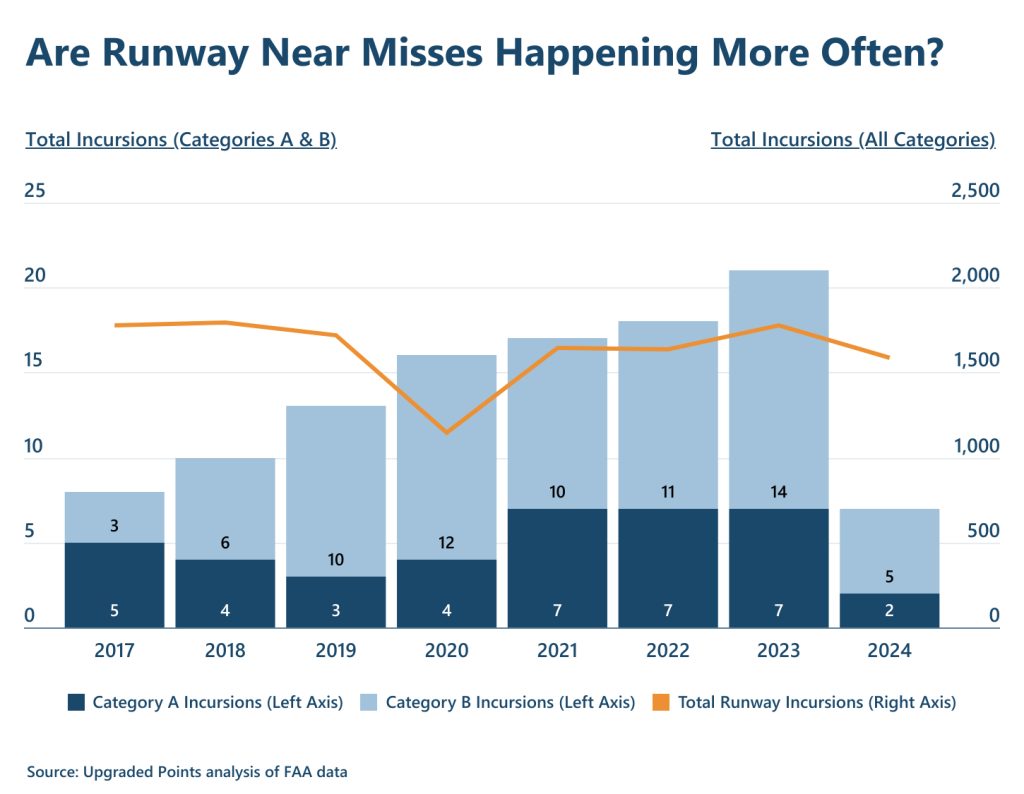
The study found that while the total number of runway incursions has remained relatively stable in recent years, the number of high-risk incidents (Category A and B) rose between 2017 and 2023. In 2017, there were eight high-risk incursions nationally, and that number nearly tripled to 21 by 2023, the highest annual total in over a decade.
This increase prompted the FAA to issue a “Safety Call to Action” in 2023. Preliminary data from 2024 suggests these efforts may be having a positive effect. The number of high-risk incursions dropped sharply to seven, the lowest total since 2010.
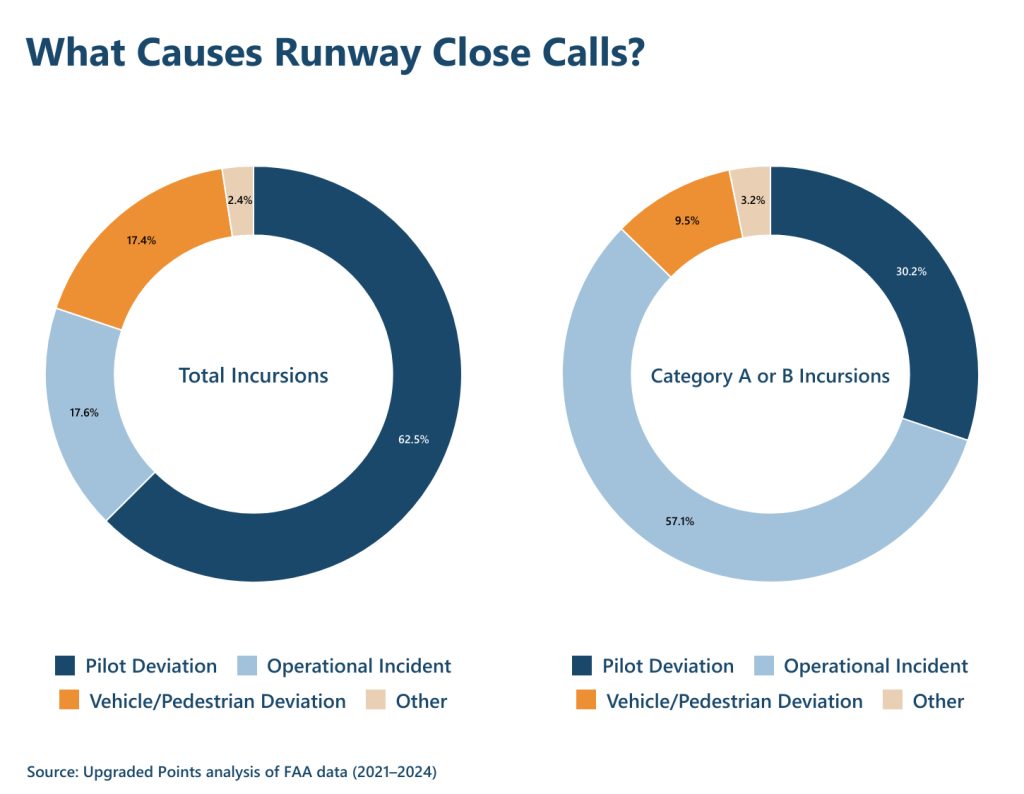
According to the data, pilot deviation is the most common cause of all runway incursions, accounting for 63% of incidents nationwide. These typically involve pilots failing to follow air traffic control instructions, misinterpreting taxiway signage, or mistakenly entering an active runway.
Other contributing factors include operational incidents — errors made by air traffic controllers — which represent 18% of all cases, and vehicle or pedestrian deviations, which occur when ground vehicles or personnel mistakenly enter a runway area, accounting for 17% of cases.
The study showed that runway incursions are not confined to a single region or airport type. The top five airports with the most total runway incursions from 2021 to 2024 at all airports nationwide included both major commercial hubs and smaller, noncommercial airports. Dekalb–Peachtree Airport in Atlanta topped the all-airports list with 103 incursions. It was followed by Chicago Midway International Airport with 89 incursions and North Las Vegas Airport with 88. Boston Logan International Airport and Chicago O’Hare International Airport each had 83.
Conversely, several high-volume commercial airports had very low incursion totals. Seattle-Tacoma International Airport, Orlando International Airport and LaGuardia Airport all had fewer than 20 incursions and no high-risk incidents during the period.
When focusing specifically on high-risk incidents, just eight US airports accounted for nearly a third of the 62 high-risk incursions that occurred nationally between 2021 and 2024. All four airports that experienced the maximum of three high-risk incursions were located in California: Montgomery Gibbs Executive Airport, San Francisco International Airport, Long Beach Airport and San Diego International Airport.
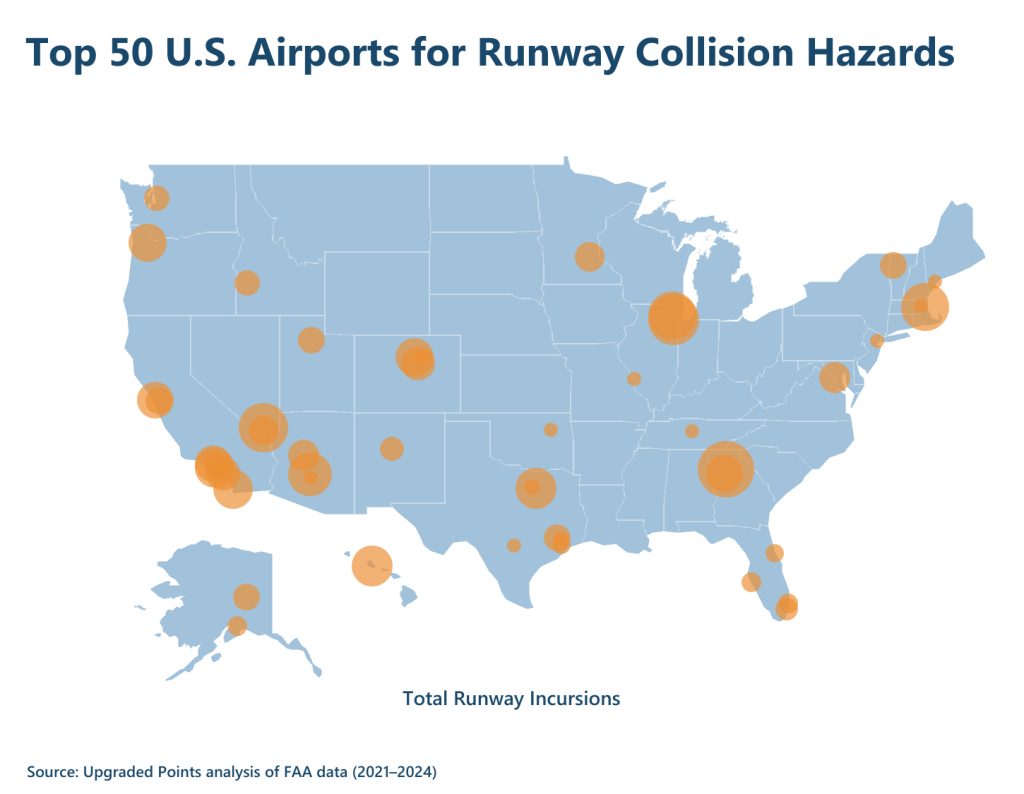
To determine which US airports experienced the most runway incursions, Upgraded Points analyzed data covering a four-year period from 2021 through 2024, the most recent years with complete records available. Airports were ranked based on their total number of runway incursions during this timeframe. In the event of ties, higher priority was first given to airports with a greater number of Category A or B incursions, reflecting more serious safety risks, and then to airports with a higher rate of incursions per 1 million flight operations.
The FAA emphasized that domestic air travel remains one of the safest forms of transportation. However, the US aviation system has come under renewed scrutiny in recent years because of a number of incidents. One of those was in January when a mid-air collision occurred over the Potomac River, killing 67 people, the first fatal crash involving a major US commercial passenger flight in more than a decade.
Also, a series of communication and radar outages earlier this year disrupted operations at multiple air traffic control towers, highlighting mounting strain on the national airspace system. And ongoing staffing shortages among air traffic controllers have been the cause of delays at major commercial hubs.
Sponsored Content