



 Hawai'i Journalism Initiative
Lahaina businesses took a ‘backseat’ in fire recovery. Now the focus is turning to rebuilding Front Street
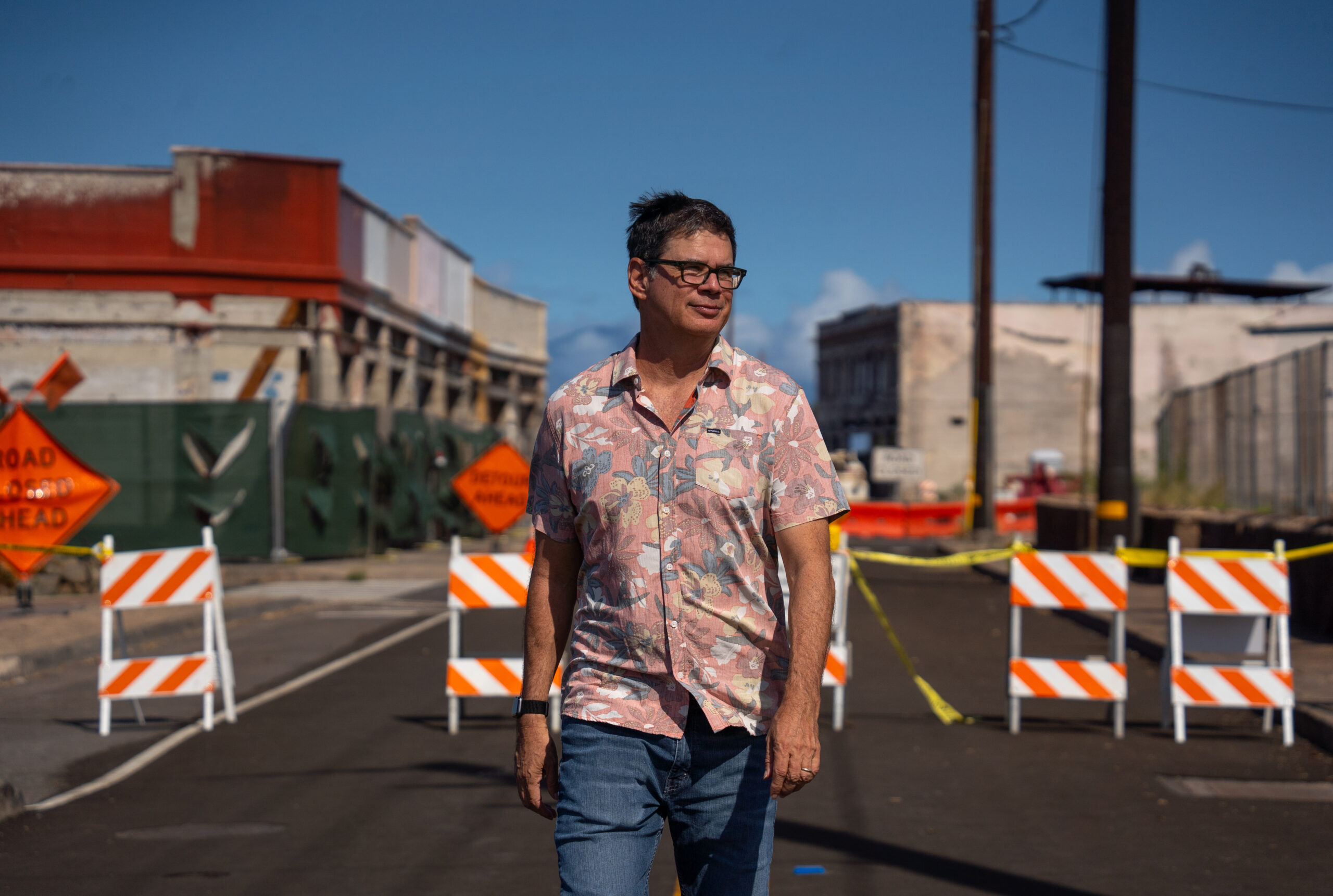
LAHAINA — When Warren Freeland thinks of the summers he spent as a kid on Lahaina’s Front Street in the 1970s, his “most fond memory” is eating pancakes with coconut syrup at the historic Pioneer Inn built by his great-grandfather in 1901.
Freeland hopes one day to again serve up the same food and hospitality he enjoyed so much growing up. But first, he and his family must rebuild the inn that burned to the ground, along with most of the historic town, in the Aug. 8, 2023 wildfire.
HJI Weekly Newsletter
Get more stories like these delivered straight to your inbox. Sign up for the Hawai‘i Journalism Initiative's weekly newsletter:
For most of the first two years since the fire, the county’s and community’s priority has been on rebuilding people’s homes. “We made that no secret,” Maui County Mayor Richard Bissen said.
Now, with 64 homes rebuilt in Lahaina and 290 undergoing construction, the focus is shifting to rebuilding Lahaina’s commercial district. Last week, Maui County released design options that include keeping the once-bustling Front Street as a two-lane road and purchasing makai properties to develop a more connected waterfront. The designs are open for public comment through Friday.
While commercial property owners are grateful the process is moving forward, they say rebuilding now needs to go faster.
“Time is our enemy, and it’s already too long, frankly,” said Kent Untermann, owner of CocoNene, part-owner of Tabora Gallery and part-owner of 736 Front Street.
The push to rebuild Lahaina’s businesses comes at a time when University of Hawai‘i economists warn the state is heading into a mild recession driven by falling tourism, stagnant job growth, federal tariffs and a weak housing market.
Bissen said “we absolutely need our businesses” as Lahaina recovers, but he added that the county is facing the challenge of rebuilding a town that developed over decades.
“We’re moving as fast as we can,” the mayor said.
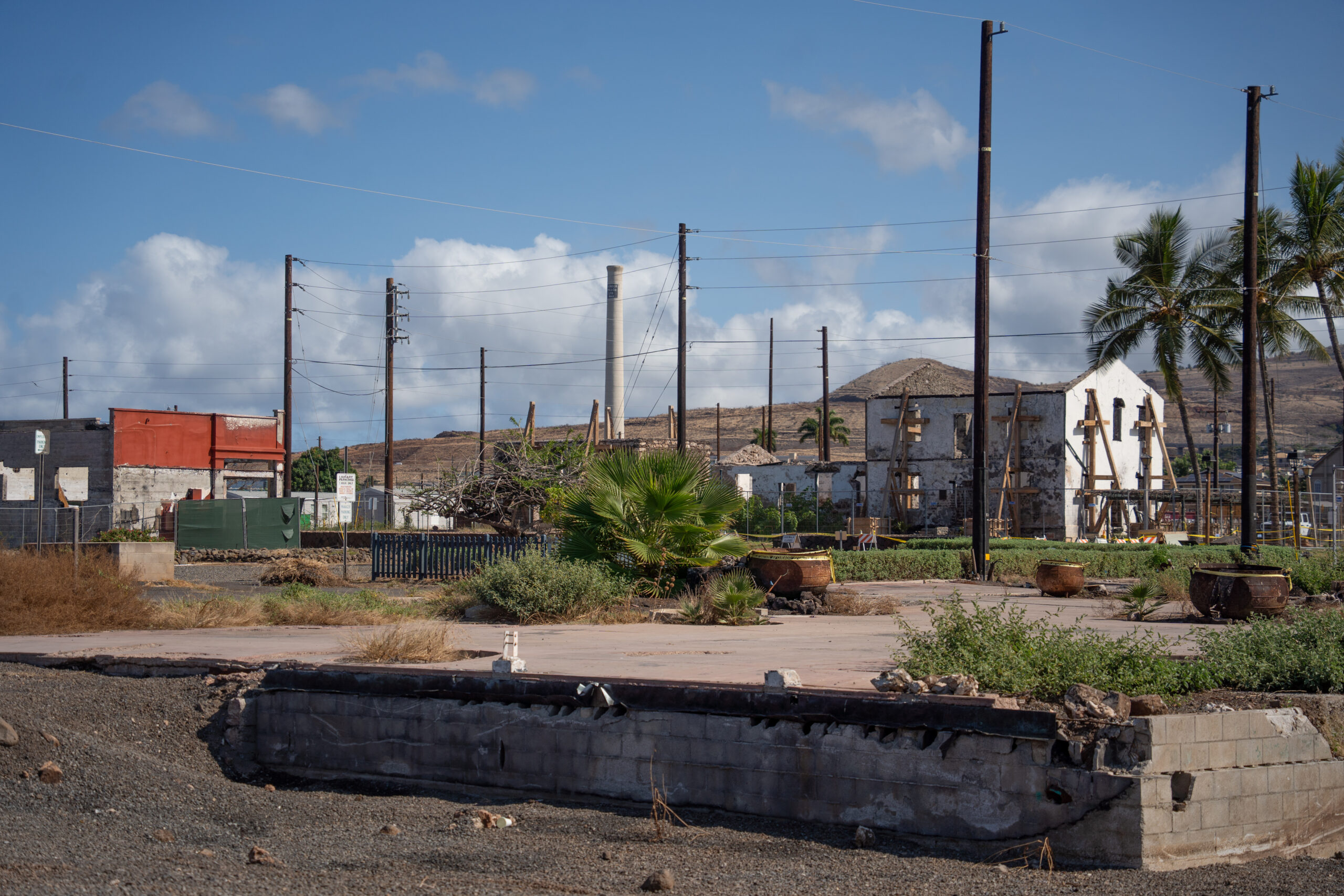
FRONT STREET FOR MORE FOLKS
Before the fire, businesses in Lahaina generated more than $70 million in monthly revenue from visitor accommodations, food services, retail sales and other categories, and they employed about 8,500 people, according to the University of Hawai‘i Economic Research Organization.
Lahaina made up 13.5% of the employment in Maui County and 1.5% of employment in the state prior to the fires, state chief economist Seth Colby told the Hawai‘i Journalism Initiative.
“It is very important to support the recovery of businesses in the wake of the Lahaina wildfires,” Colby said. “Not only do local companies provide employment opportunities and earnings, they contribute to the social fabric of the community. There are big returns to getting businesses up and running quickly. The longer stores and offices remain dormant, the less likely they are to come back.”
In Lahaina, Front Street was especially good for business. Locals and visitors crowded the walkable seaside street to browse the colorful storefronts, stop for dinner or gather for events like 4th of July fireworks and Halloween costume contests.
But Front Street struggled with overcrowding, narrow sidewalks and limited ocean access. Now, there’s a chance to redesign the area with elements people loved but with more accessible features, Deputy Managing Director Erin Wade said.
She said the county is focusing on makai areas of the district then working its way mauka.
“The priority has been in ensuring we have some certainty with Front Street and then that’ll have a ripple effect as we move beyond that,” Wade said.
While the designs aren’t final yet, one key decision the county has made is keeping Front Street as two lanes open to both vehicle and pedestrian traffic. Wade said that while some people liked the idea of turning Front Street into a pedestrian-only roadway, there’s still a need for delivery trucks and emergency vehicles to pass through.
 A proposed design for Front Street with a straight alignment is shown. Graphic courtesy: Maui County
- Proposed angled and curving designs for Front Street are shown. Graphic courtesy: Maui County
- A design option for the 800 block of Front Street is shown. Graphic courtesy: Maui County
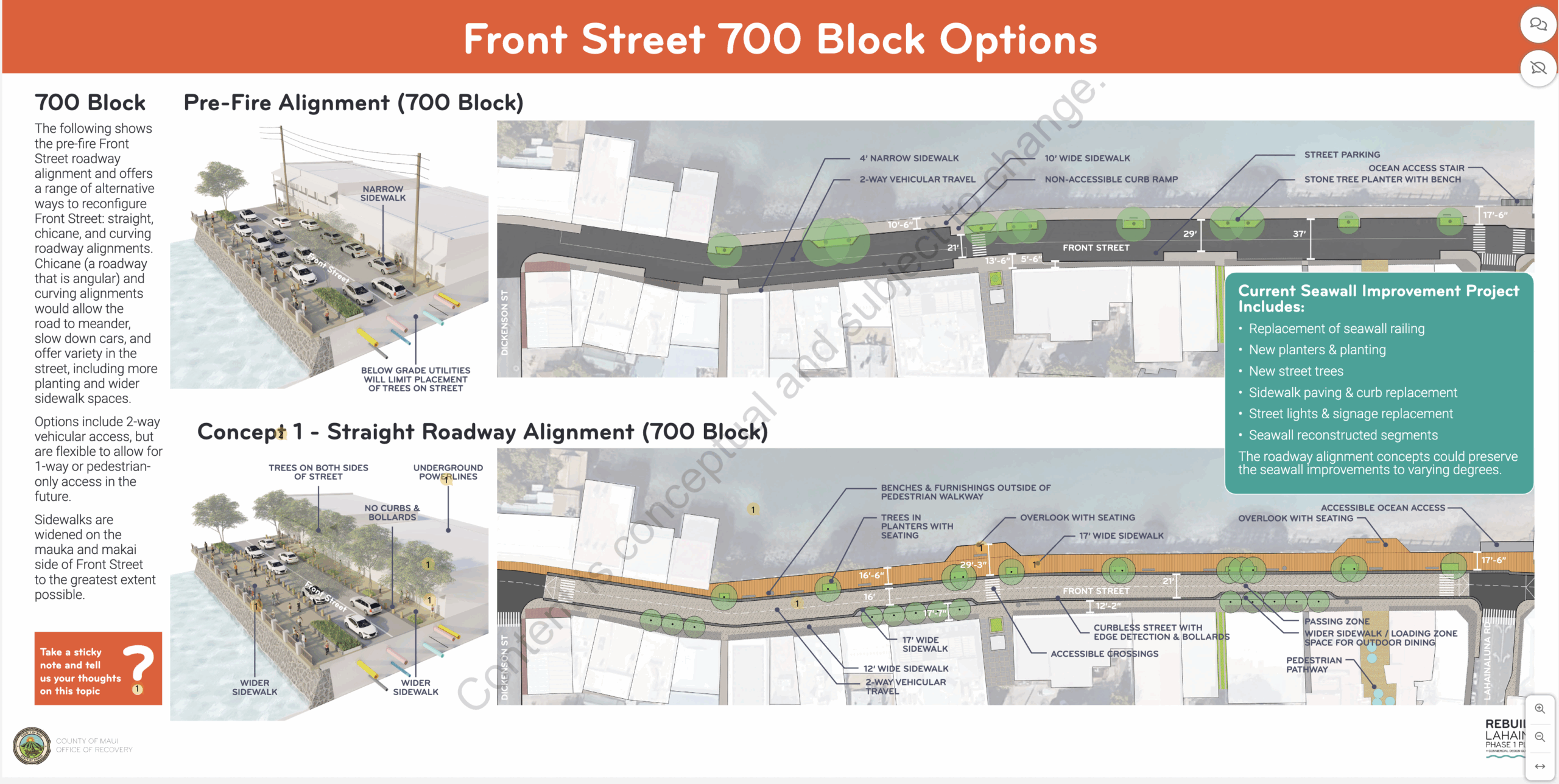
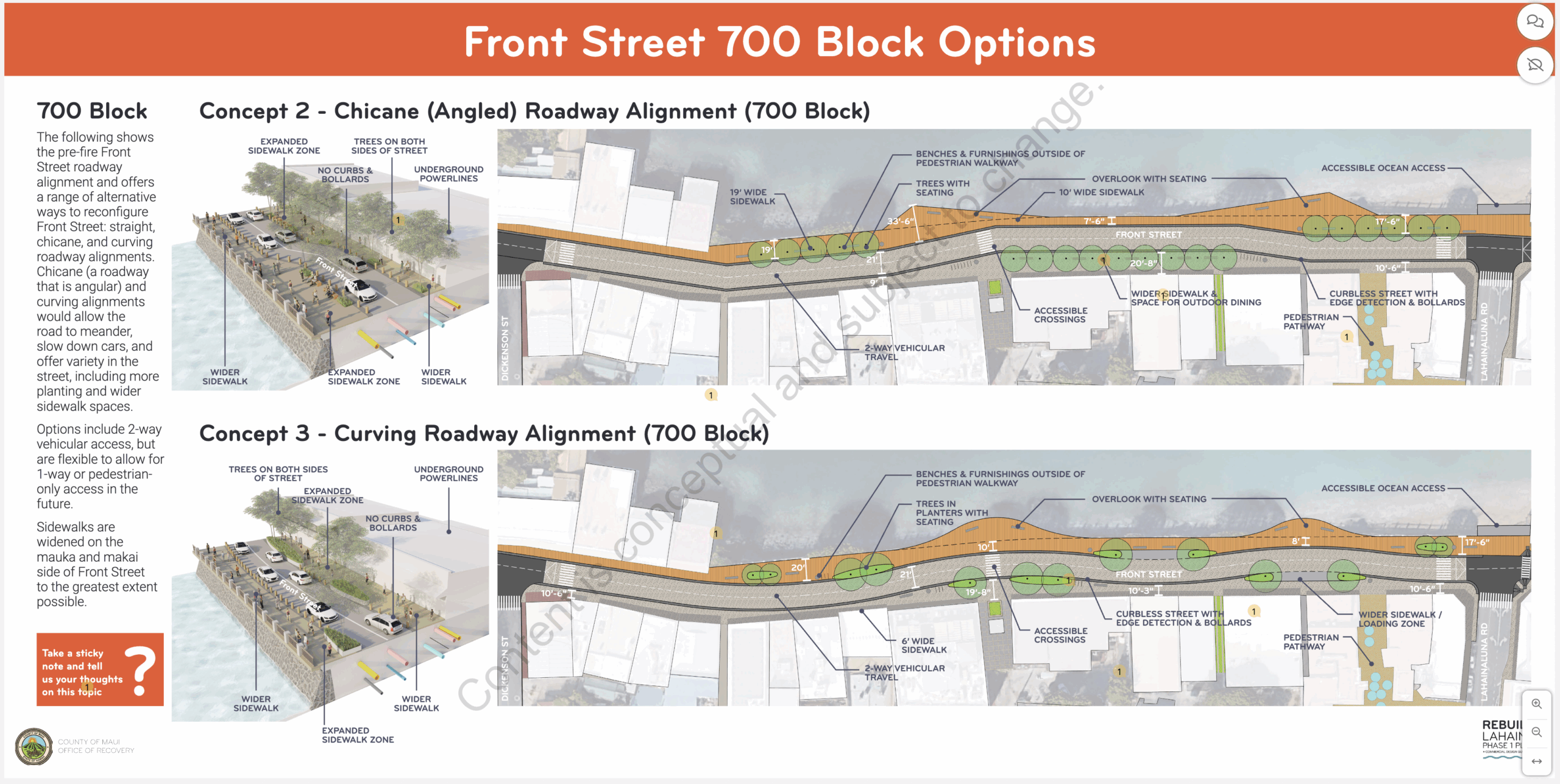
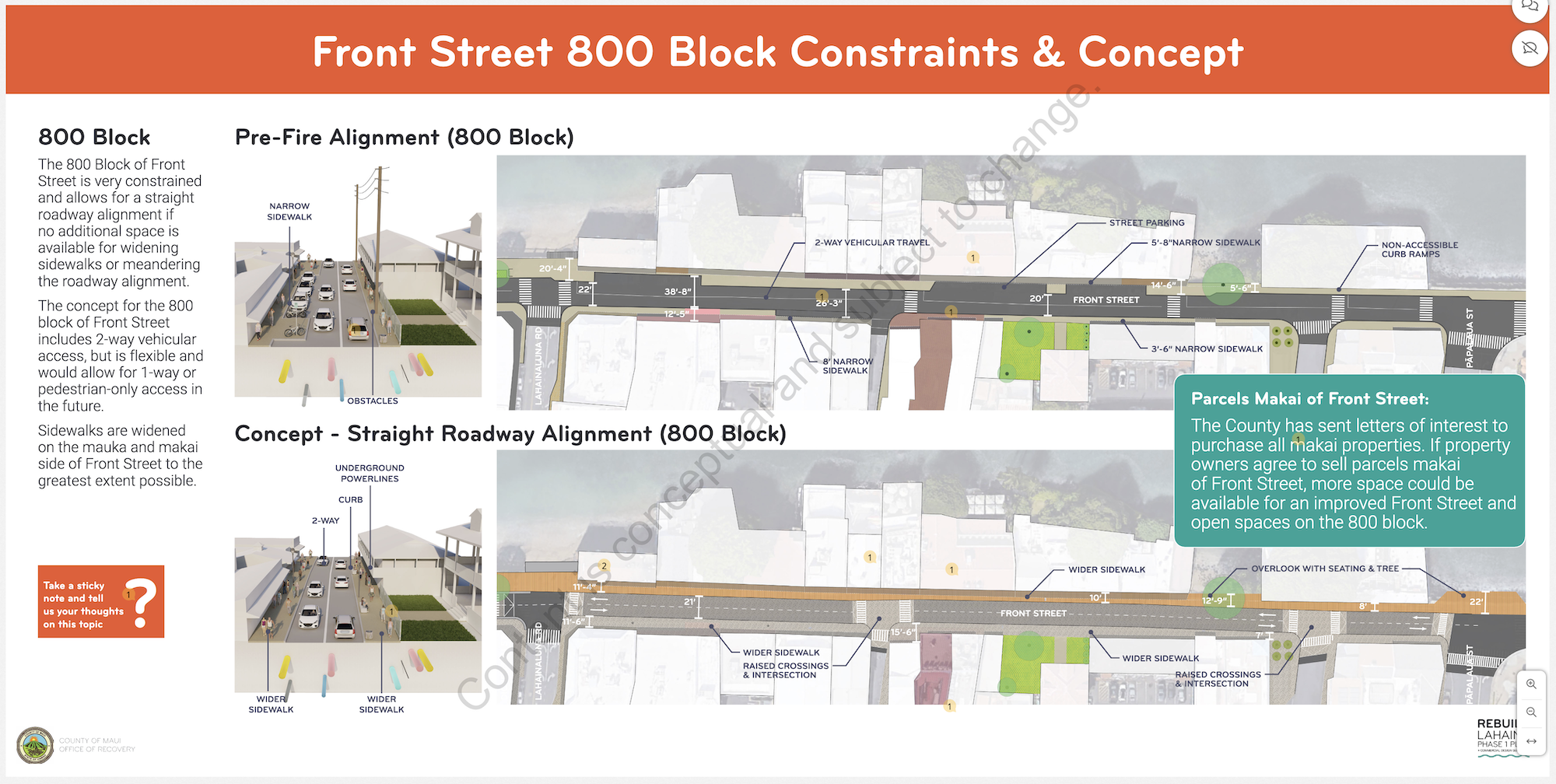
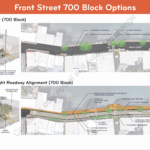
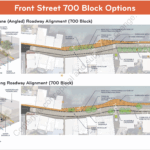
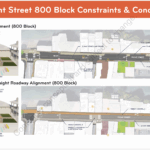
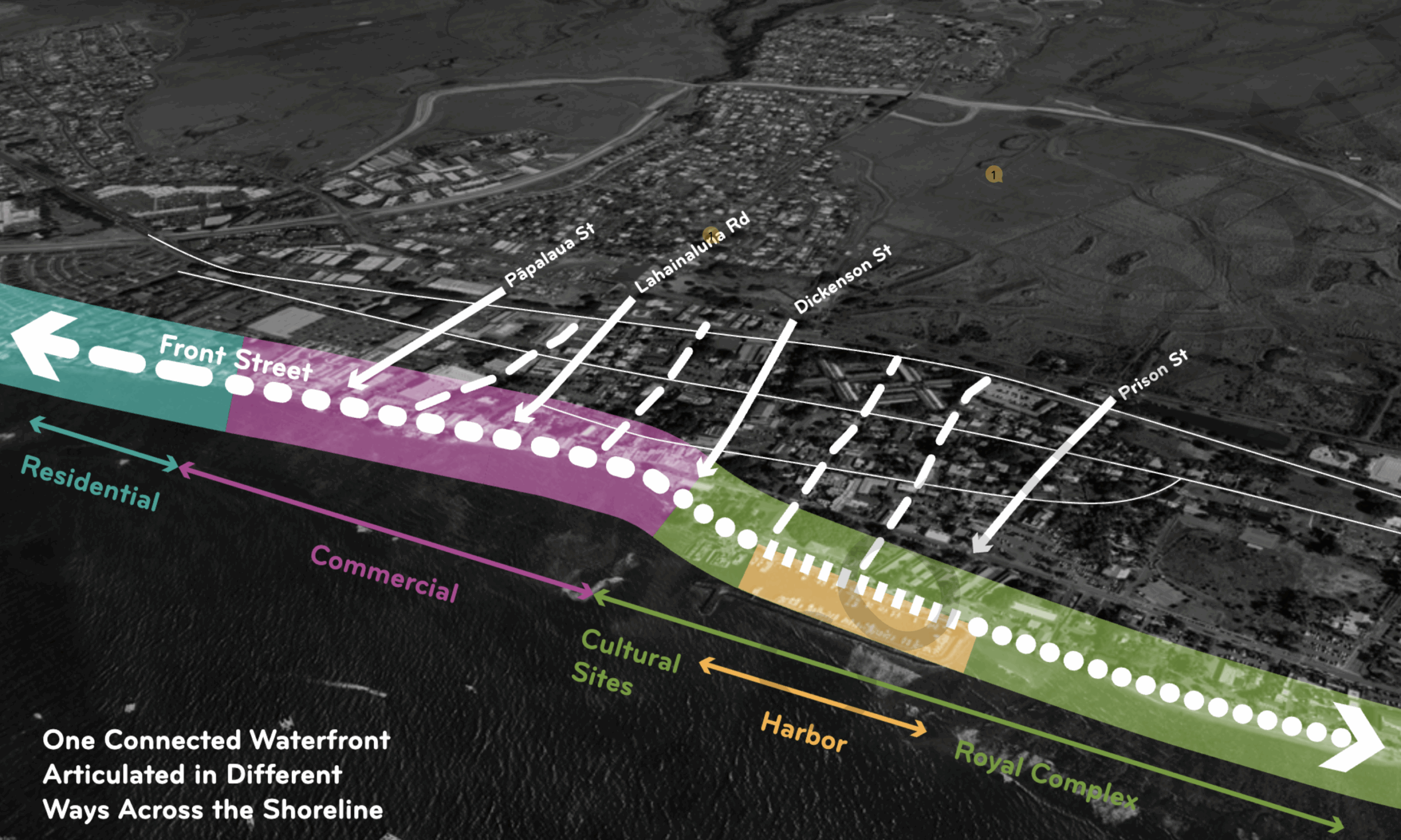
The design concepts the county has put forward for the 700 and 800 blocks of Front Street include two-way vehicle access but allow flexibility for one-way vehicle traffic or pedestrian-only access. They also call for wider sidewalks on both sides “to the greatest extent possible.”
“The community really liked the framing, the intimate nature of the way Front Street was designed and originally developed,” Wade said. “That’s the piece that’s not going to change.”
The county also wants to develop the waterfront into a connected area and has sent owners with properties along the water letters of interest to purchase them. A more connected waterfront could protect against flooding, provide access to the beach, improve reef habitats and offer access for traditional cultural practices.
There are no monetary offers yet, and Wade said if owners aren’t interested in selling, the county isn’t pursuing eminent domain actions in which the government takes property by force.
“We’re just hoping that if there is a collection of properties … we’ll be able to create an opportunity for additional public space,” Wade said.
BUSINESSES ON THE BACKBURNER
The visibility that businesses got on Front Street is hard to replicate anywhere else.
CocoNene, which sells crafted wooden home decor and gifts, made an average of $3 million a year at its Front Street location, Untermann said. Now, its four branches combined — in Kā‘anapali, Kīhei, Waikīkī and Waikoloa — can’t compare to the volume of the Front Street location. The company brings in about 75% of what it once made before the fire.
Tabora Gallery, another business he has ownership in that is now located in Mā‘alaea, is making about 25% of what it did in Lahaina.
“We’ve been able to rebuild in other areas, (but) nothing like Front Street,” said Untermann, who’s also a spokesperson for the Front Street Recovery group that represents 73 generational landowners.
There have been barriers to keeping businesses from coming back. For starters, it took much longer for the commercial properties to be cleared of debris. While the U.S. Army Corps of Engineers was able to clear 1,390 residential properties in eight months, it took a year to clear out 148 commercial properties.
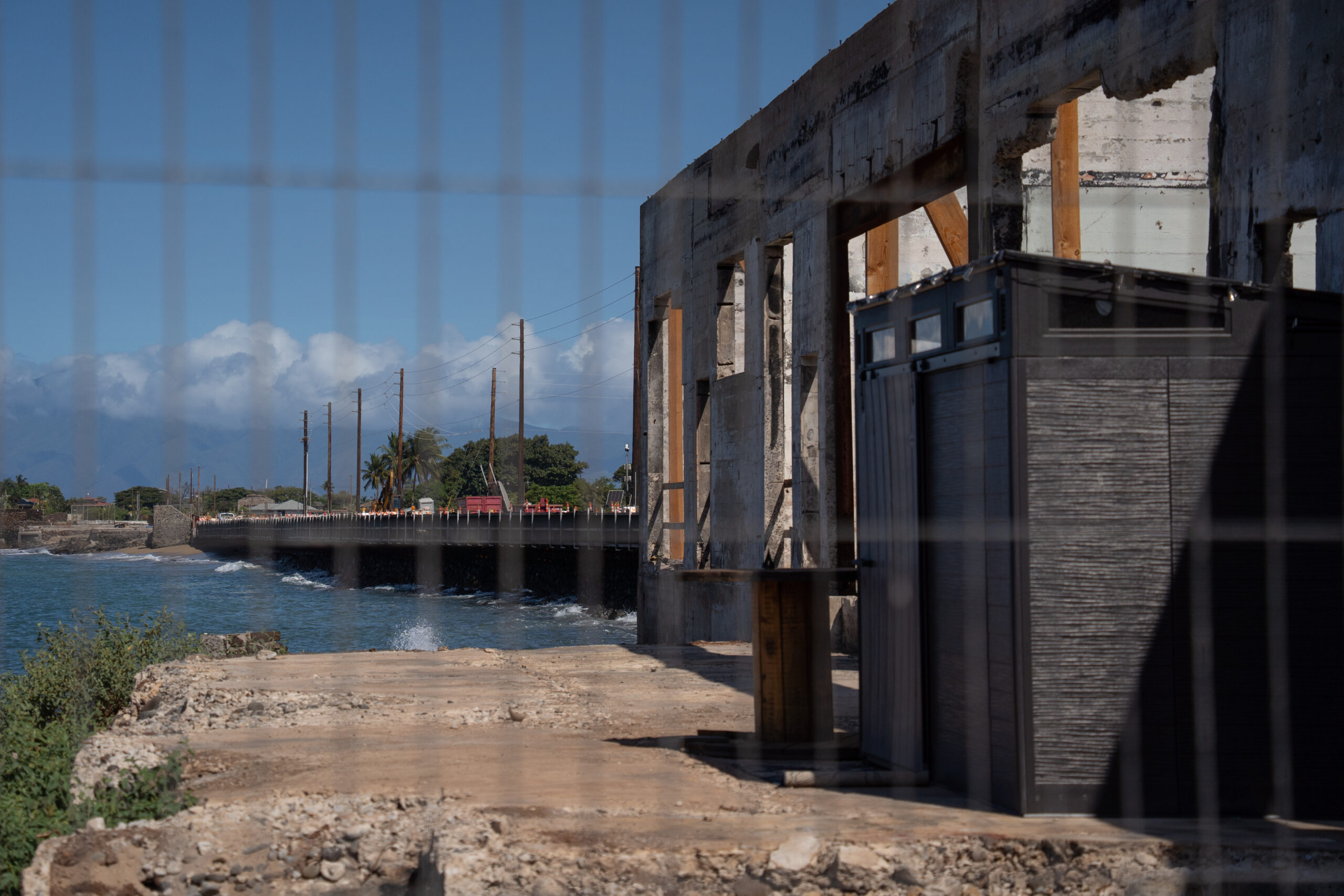
Many burned-down commercial properties still don’t have connection to water or power, said Glenn Mason, vice president of O‘ahu-based Mason Architects, who is helping to design the seawall and walkway on Front Street as well as buildings for multiple owners. Wade said the utilities are ready to go but owners need to request to have their water meters and electricity restored to their individual properties.
Mason said the biggest challenge of rebuilding has been the “lack of certainty” over the county’s design plans, the rules that apply to rebuilding, and the time it takes to get approvals.
Until recently, owners weren’t even sure how many lanes Front Street would have and if the widening of the road would force them to give up portions of their properties.
Mason said he understands that rebuilding after the fire is “unprecedented,” but that it’s “a little disappointing that it’s taken this long to figure that out.”
“The problem is you want to bring Lahaina back, you want to have a commercial center, and yet you have to tell everybody, well, we haven’t really decided what we’re going to do yet,” Mason said.
Even those whose buildings are still standing face an uphill battle. Leil Koch, owner of the 744 Front of Street building that once housed Fleetwood’s on Front Street, estimated it may cost at least $12 million to remodel the concrete structure, which was gutted by the fire but remains intact. Koch said the heavy machinery that the Army Corps used to remove restaurant debris on the second floor left it structurally damaged.
Koch’s building may be among the first to reopen, but “the million dollar question” is whether that will help or hurt the restaurant and shops, which could end up being the lone businesses in a sea of empty lots for a while. Front Street does have surviving businesses, including the Lahaina Cannery Mall and the restaurants around it, but they are north of the main business district.
“Will it be visited because it’s the only place to go to on (this area of) Front Street at the moment? Or will nobody come because it’s the only place on Front Street to visit?” Koch said. “Those are the things you wrestle with. But I’m an optimist at heart, and it’s the right thing for all of us to be back up and going. Somebody’s got to be the first one to take a chance.”
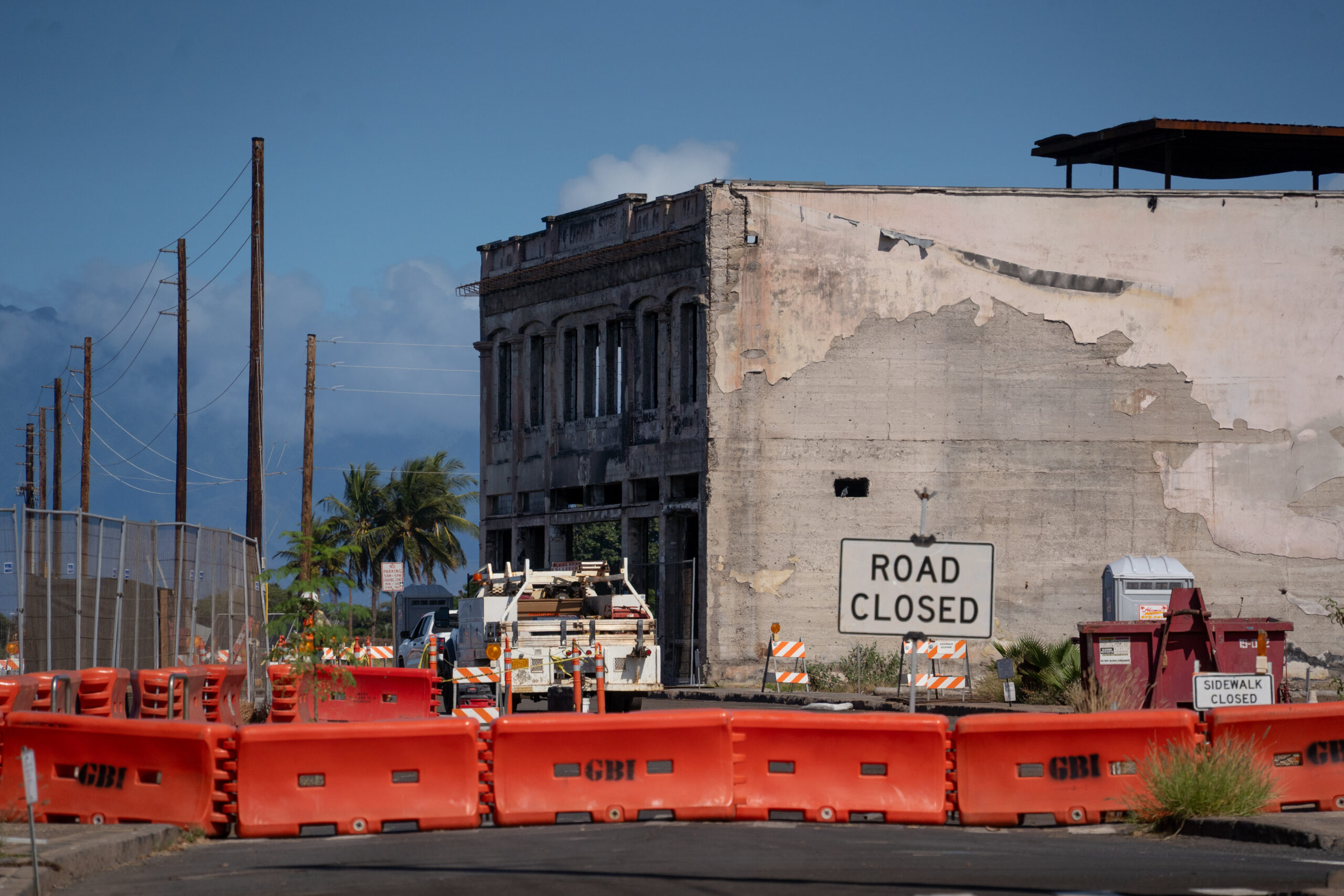
Koch, who plans to apply for permits in the next couple of months, said he’s glad to see the commercial design options released. He likes the idea of creating a better flow on the street and making the area more walkable, which would help businesses. But he hopes the minutiae, such as where certain plants will be located, will not bog down the rebuilding.
“We need to expedite some of this process … but there’s a lot of great things coming out,” he said.
Untermann said the business owners are “in full support” of most of what the county is proposing. However, he disagreed with the idea of replacing businesses on the ocean side of the road in favor of a connected waterfront, saying he wants to see it rebuilt the way it was.
“The cost for all of our 73 individual landowners to have the resources to come back is going to be really hard anyway, and so I’m in favor of bringing back as much as we can,” Untermann said.
Because each business is in a different situation, it’s unclear how many will return to Lahaina and when they’ll be able to do so. Untermann is also facing steep costs to rebuild, estimating that his 10,000-square-foot building could cost about $15 million as commercial construction rates reach nearly $1,500 per square foot. The longer the rebuild takes, “the harder it’s going to be,” he said.
“As a business community, we wanted to sit in the backseat for the first year and let everybody grieve,” Untermann said. “But we feel that we play a big role … and we think we’re an important ingredient for the town to fully recover as much as possible. And the reality is all of Front Street is not going to come back.”
Freeland hopes The Pioneer Inn, which was Lahaina’s first hotel, will be among the longtime businesses to return. The property was one of the last ones to be cleared in February, and Freeland said once the family sorts out their internal plans, they’ll be ready to take the next steps toward rebuilding what they had before.
He sees the release of the design options as a sign of progress.
“We’re seeing a very diligent effort by the county to resolve issues and mitigate uncertainties, which is very helpful to the rebuilding process going forward,” he said.
He and the other business owners agree that housing for Lahaina families needed to be a priority, “but up until recently we had not seen a similar effort towards commercial, so this is very welcome,” Freeland said.
Freeland’s grandparents owned one of the handful of homes on Front Street that later became the Wharf Cinema Center. As a kid growing up in the small plantation town of Waipahu, he came to Lahaina to surf at the breakwall, play in the banyan tree and eat sweet-and-sour spareribs at Sunset Freeze.
On Friday, as he looked out over the empty gravel lot where the inn once stood, he said he still feels “a lot of sadness.” As he spoke, a Lahaina man approached to talk story. It turned out he knew Freeland’s dad, Keoki, and stopped to swap memories of the town as they knew it, back when it was mostly for locals.
It’s that kind of legacy that Freeland, who is part Native Hawaiian and has lived on Maui for the last 35 years, treasures about Lahaina. Rebuilding what was there before will protect against “having somebody else that we don’t know in the future coming and building steel and glass.”
“The historic character of Lahaina was so important, and hopefully we get it back,” he said.
‘SLOW IS FAST’ ON FRONT STREET
Earlier this year, Maui County received a big boost in its recovery efforts — a $1.6 billion Community Development Block Grant that includes $400 million for infrastructure projects.
Bissen said the federal funding could help businesses restore their infrastructure including water and power service. With Front Street containing a lot of critical infrastructure for the Lahaina area, the county needs to make sure it has “a redundancy plan that is going to help the businesses.”
“I really want to say thank you for the patience that the commercial properties have had while we’ve come back with the owner-occupied homes, which we’ve focused on,” Bissen said.
He said he understands the need for jobs and tourism and the businesses’ desire to build something now.
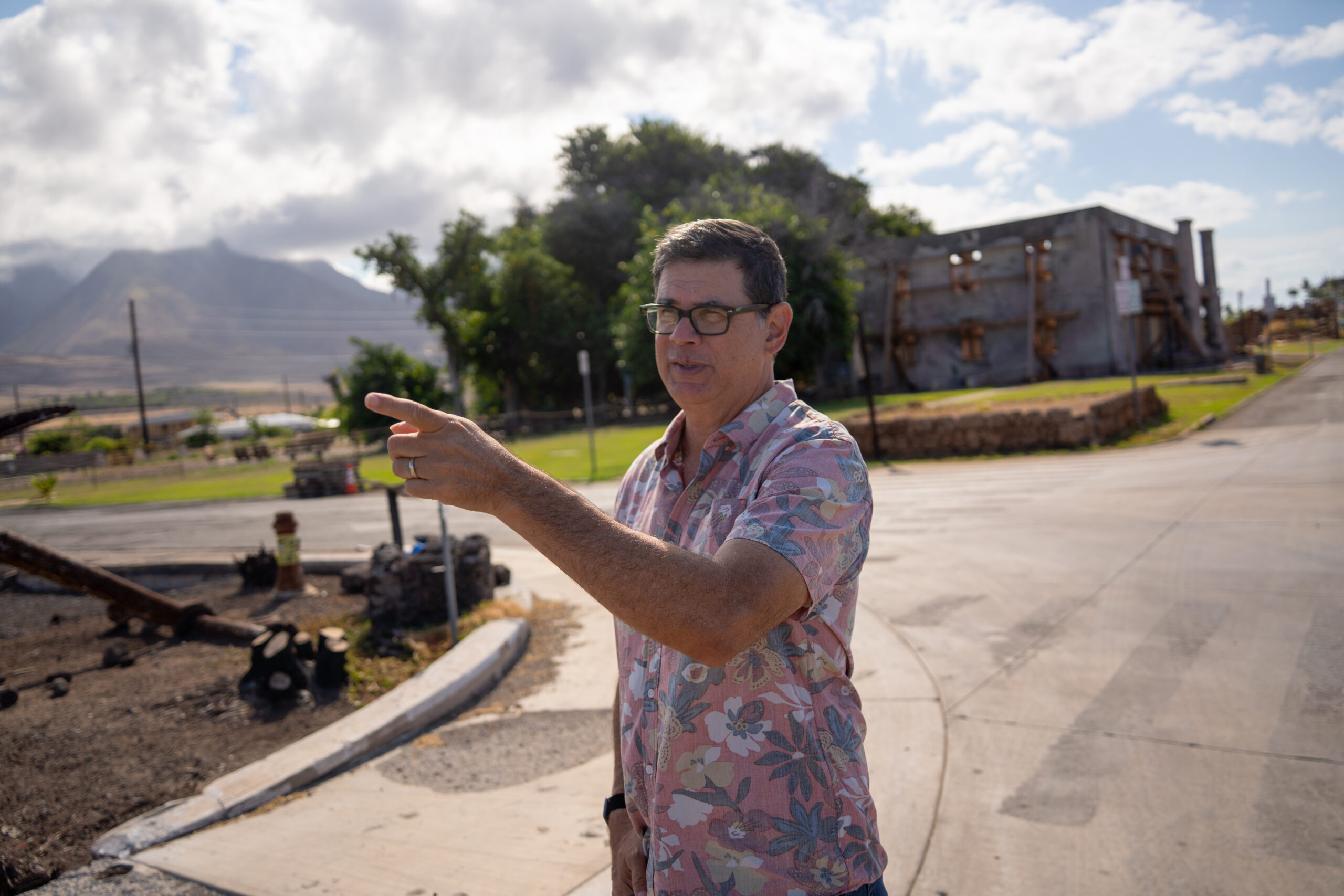
“But we feel like the approach we’re taking is almost that slow is fast,” he said. ”Letting us literally set the groundwork, it’s going to make it easier and less expensive for businesses.”

Maui County and the state have taken some steps to ease barriers to rebuilding. Earlier this year, the council passed a bill that allows noncomforming structures — such as businesses that were built in an area where the zoning later changed to residential — to rebuild what they had before.
The state’s emergency proclamation also gives businesses mauka of Front Street exemptions to special management area rules that apply to the shoreline.
Wade said there are more changes in the works. Another bill is going through the council that would allow the rebuilding of awnings and balconies that technically “encroached” on the sidewalk but were iconic of small towns like Lahaina.
The county also is working to update architectural guidelines for the area, with plans to release a draft in November or December. And, it’s looking to request a waiver for off-street parking requirements for buildings in the historic districts, which were built out before there were cars.
She agreed it’s “100% a concern” for the county that some businesses may not be able to come back the longer it takes to rebuild. She pointed out that the Office of Recovery has given a grant to the LahainaTown Action Committee to create a “business incubator” site where Lahaina vendors can offer their products in a shared space.
With design plans getting underway for Front Street, she hopes that will help move the commercial area forward.
“Of course we all would have loved to be much further along,” Wade said. “But now that we’re underway and rolling, I think by the end of the year we’ll have a whole lot of certainty.”