After 15 years, Maui County takes ‘first step’ on Kīhei remnant lot
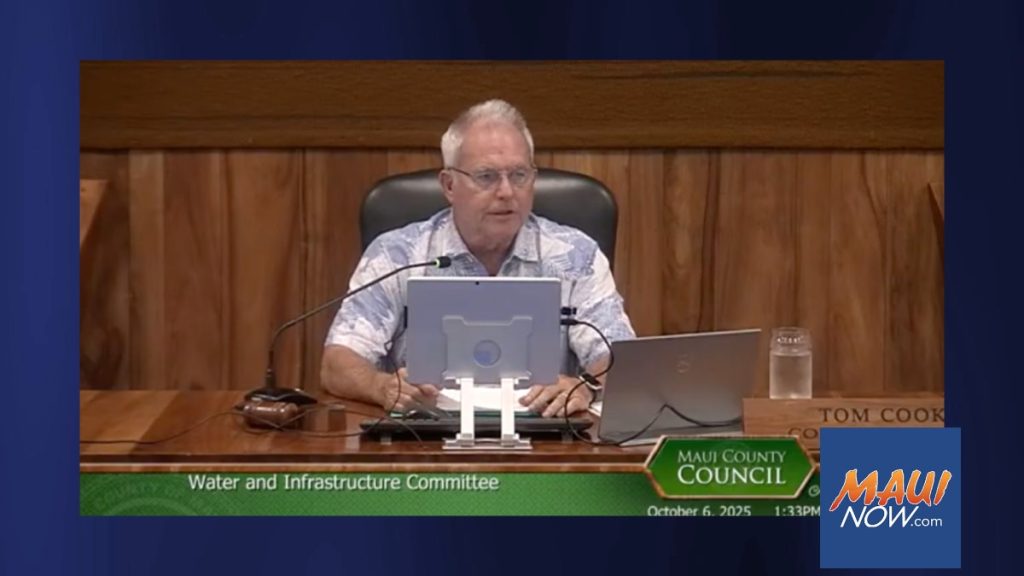
A longstanding community property issue in South Maui, involving a small remnant road, finally moved forward this week, with the Maui County Council’s Water and Infrastructure Committee advancing a resolution on Monday that multiple members noted was 15 years in the making.
The committee, chaired by Council Member Tom Cook of South Maui, unanimously recommended the adoption of Resolution 25-177 (Committee Draft 1). It authorizes the County to take over and abandon the use of a portion of the old Alulike-Kaonoulu Street as a public highway. The resolution is being called a “very substantive first step” in what is expected to be a multi-phase process.
A long, murky road to clear title
The undeveloped parcel, a remnant created during the 1989 Kaonoulu Estates subdivision, abuts the properties of the Jewish Congregation of Maui, Inc. and Maui Bay Villas. The congestion-plagued property has been the subject of discussion for over a decade and a half, with the Jewish Congregation seeking to use the land for essential purposes such as off-street parking and access improvements.
Council Chair Alice Lee recalled the Jewish Congregation of Maui discussing the remnant roadway issue with her 15 years ago when she was in “a different occupation,” and, at that time, she thought: “So that’s what they need, but I’m not sure I can do anything.”
“But here we are 15 years later, and I think it’s just amazing that I can now be here and do something and give them what they had need of 15 years ago,” she said.
The current resolution is critical because it authorizes the County to accept a quitclaim deed from the State of Hawai’i, thereby securing clear title to the lot.
Intent is transfer, not ownership
In response to Council Member Gabe Johnson’s question about whether the intention is to keep the lot or turn it into parking, Deputy Corporation Counsel Caleb Rowe clarified that the resolution itself before council members is solely about accepting the lot and abandoning its use as a public road.
However, “there is an intention to transfer it eventually, but that that’s not what we’re doing today. But that will come up later,” Rowe said.
“My office has been working for the last three years also with them to be able to use this for off-street parking,” Cook said. He added that, while this is a substantive first step, “a number of things need to be done for the county to transfer it to the Jewish congregation church . . . Hopefully the other steps won’t take too long.”
According to the resolution, the state Board of Land and Natural Resources approved on July 11 a quitclaim of the State of Hawai‘i’s interest the remnant roadway parcel, which amounts to about 11,567 square feet or a little more than a quarter of an acre.
The resolution then has council members, on behalf of Maui County, accept the quitclaim from the state but then also declare that the land is “vacated, closed, abandoned, or discontinued as a County public highway.”
The committee noted that the state’s willingness to execute the quitclaim deed marks a significant milestone, one that may serve as a potential mechanism for addressing similar remnant road issues across other districts in Maui.
After a motion to recommend adoption of Resolution 25-177 passed unanimously, the measure advances to a final vote before the full Council. If adopted, the County will begin the process of obtaining title, followed by a separate action to eventually dispose of the property to the adjacent community landowner.
Sponsored Content