Op-Ed: Preparing innovative financing for our East Maui water future
Op-Ed: Preparing innovative financing for our East Maui water future
By Dr. Jonathan Likeke Scheuer, board chair, ʻAha Wai o Maui Hikina
& Lourdes German, executive director, Public Finance Initiative
Maui Hikina (East Maui) and the rest of Maui that depends on it stands at a crossroads. Renowned for its abundance of water, Maui Hikina is experiencing a historic drought, with some streams that have been measured for over a century showing record-low flows. At the same time we are facing long term climate risks, competing and increasing off-stream water demands and a renewed push by the state to issue a 30-year water license to a foreign crown corporation.
To begin to meet these challenges, in 2022, 64% of Maui voters created the East Maui Water Authority (EMWA) and its governing board, the ʻAha Wai o Maui Hikina. The mandate was to create a Maui County-based, community-led non-potable water utility to take over the historic plantation infrastructure – and to govern it with fairness and equity to ensure long-term access to water, sustainability and community benefit.
Bringing that to bear requires not only the will of the people but also new, creative and tailored financing mechanisms. Fortunately, we have been preparing for this. The EMWA – with the support of the Rural and Small Cities program of the Public Finance Initiative (PFI), funded by the Robert Wood Johnson Foundation – is continuing to build the capacity of leaders and residents of East Maui to chart a new financial path for stewarding our vital water resources.
The EWMA and the PFI share the philosophy that community-driven solutions and the equitable outcomes they demand, are key to restoring local control of essential systems like water. This ensures that our resources can be managed in accordance with the public trust doctrine – the legal principle that natural resources must be held in trust by the government for the protection of the resource and the use and benefit of the people.
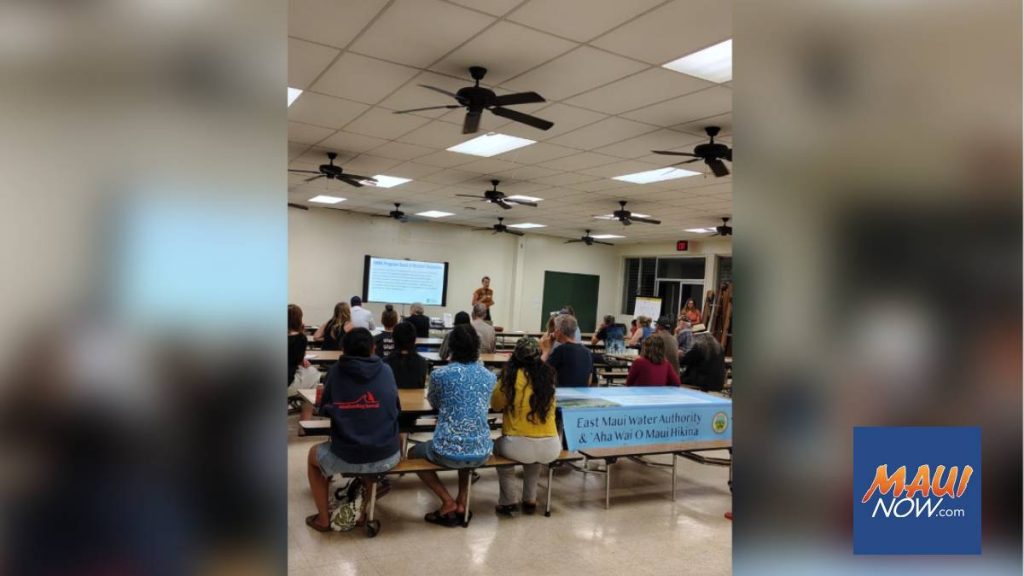
After months of preparation, EWMA and PFI met in June 2025 with residents in Keʻanae, Kula and Haʻikū, toured East Maui streams and met with water and finance experts. The community raised concerns about fairness in water systems, modernizing infrastructure, increasing transparency, supporting food security and strengthening decision-making based in day-to-day stakeholder experiences. Each region also identified unique needs: watershed restoration as a new economic engine, resolving long-standing water needs in Kula and addressing the effects of devastating climate change while also promoting fairness and cultural respect in Haʻikū-Huelo. All communities shared their exhaustion from a continued lack of access to water and called for stronger local control and stewardship.
These discussions continued Oct. 28 and 29, when community members, advocates, policy makers and officials gathered in Keʻanae, Wailuku and Haʻikū to prioritize projects and community benefits. In both Keʻanae and Haʻikū, residents brainstormed the specifics of county acquisition, a baseyard/operations hub, adopt-a-stream citizen science, water monitoring, comprehensive mapping and reporting, educational programs and community and research partnerships, which taken together, make up the necessary elements of a community-led operations plan for stewardship and resource management of the waters of East Maui. In Wailuku, participants added more specifics to how water systems improvements and watershed programs could be conducted, as well as ideas around community stewardship and ownership of the systems.
After the community brainstorming and prioritization, EMWA and PFI showcased how intentional financial strategies and collaborative planning could bring these projects to life. They shared strategies on how public finance tools can be integrated with philanthropic investments to expand the base of resources for the East Maui water system – lessening reliance on private funders and creating stepping stones towards greater local control. They also shared how community based management can potentially enhance access to other funding sources, increasingly important in the era of cuts to traditional government funding.
The October workshops provided an opportunity for community members, officials and partners to work together to design our future and learn about new tools to achieve our goals. They also offered opportunities for water advocates and professionals from across Maui County to learn about innovative strategies for financing lasting infrastructure improvements.
By relying on an intentional mix of funding, Maui will be able to take the important steps to ensure decision-making power and funding flows remain firmly grounded in community priorities and cultural stewardship. This will enable us to address water system leakages, storage, watershed restoration, food sovereignty initiatives and other critical needs.
Maui Hikina stands at a crossroads, but we now have the opportunity to manage our precious and finite resources, led by the community and supported by creative and collaborative financing.
About the Authors:
Jonathan Likeke Scheuer, Ph.D. is the chair of the ʻAha Wai o Maui Hikina (East Maui Regional Community Board) and serves there as a representative of the Hawaiian Homes Commission recommended by the Department of Hawaiian Home Lands.
Lourdes German is the executive director of the Public Finance Initiative, a nonprofit organization that partners with governments and organizations who want to embed values in public finance decision-making to create lasting change in the world. The EMWA was recently chosen to participate in PFIʻs Rural and Small Cities Program to help East Maui transform local priorities into well-funded projects.
*****Views expressed in Op-Ed pieces are those of the author’s alone and do not reflect or represent the opinions, policies or positions of Maui Now.*****
Sponsored Content


_(1)_1787857947612.webp)