
 Hawai'i Journalism Initiative
More Maui schools adopt e-bike bans or regulations following state Department of Education guidelines
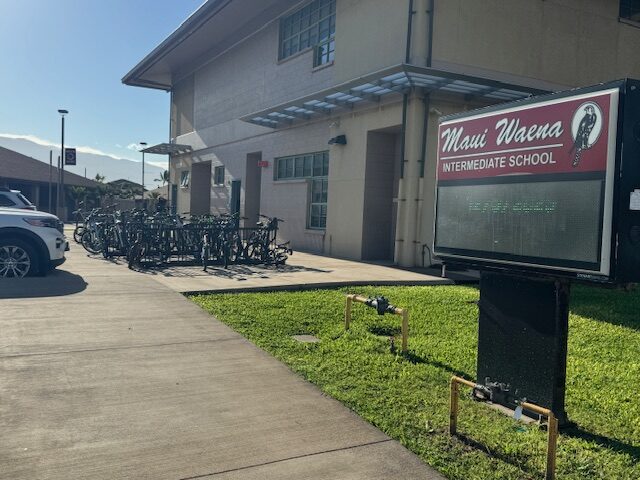
Principal Jacquelyn McCandless was driving to Maui Waena Intermediate School in Kahului on a spring afternoon in 2024 when she realized electronic bicycles were becoming a safety problem at the campus.
“I watched our students weave in and out of traffic,” McCandless said. “They created a dangerous environment for our parents who were driving.”
HJI Weekly Newsletter
Get more stories like these delivered straight to your inbox. Sign up for the Hawai‘i Journalism Initiative's weekly newsletter:
At that moment McCandless decided Maui Waena would be the first school in Maui County to ban e-bikes, some of which can reach speeds of 28 miles per hour. Maui Waena sent a letter to parents on June 1, 2024, informing them about the new policy.
But it was not until last month, despite it being illegal under Hawaiʻi state law for children under the age of 15 to have or operate e-bikes, that the state Department of Education set new regulations that banned e-bikes at all elementary and intermediate schools in its system.
The policy was sent out in a letter to parents on Nov. 3, followed by a news release on Nov. 5.
For older students, the letter also included regulations on the use of e-bike on state-run high school campuses. Students 15 years of age and older are permitted to have e-bikes at any campus or property in the state system, but they have to be registered and licensed by the county in which they reside, with a county-issued decal.
The letter also said any e-bike without a properly issued decal will be confiscated and returned to the student’s parent. Those e-bikes would be prohibited from entry on all department campuses and properties until it is properly registered and licensed.
“The safety of our students is always our top priority,” state Department of Education superintendent Keith Hayashi said in the Nov. 5 news release. “With the growing popularity of electric bicycles and other motorized vehicles, we have seen both the convenience they provide and the risks they pose.”
‘Īao Intermediate School started to ban e-bikes on campus in January, principal Matt Dillon said.
“Principal McCandless got us on board with it,” Dillon said. “Once we reviewed it … we just saw it as a way to keep kids safe.”
Maui Waena Intermediate School, the feeder school for Maui High, has about 1,040 students this year. McCandless said there were “about 50 e-bike riders” at her school immediately before the ban she put in place “because I had to buy an additional rack.”
“I had seen an uptick of accidents already with e-bikes on Oʻahu and had heard that a couple of schools had started their ban,” McCandless said. “And I said, ‘we need to do that.’”
McCandless thinks intermediate school age kids are “better off using regular bikes and to be exercising and hopefully being a little bit more cautious.”
On Friday, the Maui Waena bike racks held 26 regular bikes and no e-bikes. At ‘Iao Intermediate School, only about 12 of 850 students ride regular bikes to school, Dillon said.
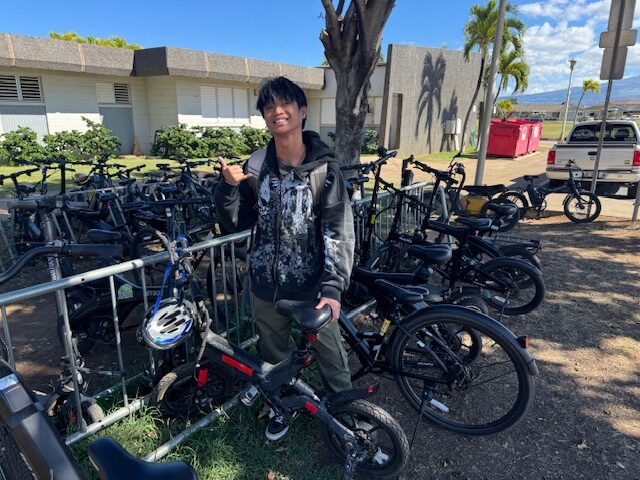
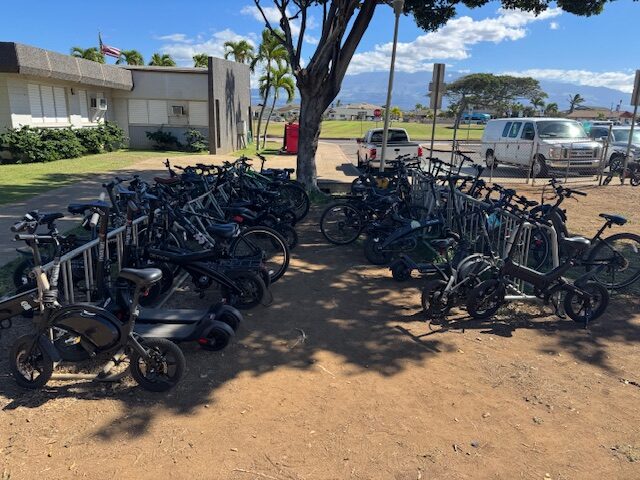
Jerry Lee Dela Cruz Fernandez, a 16-year-old Maui High School junior who carries a 4.1 grade-point average, used to ride an e-bike to Maui Waena when he was in intermediate school. Now, he is one of about 30 student who ride an e-bike to Maui High. When they reach campus, students are required to get off the bike and walk it to the school’s bike racks that are located near the school office.
On Wednesday at Maui High School, the largest in Maui County with 1,541 students, the bike racks held 30 e-bikes, 10 regular bicycles and 6 e-scooters. Maui High has 206 students who drive cars to school.
Fernandez said he is safety conscious, always wearing a helmet when riding his e-bike. The faster bike allows him to get to school in “5 to 10 minutes” from his Kahului home.
On weekends and after school, Fernandez enjoys using his Jetson e-bike for recreation.
“You don’t have to go on your phone,” Fernandez said. “You can just ride your bike, enjoy the views, just cruise around the neighborhood, watch all the kids play, laugh. Just being outside, in general, with the bike, just feels very nice, like everything’s in slow motion. It’s relaxing. Very relaxing.”
Maui High Principal Ty Ogasawara said the students at his school “are very compliant” with the rule that e-bikes must be walked on campus.
“Out in the community … I know there’s a huge issue with them riding in the street,” Ogasawara said. “And so it concerns me that that’s the case that these kids are riding basically a vehicle that they can really get themselves hurt.”
E-bikes have soared in popularity nationwide, but so have the risks and number of accidents as more people adopt them. Over the summer, a 15-year-old boy was killed while riding his e-bike through a crosswalk in Ewa Beach on Oʻahu. Just a week ago, a 19-year-old was severely injured in an e-bike accident in Waipahu on Oʻahu.
Kainoa Hopfe, the vice principal in charge of e-bike regulation at Baldwin High School, said there are fewer than five regular riders to the Wailuku campus attended by 1,187 students. On Friday, there were two e-bikes locked in Baldwin’s bike racks. Baldwin has 132 students who drive cars to school.
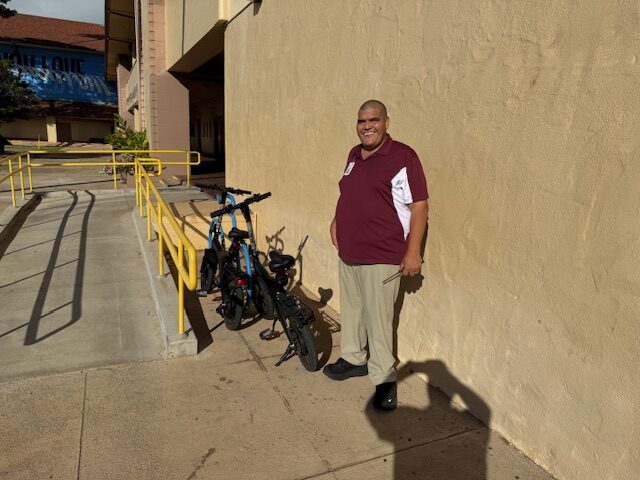
“We haven’t had too many e-bikes on campus,” Hopfe said. “But the ones that I did see, as soon as the (DOE) announcement was made, I just gave the kids a heads up. … It needs to have the County of Maui bicycle registration.”
E-bike use also is minimal at Lahainaluna High School, with an enrollment now of 797 students, according to principal Richard Carosso, who sometimes directs traffic onto campus in the mornings.
“We rarely see e-bike riders for school, but maybe two or three on some afternoons for extra-curricular activities,” Carosso said. “It is not a problem for us.”
Alana Pico, public information officer for the Maui Police Department, said there has been only one known traffic fatality on Maui involving an e-bike rider. On Oct. 22, 79-year-old Richard Holland was riding an e-bike in Kīhei when he crashed with a pickup truck and died.
“Unfortunately our current reporting system does not currently have the ability to easily track accidents involving e-bikes,” Pico said in an email to Hawaiʻi Journalism Initiative. “Classification can vary depending on factors such as pedals, wattage, and whether another vehicle was involved.”
Pico added that MPD officers who are posted at Maui County high schools have seen some e-bike activity among youths that could be concerning.
“School Resource Officers have reported issues with e-bike riders who often gather off campus after school and ride in various areas, which can create safety concerns,” Pico said.
Fernandez said some e-bike riders he knows can be unsafe, but he tries to be safe. In addition to wearing a helmet, when he crosses road he makes sure to “look both ways, left, right,” and watch for cars.
“I always look behind me and in front of me, like maybe every minute or so,” he said, adding: “In general, I just watch my speed and I stay on the sidewalk.”
Maui High School Vice Principal Mike Ban said students like Fernandez are the norm at his school.
“You can see the popularity of the e-bikes among the teenagers,” Ban said. “We see an increase in the amount of e-bikes being rode to school and around our community as well. … Maybe in the last couple of years we’ve seen the popularity of e-bikes increase.”
Ban added the new regulations from the Hawai’i state Department of Education a month ago already has a solid base at Maui High where the popularity of riding e-bikes to school is higher than anywhere else in the county.
“You see it in your neighborhoods,” Ban said. “The whole idea behind this initiative is to make sure that we educate our students, our community, about being safe. Our kids feel that it’s important.”