


Keck Observatory observes first gravitationally lensed superluminous supernova
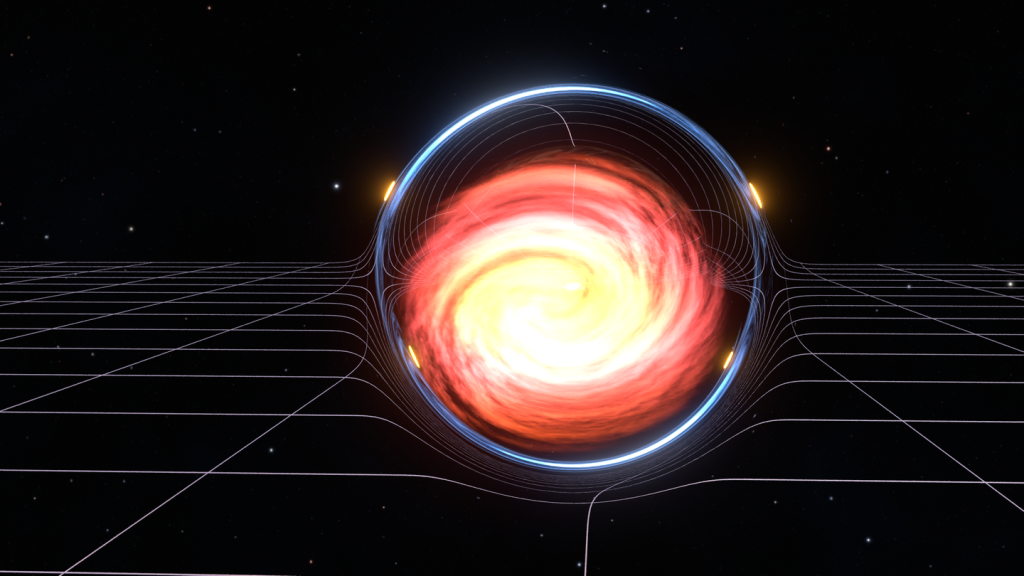
reaching Earth at different times. Credit: Oskar Klein Center, University of Stockholm /
Samuel Avraham & Joel Johansson.
An international team of astronomers using a combination of ground-based telescopes, including the W. M. Keck Observatory on Maunakea, Hawaiʻi Island, has discovered the first-ever spatially resolved, gravitationally lensed superluminous supernova.
The object, dubbed SN 2025wny, offers a rare look at a stellar cataclysm from the early Universe and provides a striking confirmation of Einstein’s theory of general relativity.
SN 2025wny lies so far away that its light has traveled 10 billion years to reach Earth; the Universe was just 4 billion years old when the explosion occurred. Normally, a supernova at this distance would be far too faint to detect from the ground. But two foreground galaxies act as a natural gravitational “magnifying glass,” boosting the supernova’s brightness by a factor of 50 and splitting it into distinct, spatially separated images.
“This is nature’s own telescope,” says Joel Johansson, lead author from the Oskar Klein Centre, Stockholm University. “The magnification lets us study a supernova at a distance where detailed observations would otherwise be impossible.”
The study, led by Stockholm University, is published in The Astrophysical Journal Letters.
A new method to probe the expansion of the universe
Because each of the multiple lensed images takes a slightly different path around the intervening galaxies, their arrival times differ. Measuring these time delays provides a powerful, independent method to determine the Hubble constant—the rate at which the Universe is expanding.
A major unsolved problem in modern cosmology is the Hubble tension—the growing mismatch between measurements of the Universe’s expansion rate made from the early Universe versus those made from nearby objects. The disagreement suggests that our current cosmological model may be incomplete. Strongly lensed supernovae like SN 2025wny offer a new, independent way to measure this expansion rate through time-delay differences between the lensed images, helping determine whether the tension reflects new physics or limitations in existing methods.
“A lensed supernova with multiple, well-resolved images provides one of the cleanest ways to measure the expansion rate of the Universe,” says Ariel Goobar of the Oskar Klein Centre. “SN 2025wny is an important step toward resolving one of cosmology’s most significant challenges.”
A surprising and exceptionally hot explosion
Superluminous supernovae are extremely bright, rare explosions. SN 2025wny stands out even in this elite category: its early ultraviolet light, stretched into optical wavelengths by cosmic expansion, revealed an exceptionally hot, brilliant event.
The supernova’s intense brightness illuminated its host galaxy, allowing astronomers to identify narrow absorption lines from elements such as carbon, iron, and silicon. These fingerprints point to a low-metallicity, star-forming dwarf galaxy—exactly the kind of environment thought to produce superluminous supernovae during the Universe’s youth.
How the Discovery Was Made
The discovery relied on a chain of cutting-edge observatories working together on scientific breakthroughs. The Zwicky Transient Facility at Palomar Observatory in California first detected the explosion during its nightly monitoring of the sky. The Nordic Optical Telescope on La Palma in the Canary Islands provided early spectroscopy of the transient, Liverpool Telescope also on La palma provided four separate images of SN 2025wny, and Keck Observatory ultimately provided the decisive spectra that confirmed both the supernova type and its extreme distance.
Yu-Jing Qin, a postdoctoral researcher at Caltech, led a series of spectroscopic observations using Keck Observatory’s Low Resolution Imaging Spectrometer, targeting each of the individual supernova images and the lensing galaxies.
The Keck spectra revealed a forest of narrow absorption lines from the supernova’s host galaxy – the fingerprints of elements such as carbon, iron and silicon – which nailed down the redshift and nature of the event.
“The spectrum taken with LRIS provides the most convincing measurement of its distance/redshift and pinpointed its classification as a superluminous supernova, which is a rare subclass. We were really impressed by the data quality and are pursuing further observations using other Keck instruments,” said Qin.
These rapid-response observations were enabled by Keck Observatory’s Target of Opportunity policy, which allows scientists to request immediate access for short-lived cosmic events.
“It’s always exciting to get a request for a very rapid response to a transient event like this,” said John O’Meara, Chief Scientist and Deputy Director for Keck Observatory. “Keck was ready to respond, and we were happy to deliver and participate in this breakthrough.”
What Comes Next?
SN 2025wny demonstrates that strongly lensed supernovae at very high redshifts can be discovered and resolved with today’s surveys—a crucial proof of concept ahead of the Vera C. Rubin Observatory’s Legacy Survey of Space and Time, which is expected to uncover hundreds more.
Follow-up observations with the Hubble Space Telescope and James Webb Space Telescope are already underway. These data will refine the gravitational lens model, map the multiple images with exceptional precision, and ultimately measure the time delays needed for a new, independent determination of the Hubble constant.
The extraordinary magnification also offers an unprecedented view into how such extreme explosions work and how stars evolved in the early Universe.
Sponsored Content