Rare interstellar comet 3I/ATLAS coming closest to Earth on Friday
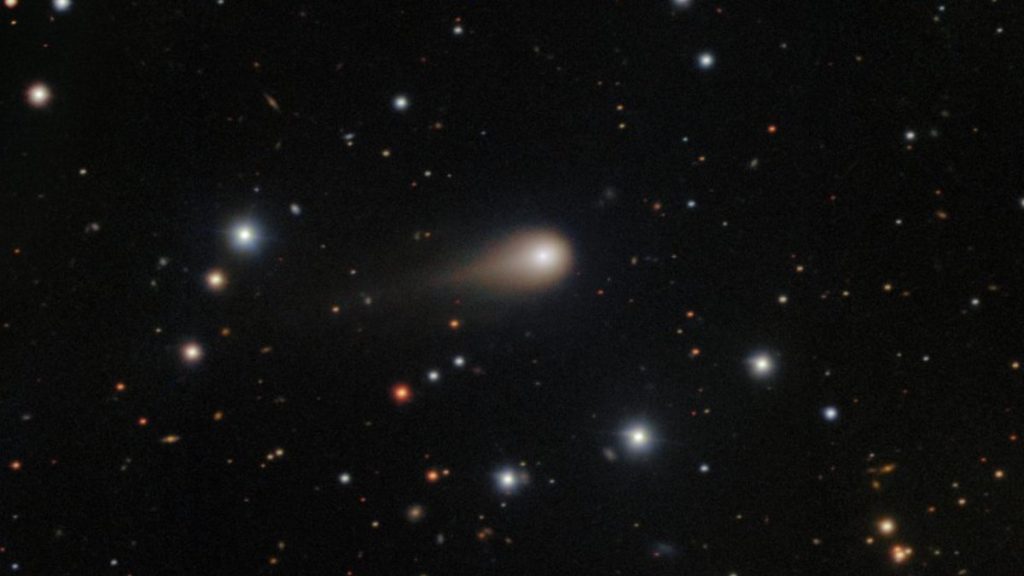
Note: The peak viewing window for 3I/ATLAS over Hawaiʻi skies is between 4 and 5:45 a.m., Friday, Dec. 19, 2025. Optimal viewing is 90 minutes before sunrise in the eastern to southeastern sky in the constellation Leo, appearing near the bright star Regulus. It is not visible with the naked eye, and requires a telescope or high grade binoculars. It appears as a “faint smudge.”
Scientists atop Mauna Kea on the Island of Hawaiʻi and across the Hawaiian chain are turning their telescopes skyward Friday as a fast-moving object known as Comet 3I/ATLAS that has come from another solar system is expected to make its closest approach to Earth, drawing global and local fascination.
More than 80 participating observatories worldwide also are gearing up to catch a glimpse of the rare interstallar comet as it passes within 170 million miles of Earth, on Dec. 19. In comparison, the distance to the Sun is about 93 million miles.
“I am excited; it’s pretty cool,” said John O’Meara, Chief Scientist and Deputy Director at W. M. Keck Observatory on Hawaiʻi Island. “I think it’s totally awesome that Hawaiʻi is excited. It’s great to have a reason for everybody to get together around a common fun cause.”
Comet 3I/ATLAS was discovered just a few months ago on July 1 at the NASA-funded Asteroid Terrestrial-impact Last Alert System survey telescope, in Río Hurtado, Chile.
Since its discovery, a frenzy of possible theories about the actual identity of 3I/ATLAS have gone viral across social media, from a UFO spacecraft to space rubbish to a piece of another planet.
“It is definitely true that the ratio of the elements that we’re seeing in the comet are different than comets in our solar system,” O’Meara said. “But I would expect that because 3I came from outside of the solar system.”
He said the comet comes “from a solar system that formed out of different stuff than ours. It came from an earlier time in the universe, and if anything, that’s why it’s super exciting, because it’s one of the very few opportunities we have to directly measure the environments of another solar system, because it was formed out there.”
Astrophysicist Avi Loeb has made numerous appearances on mainstream media, fueling extraterrestrial theories. Such theories also circulated in 2017, when 1I/ʻOumuamua was discovered using the Pan-STARRS telescope at Haleakalā Observatory on Maui.
The discovery of 1I/ʻOumuamua is the first interstellar object detected to have soared through our solar system.
But astrophysicist Dr. Alex Filippenko, who is currently visiting Kauaʻi from California with his wife, Noelle Filippenko, said: “The object is a fascinating comet, not an alien spacecraft.”
He added: “The comet has generated a lot of excitement because it gives us a chance to study an object from another planetary system.”
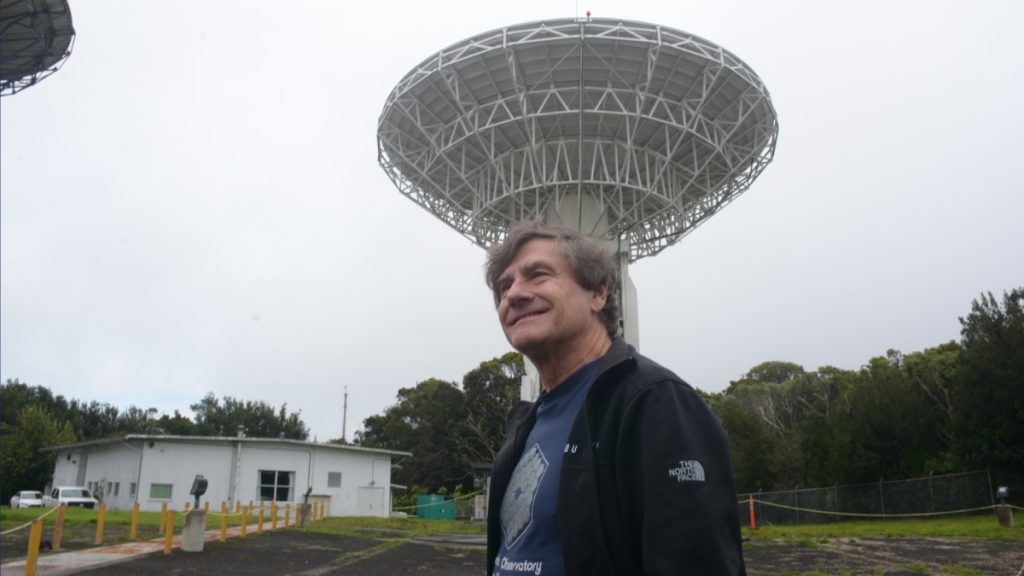
Joseph Tremonti, creative media program coordinator at Kauaʻi Community College, and Dr. Lisa Thompson, owner of Big Island UFO Tours, also are tracking Comet 3I/ATLAS.
“I support the theory that 3I/ATLAS could be an alien spacecraft,” Tremonti said.
His students, who produce Kauaʻi Uncanny, a paranormal podcast that explores Kauaʻi’s paranormal history and folklore, are scheduled to release an episode next year on the scientific debate surrounding the origin of 3I/ATLAS.
“The hypothesis expands the Overton Window and encourages scientific peers to engage with a topic that has long been mired in stigma,” Tremonti said.
The Overton Window is a model in political science showing the range of ideas society finds acceptable for public discussion at a given time, from unthinkable to mainstream.
Season two of Kauaʻi Uncanny, which premiered last week, also touched on the subject of being alone on the island. Episode 6, “Are we alone?'” explores Kauaʻi’s mysteries, including blue orbs, underwater lights and objects near the Pacific Missile Range Facility on Kauaʻi’s west side.

On the Big Island, Thompson said: “I do believe it’s something, not just a comet, like 1I/ʻOumuamua.”
The Big Island is considered a UFO hotspot due to its frequent sightings, unique geography and deep spiritual connections. The island’s remote location, vast ocean surroundings and minimal light pollution make it an ideal setting for unexplained aerial phenomena.
UFO Tours’ Big Island website touches on the belief that there is an underwater UFO base off the island’s southern coast. The theory gained momentum in December 2020, when a glowing blue craft was seen hovering above Oʻahu before it plunged into the ocean, disappearing without a trace.
“No matter if it’s a comet or a spacecraft or whatever it turns out to actually be, it is getting people’s attention in the skies and off of this Earth and maybe realizing and opening people’s minds that there’s more than just this Earth, and us as humans, but that there is other intelligence out there in the universe,” Thompson said.
“They do have the ability to travel here. They’re not all physical like we are. But it’s planting seeds for when we do have more and more open contact with our galactic family and friends out there, which in the next couple of years is gonna start happening more and more and more.”
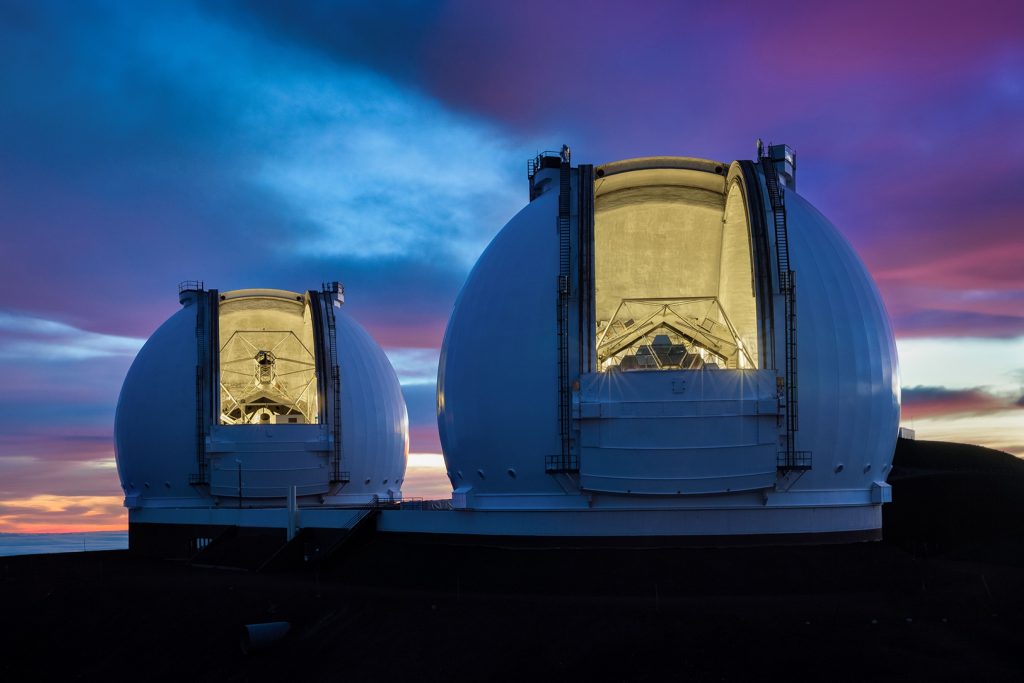
Scientist O’Meara added: “I think anytime something is interesting enough for people to have that debate, it’s a good thing because it shows off how science can work.”
He further explained that when astronomers first spotted 3I/ATLAS, they only had images and didn’t know what it was made of. As they used more powerful telescopes, including ones on Mauna Kea and Haleakalā, they gathered better data about its composition and movement. That data showed the object was unusual but behaved exactly the way a comet should — not like anything artificial.
“Scientists test ideas and rule them out as new evidence comes in,” he said. “In this case, the idea that it could be aliens was dismissed as more data was collected. 3I/ATLAS is a comet made of ice and rock, similar to others, though its chemistry is different because it came from another solar system.”
Unlike comets born far beyond Pluto in our own solar system, 3I/ATLAS traveled through the galaxy before passing near the sun, which bent its path as expected. As it neared the Sun, heat burned away its outer layers, creating a tail and exposing material inside.
Astronomers will likely keep watching it for months. It’s only the third known object from outside our solar system to pass through — exciting scientifically, but not evidence of aliens.
Watch below as NASA shares images of interstellar Comet 3I/ATLAS.
“Telescopes on Mauna Kea don’t just take pictures — they can analyze what objects are made of using a technique called spectroscopy,” OʻMeara said. “By breaking light into its colors, like a very precise rainbow, scientists can identify the atoms and chemicals inside objects like 3I.
“That’s one of the most powerful things about astronomy. Even though we can’t travel to most places in space, we don’t have to. By understanding chemistry and studying the light that reaches Earth, astronomers can learn what distant objects are made of.”
O’Meara also revealed that his team has begun using a new telescope called the Vera Rubin Observatory, named after the renowned American astronomer who pioneered work on galaxy rotation rates.
“That telescope is going to find lots of things like 3I/ATLAS,” O’Meara said. “It looks at huge, vast parts of the sky over and over and over, and so we’re going to start to enter a period of time where we’re going to be finding hundreds if not thousands of these things over the next decade.
He said that is “really cool for the same reason why 3I is cool,” because scientists will be able to do these same types of experiments.
“What’s coming next is not 3I or 4I or 5I, but 300I, 4000I, 50,000I of these things, and that’s just really neat,” explained O’Meara, full of excitement.
“Hawai’i is really lucky and privileged to have a place like Mauna Kea to observe from. It’s a privilege to be able to operate telescopes on Mauna Kea and do some of the best science in the world from there.”
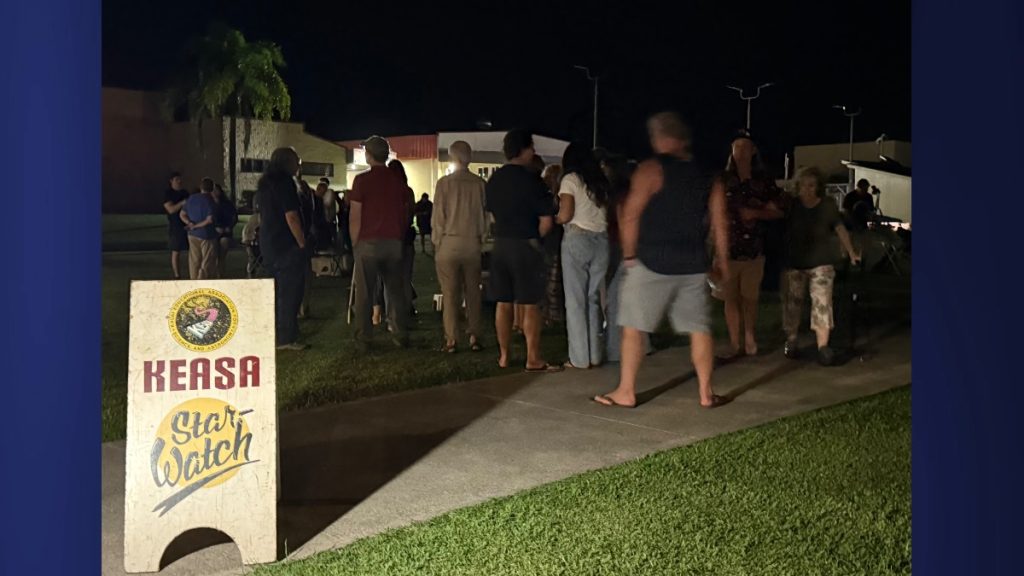
On Kauaʻi, members of the Kauaʻi Educational Association for Science and Astronomy are hoping to gather at the Pacific Missile Range Facility on Friday for the monthly star-watch party.
The gathering was canceled last Friday due to the weather. James Merritt, Director of Events for the local astronomy association, said he’s “not very hopeful” for this Friday.
“It’s not looking good, not with the weather pattern the way it’s been,” he said. “This convergence of 22 fronts with possible thunderstorms, I’m not sure we’re gonna be able to see anything.”
He added that in his 30 years as a member of the Kauaʻi Educational Association for Science and Astronomy, 2025 has been the worst year for star watches due to the weather.
Regardless, he encourages Hawai’i residents to “be out and observe with their telescopes because it can be seen with a backyard telescope.”
Residents who capture a picture of Comet 3I/ATLAS are also encouraged to share it with James Merritt via email at jcm7@netzero.net.
To sign up for the Kauaʻi Educational Association for Science and Astronomy newsletter or to become a member and fill out the application, click here.
For further information on Comet 3I/ATLAS or to view photos from the University of Hawai’i Institute of Astronomy, click here.
Sponsored Content



Subscribe to our Newsletter
Comments