Rep. Case announces 2025 winners of his Congressional App Challenge
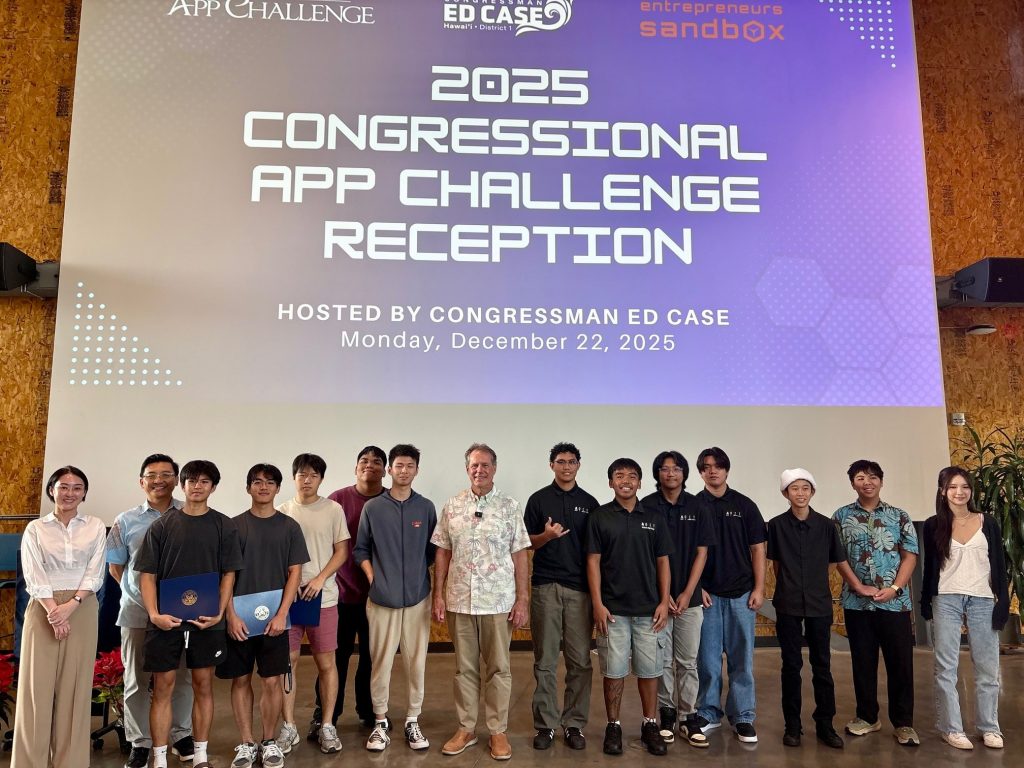
US Congressman Ed Case (HI-01) today announced the winners of his 2025 Congressional App Challenge for Hawaiʻi’s First Congressional District at a reception at the Entrepreneurs Sandbox in Kakaʻako.
The App Challenge is an official national initiative of the US House of Representatives, in which Members of Congress host annuals contests in their districts for middle and high school students. For 2025, 394 of the 441 Members of the House, or 89%, hosted such contests.
More information is here: congressionalappchallenge.us/.
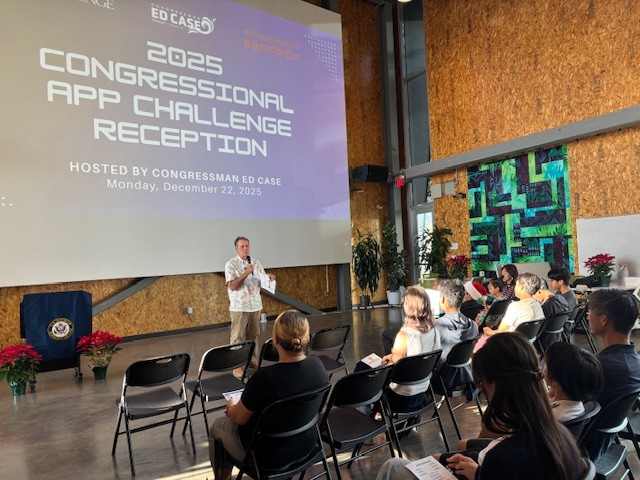
“My Challenge is a great opportunity for our local students to focus their skills and creativity on developing, testing and analyzing new applications for real-world use,” said Case. “Congratulating the contestants and their ‘ohana at the Sandbox, ‘Hawaiʻi’s community hub to inspire creativity, technology, innovation and entrepreneurship,’ adds an extra boost to what will hopefully be an inspiring and motivating experience for all of them.”
“And results of this year’s Challenge prove once again that Hawaiʻi’s youth have the skill set, imagination and resolve to compete against the best of our young people nationwide in science, technology, engineering and math, along with the potential to lead the next generations of computer science and technology.”
Participation in Congressman Case’s First District Congressional App Challenge has grown significantly from 2019, when he conducted his first Challenge after returning to Congress, to 2025. His 2019 Challenge saw 10 app submissions from 27 students across four schools. This year, his challenge saw 16 app submissions from 30 students across eight schools, including three public schools and five private schools.
The winners of Congressman Case’s First Congressional District 2025 Challenge are:
- 1st Place – Aren Sawa of Mid-Pacific Institute
Grade: 11
Instructor: n/a
App: Hawai‘iAlert.jp
Video: https://youtu.be/ifxGTRVAL0c
Summary, according to the creator:
“Hawai‘iAlert.jp is a bilingual disaster alert web app that automatically collects official emergency alerts from the U.S. National Weather Service and delivers accurate Japanese translations to users in real time.
“It focuses on major hazards affecting Hawai‘i, such as tsunamis, hurricanes, floods, high surf, strong winds, and wildfires. The app ensures that Japanese-speaking residents, students, and tourists receive the same verified information that English speakers do—instantly and without confusion.
“Built with Laravel (PHP), MySQL, and AWS Lightsail, the app automatically retrieves alerts through the NWS API, translates and summarizes them using GPT, and sends updates via the LINE Messaging API. Each message clearly shows its source and timestamp to maintain transparency and reliability.
“HawaiiAlert.jp bridges the language gap in public safety communication, helping everyone in Hawai‘i stay informed through trusted, official data—without interpretation or delay.”
- 2nd Place – Taeseong Shin (Iolani School), Lulu Wang (Punahou School), Sol Choi (Bishop Gorman High School)
Grade: 12
Instructor: n/a
App: GQX (Green Quest Exchange)
Video: https://youtu.be/PMIBJPXX/nk
Summary, according to the creator:
“GreenQuest Exchange (GQX) is a student-built platform turning climate concern into daily, trackable action. GQX has three main aspects.
“Action Tracking: students can log everyday behaviors (walking/biking, reusables, plant-forward meals, home energy steps), where each action converts to estimated CO2e savings using assumptions housed in the app Gamified Mechanics: school/user leaderboards, tree growth, streaks, and badges make progress visible and fun, making it an app fit for young students.
“Sustainable Marketplace: each school gets a moderated exchange where students post, borrow, or trade items like calculators, lab coats, art supplies, uniforms, and textbooks, or anything you can think of. That local loop reduces purchases, keeps materials in circulation, and meets real student needs.
“Privacy and safety are non-negotiable. GQX is hosted on Microsoft Azure with integrations through Google Firebase and MongoDB Atlas. We minimize data collection, default to private profiles, and use school-domain access where possible. We provide institution-level insights so schools can see aggregate participation and CO2e estimates, while individual data is never shared without proper consent, in compliance with applicable regulations.
“GQX is built for equity and adoption. The interface is lightweight for low-bandwidth use, mobile-first, and accessible. Moderation tools and community guidelines create safe exchanges.”
- 3rd Place – Owen Roe of Punahou School
Grade: 10
Instructor: n/a
App: The Mock Trial Online Trainer
Video: https://youtu.be/L_Y8dgDElj4
Summary, according to the creator: “My app was designed to help students in mock trial. Mock trial is an annual state competition that mimics real court cases. Students must work as a team to prosecute or defend a random case. This requires different people to specialize in various roles. These include questioning witnesses, playing witnesses, or making long speeches. The Mock Trial Online Trainer mirrors the mock trial system as much as possible.
“To begin, in mock trial, there are three witnesses on each side, which is reflected in the MTOT. Each witness has a name, a title, and a short statement, which allows the user to have a starting point for their questions.
“The witnesses are split into two differently colored boxes, green for the prosecution and purple for the defense. Below the witnesses is the evidence, marked by a yellow box, including a name and a short description for each piece. Next, I made all of the different roles that students play during a trial. This includes the opening and closing statement lawyers, who give long speeches; the cross and direct lawyers, who question the witnesses; and the witnesses.
“The statement lawyers are fairly simple; you give a speech to summarize the evidence, then the ‘adversary’ side gives their speech. In order to have the ‘adversary’ side give speeches, I used Groq’s Llama 4 Scout API to generate random text output. This AI model is effective because it has a large limit on the number of tokens it can send each day. The cross and direct lawyer roles work similarly to the statement lawyers, just in an extended format. While the statement lawyers only require one response, the cross and direct roles act as a conversation, so you must repeatedly question the witness, building upon previous statements.
“Finally, as a witness, you are being cross-examined by the ‘adversary’ lawyer, and you must try to avoid their attacks and reaffirm your own case.
After you have finished your case, you get judged. There is a ‘judge me’ button, available once the case is closed, which gives you a score out of 10 along with feedback on how you can improve. All of your cases are saved for later, so you are able to review your scores and see how you have improved over time. However, if you practice a lot, you can clear past cases with the clear all button.”
The judges of Case’s 2025 Challenge were: Trung Lam, Executive Director of Hawai‘i Technology Development Corporation, a state agency that is expanding Hawai’i’s tech industry; Ellen Ng, founder of Inoa, a blockchain technology consulting firm focused on real-world asset tokenization; and Stefan Holzer, a serial entrepreneur and AI researcher who previously co-founded Fyusion, a computer-vision company in the automotive industry.
Sponsored Content