
 Hawai'i Journalism Initiative
With FEMA housing deadline for Lahaina fire survivors 39 days away, state officials hope for an extension

Sissy Rogers joked last Saturday that her family may “end up living on the beach for a couple months” if the direct housing funds provided by the Federal Emergency Management Agency for Lahaina fire survivors end as scheduled on Feb. 10.
Rogers, her husband Liko, and their youngest daughter, 21-year-old Puliki, have been living for more than a year in Kilohana, a 167-unit FEMA-funded complex, while their family home that was destroyed in the Aug. 8, 2023 fire is being built.
HJI Weekly Newsletter
Get more stories like these delivered straight to your inbox. Sign up for the Hawai‘i Journalism Initiative's weekly newsletter:
On Christmas Day, 20 members of the Rogers ‘ohana piled into their 770-square-foot, two-bedroom apartment at Kilohana to celebrate the special day with five of Sissy and Liko’s children and spouses, eight grandchildren, and one more on the way.
But while they celebrated, it has been stressful for the Rogers and 1,475 other fire survivors still in FEMA-funded housing on Maui. They are still waiting to hear from FEMA if the State of Hawaiʻi’s request to extend the benefits for a year will be accepted, or if they will have to find other housing in a tight housing market with high rents.
Feb. 10 is now just 39 days away.
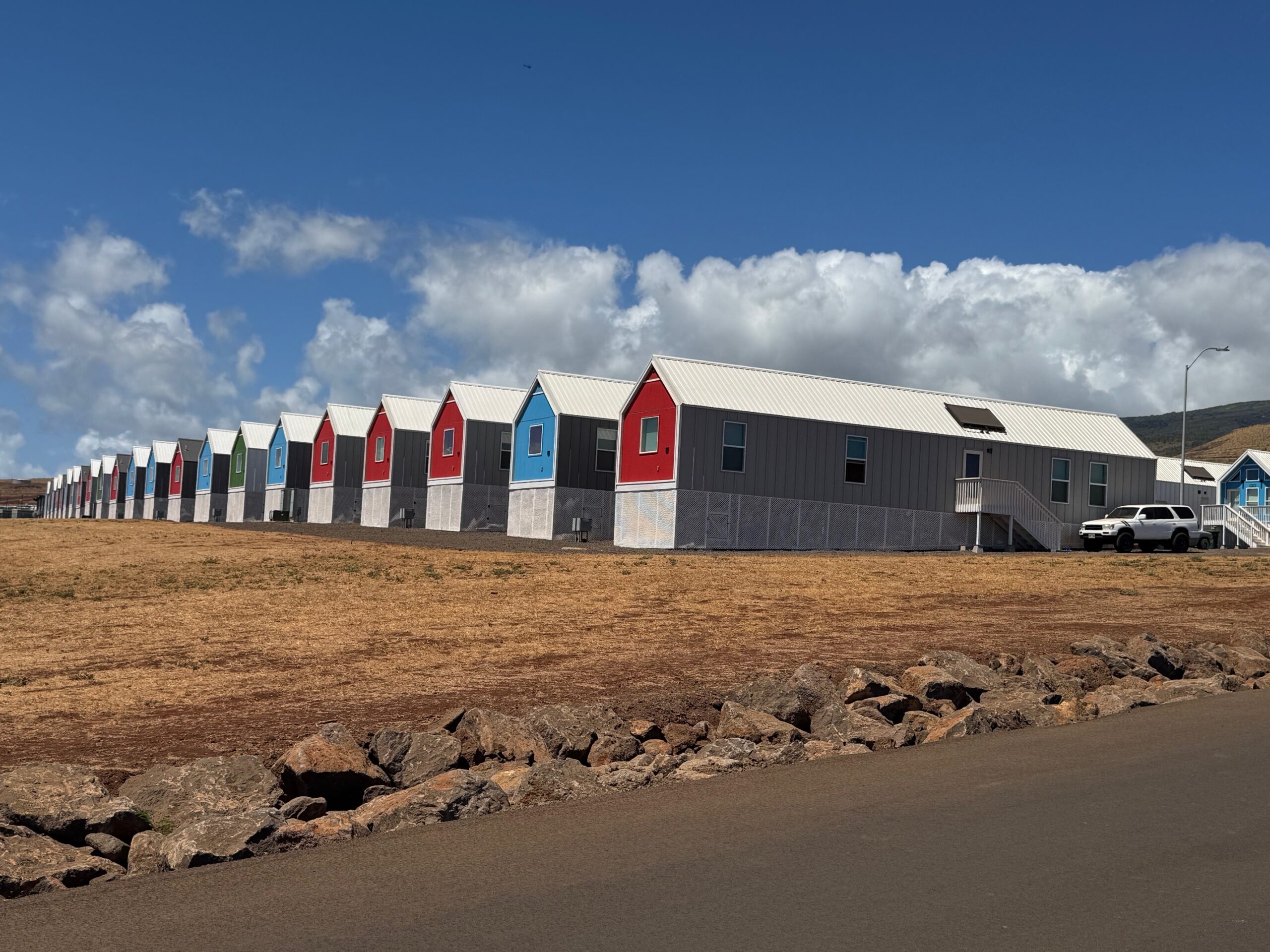
FEMA has been a critical driver of housing since the fires, providing funding to subsidize displaced families who are renting units on the islands or building temporary projects like Kilohana. Through June 17, FEMA had approved more than $73.1 million in federal assistance for 7,164 survivors of the wildfires and high winds on Maui. That included $50.6 million approved for housing assistance, of which $44.3 million has been for rental assistance. That did not include more than $100 million for the building of Kilohana.
On Saturday, FEMA sent an email to Hawaii Journalism Initiative updating those numbers: “To date, FEMA has provided more than $80 million in Individual Assistance to Maui residents affected by the wildfires, which includes over $50 million delivered for Rental Assistance funding. … For more information on Maui’s recovery, visit fema.gov/disaster/4724.”
A FEMA news release on Dec. 3, 2025, said if the Individuals and Households Program extension is not approved, all assistance under the program will end on Feb. 10, 2026. That would mean at that time all housing assistance will cease. It also means all FEMA Direct Housing units must be vacated without exception, including: direct lease units, the Kilohana temporary group housing site where the Rogers family lives along with 149 other households, private site units, and secondary site units.
The Hawai‘i Emergency Management Agency said it submitted its request on May 30, 2025, but has yet to receive word on a decision.
Joe Campos, deputy director of the state Department of Human Services, said Monday that the state had hoped for a response from FEMA in mid-December, but is now expecting one in the next week or so. The word must come 30 days prior to the deadline, according to FEMA.

“Currently, we’re just waiting for a response,” Campos said on a Zoom call Monday with the Hawai‘i Journalism Initiative. “We anticipate that the response will be positive just because of all of the continued issues that wildfire survivors are facing.”
Campos said that FEMA funding provided housing for 6,775 individuals immediately after the wildfires in Lahaina and Kula and 5,300 have found housing since then. The original number of households in the FEMA Direct Housing program was between “3,300 to 4,000,” according to Campos, and is now down to 754 households.
“A decrease from a high of 4,000 households down to 754 … and then 6,000-something to 1,475 individuals shows a good amount of progress,” Campos said, adding that the extension request is “crucial” as Maui continues to recover from the disaster that killed at least 102 people.
When asked what contingency plans the state has if the deadline is not extended, Campos said they are being worked on and cannot be disclosed at this point: ”We’re having discussions about what the needs are. So, currently, right now, we’re in a needs assessment phase.”
Fellow deputy director of the state Department of Human Services Trista Speer said on the Zoom call, “Given the unique geographical nature of this disaster, being on an island, everyone is working together to identify what those alternative solutions may be.”
Speer added that housing inventory and options are very limited on Maui. She said this is one reason “why we are hopeful that FEMA will continue to be supportive and grant the extension to enable the discussions and planning to continue and to identify what all of these alternatives are.”
Displaced residents and the folks who’ve helped them out since the fire say people still need assistance over two years later.

Desilee Santiago was a Maui County permits clerk for four years before becoming a senior development permit technician at 4Leaf, the company that is helping fire survivors with their permit process, about 18 months ago. She handles 121 permit cases for the Puamana subdivision alone.
“Oh, it’s a crucial need for our community, for sure,” Santiago said of the extension request.
The temporary housing allows families like the Rogers to stay on the west side. All three of the Rogers ‘ohana living at Kilohana work in Lahaina. Sissy Rogers is a 21-year school administrative services assistant at Lahainaluna High School, Liko Rogers is a kindergarten Hawaiian language teacher at Princess Nāhi‘ena‘ena Elementary School, and Puliki is a Pūnana Leo O Lahaina preschool teacher at Nāhi‘ena‘ena.
Sissy Rogers said her family is preparing to leave the 167-unit Kilohana housing complex with the deadline looming. Their options are limited — one of their sons lives in a small unit at the state-run Ka La‘i Ola complex next door to Kilohana, two of their older daughters live with in-laws as the work on rebuilding their homes takes place, and another daughter has a one-bedroom apartment in Wailuku.
Ka La‘i Ola is the 57-acre state-run facility next door to Kilohana that will allow its more than 900 residents to stay until 2029 before being turned over to the Department of Hawaiian Home Lands. Ka La‘i Ola was built for fire survivors not eligible for FEMA funded housing (those without U.S. citizenship/qualified alien status, renters without leases, individuals not occupying damaged property as primary residence, or those whose damages were fully covered by insurance).

“Liko and I will have to sit down and kind of think about, ‘Okay, where would we go for maybe two, maybe three months at the most?’ ” Sissy Rogers said. “And then from there, we just have to figure out some place.”
After providing 18 months of rent-free housing, FEMA began charging fair market rent on March 1, 2025, to all households in its direct lease program, which includes Kilohana that currently has 150 households staying there.
FEMA said 91% of households in the program were renting when they lost their homes, and finding housing for renters is much more difficult.
The rates are based on fair market rent rates on Maui from the U.S. Department of Housing and Urban Development. They are $1,750 per month for an efficiency unit, $1,762 for a one bedroom, $2,309 for a two bedroom, and $3,103 for a three bedroom.
A spokesperson from FEMA said in an email to the Hawaiʻi Journalism Initiative: “FEMA’s Direct Temporary Housing Assistance and financial assistance is currently approved until February 10, 2026. The State of Hawaiʻi requested an extension for the Individuals and Households Program for an additional 12 months. The request is currently under review.”
The spokesperson added: “Direct Temporary Housing is intended to be a short-term solution to help survivors stabilize after a disaster. FEMA’s goal is to support survivors as they transition into permanent housing as quickly as possible. FEMA continues to work closely with the State of Hawai‘i to support long-term and permanent housing solutions for Lahaina fire survivors.”
Like the Rogers family, Doug Reynon and his life partner Patricia Balderas are waiting on their houses to be brought online before they can move out of FEMA housing. Reynon turned 81 years old on Dec. 26, and Balderas is 82. They met while living in FEMA-funded housing in the Royal Lahaina Resort soon after the wildfire.
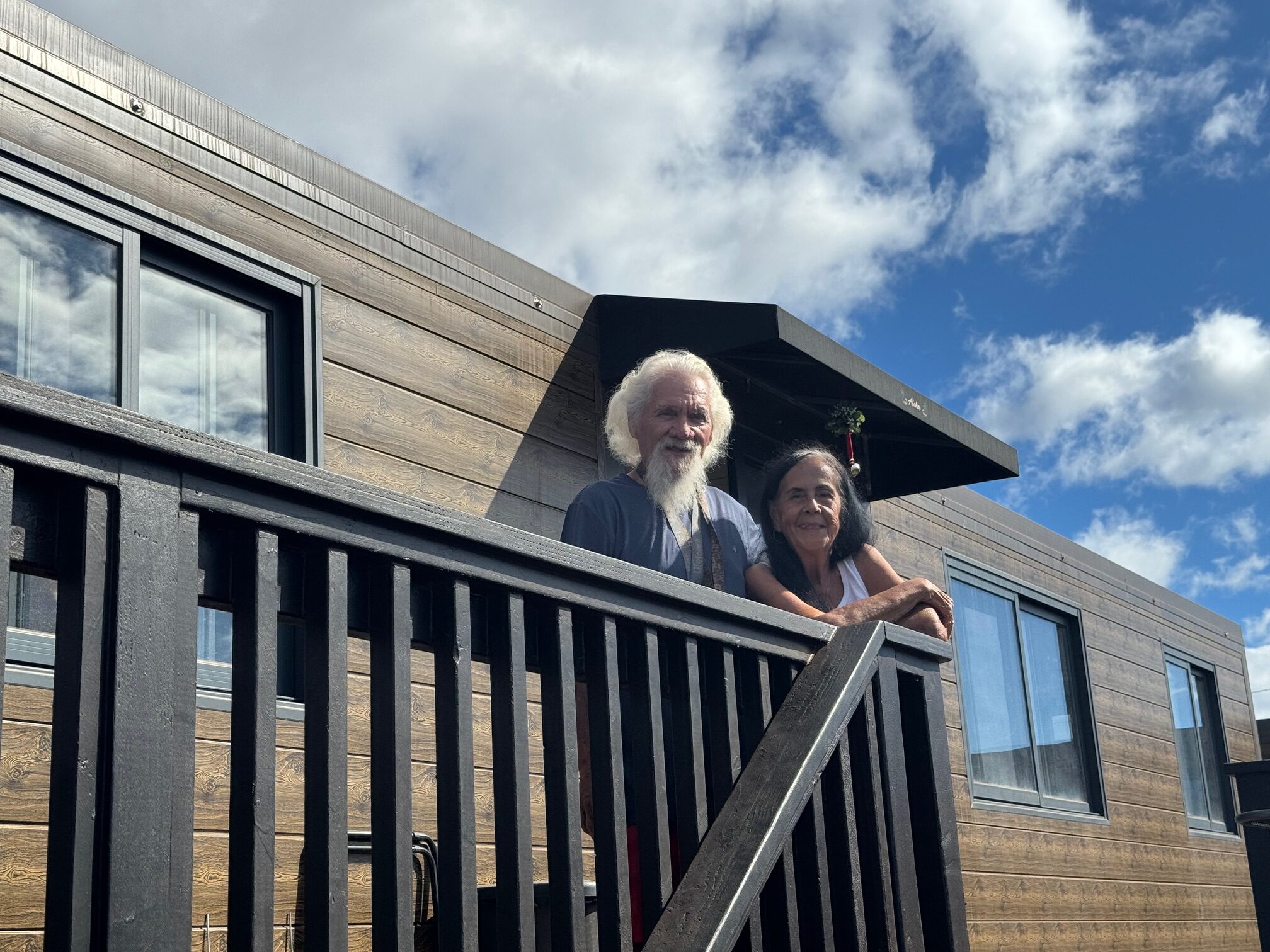
Before the fire Reynon lived at Hale Mahaolu near the Lahaina Aquatic Center and Balderas owned a four-bedroom house on Kahoma Street. Both dwellings were destroyed in the fire.
The couple used $200,000 in insurance money to buy a pair of 800-square-foot tiny homes built in China to place on the Kahoma Street lot where Balderas’ home was destroyed. The tiny homes are in place — one for the couple and one for Balderas’ son and his girlfriend — on the lot where Balderas’ home was located. The front tiny home for Balderas and Reynon is filled with their furniture.
Under the county’s temporary building permits process put in for fire survivors, the water meter is in place and water is flowing, but the couple has not been able to get approval for more than a year to get electricity hooked up for their units. The wall unit for the fuse box is written in Chinese language, which has been a problem for electrical contractors, who must make sure everything is up to code for the electricity to be turned on by Hawaiian Electric.
That has the pair of octogenarians stuck living in a Hale Kai condominium complex apartment in Honokōwai under FEMA-funded housing that could run out in a little more than a month while the structures they have built are not inhabitable without electricity.
Three different electricians have come to the property to try to evaluate the situation for approval to get the electricity hooked up. They currently pay $1,750 per month at Hale Kai condominium complex, but Balderas said that would increase to $5,100 per month without FEMA assistance.
“We just want to get our electricity turned on so we can move in,” Balderas said.
Reynon added: “We know we can’t stay at Hale Kai and we have our unit here all ready to go except for the electricity. … It’s frustrating.”
Santiago, the 4Leaf employee, is helping Balderas and Reynon through the permit process. Santiago said the couple is a prime example of why the state’s request to extend the FEMA housing funding deadline is so important.
“They’re just really frustrated and overwhelmed,” Santiago said. “With the funding, the FEMA funding, the federal funds (possibly) ending in February, they’re just at wit’s end.”
Santiago sees numerous housing crisis situations like Reynon and Balderas that make the state’s extension request “essential.”
There are success stories in the rebuilding process as well, including 32-year-old T.J. Rickard, his wife Makayla and their 1-year-old son Rush. The Rickards lived in FEMA funded housing in Wailuku until moving out in June and they were recipients of a shopping letter under the county’s Ho‘okumu Hou First-Time Homebuyer Opportunity Program on Nov. 18, 2025.
The family now lives in a house in Wailuku where they pay $3,700 per month in rent as they look to buy their home with up to $600,000 from the Ho‘okumu Hou program. The $600,000 is good for the funding over the loan amount that they are approved for to purchase a home.

“We’re fortunate, for sure,” 32-year-old T.J. Rickard said. “With that (FEMA) deadline looming and, if we’re going to have to pay the full price of rent, we’d rather be able to choose where we’re going to pay that rent in a place that fits our family a little bit better while we look for the home we want to buy.”
The county lauded the 100th completed home from the fire zone in a news release on Dec, 2, 2025. It came just a couple weeks more than a year after the first home destroyed in the fire was completed.
“Every week, we’re seeing a handful of homes rebuilt, families who are able to cross that finish line and return home,” County of Maui Recovery Administrator John Smith said in the release. “A hundred structures over the last year is a great milestone to reach. But with nearly 300 homes under construction right now and the launch of various assistance programs such as Hoʻokumu Hou, we’re looking forward to seeing a significant bump.”
EDITOR’S NOTE: This story has been updated with additional information sent to Hawai’i Journalism Initiative on Satuday from the Federal Emergency Management Agency.