
 Hawai'i Journalism Initiative
Olowalu residents fear failing crops, fire risks if water company raises rates dramatically
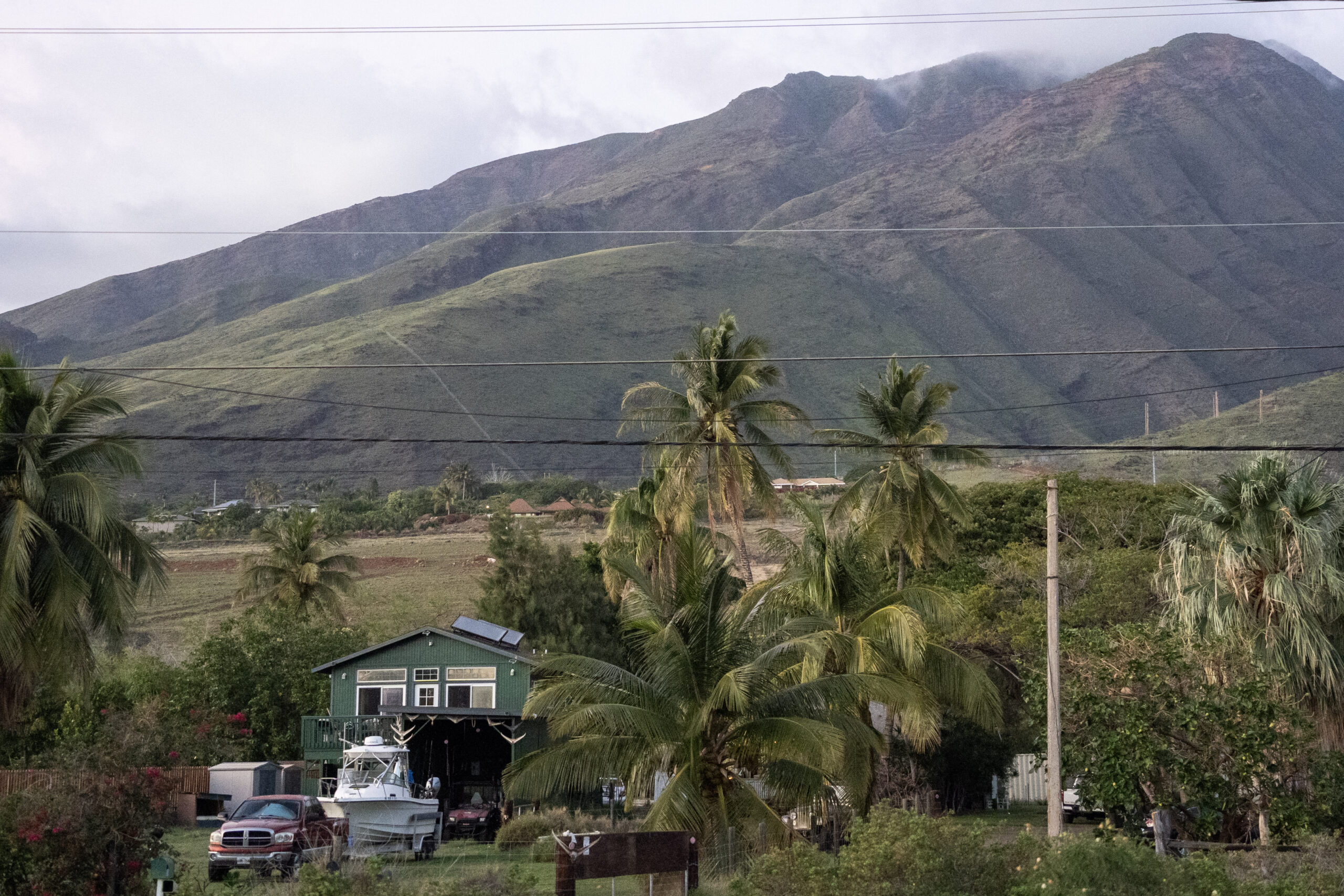
Guinevere Noble and her family have battled water outages and extreme winds to keep hundreds of young palm, citrus, mango, guava and moringa trees alive on nearly 4 acres in Olowalu.
Like many of their neighbors in agriculturally zoned Olowalu — a small community on the outskirts of Lahaina — Maui County requires them to put more than half of their land into farming.
HJI Weekly Newsletter
Get more stories like these delivered straight to your inbox. Sign up for the Hawai‘i Journalism Initiative's weekly newsletter:
But growing and maintaining their crops could get much harder with the Noble family’s water bill expected to soar from $3,000 to over $20,000 a year if Olowalu Water Company receives approval to increase annual revenues by 325.5 percent.
“We will be forced not to water, and the land would go back to barren, which further endangers all of Olowalu through fire hazard,” Noble told the Hawai‘i Public Utilities Commission during a public hearing on Tuesday.

Olowalu Water Company, which services 75 potable water customers and 72 non-potable water customers, says it hasn’t raised its rates in 15 years and has been losing money for the past seven years.
Cades Schutte attorney Reyn Ono told the commission that the company is facing the challenge of providing water to 147 customers across 750 acres with a 150-year-old plantation-era system.
Costs have gone up since 2011 when the company last raised its rates, due to drought and declining levels in Olowalu Stream, which supplies nonpotable water to the area. That forced the company to shift from a distribution system that relied on gravity to one that now requires pumping groundwater from a well restored in 2022 and a series of booster pumps, increasing energy costs “significantly,” Ono said.
Olowalu Water Company’s proposal would increase its annual revenue by $879,849 and result in total revenues of $1.15 million, enough to cover its operating expenses of $1.03 million with a “reasonable” rate of return, according to its application.
Ono said the company is proposing a tiered system, meaning that the more water a customer uses, the higher their rate will be.
Potable water tiered rate increases are proposed as follows:
- 0 to 10,000 gallons: $2.25 to $3 per 1,000 gallons
- 10,001 to 25,000 gallons: $2.53 to $5.45 per 1,000 gallons
- 25,0001 to 50,000 gallons: $3.13 to $10.43 per 1,000 gallons
Nonpotable water tiered rate increases are proposed as follows:
- 0 to 10,000 gallons: $1.09 to $3.64 per 1,000 gallons
- 10,001 to 25,000 gallons: $1.09 to $5.64 per 1,000 gallons
- 25,001 to 50,000 gallons: $1.09 to $8.16 per 1,000 gallons
Ono said 81 percent of customers use 5/8-inch meters and will actually see a decrease in their monthly service fees, from $28.80 to $28.35 for potable water customers and $21.60 to $11.30 for nonpotable water customers.
Nonpotable water customers with 3/4-inch meters also will see a decrease from $21.60 to $16.95.
All other categories will see an increase in the monthly service fees, with the biggest changes for those with the largest meters. Potable water customers with 2-inch meters, for example, will experience a hike from $26 to $226.80, while nonpotable water customers with 4-inch meters will see those fees increase from $27 to $282.50.
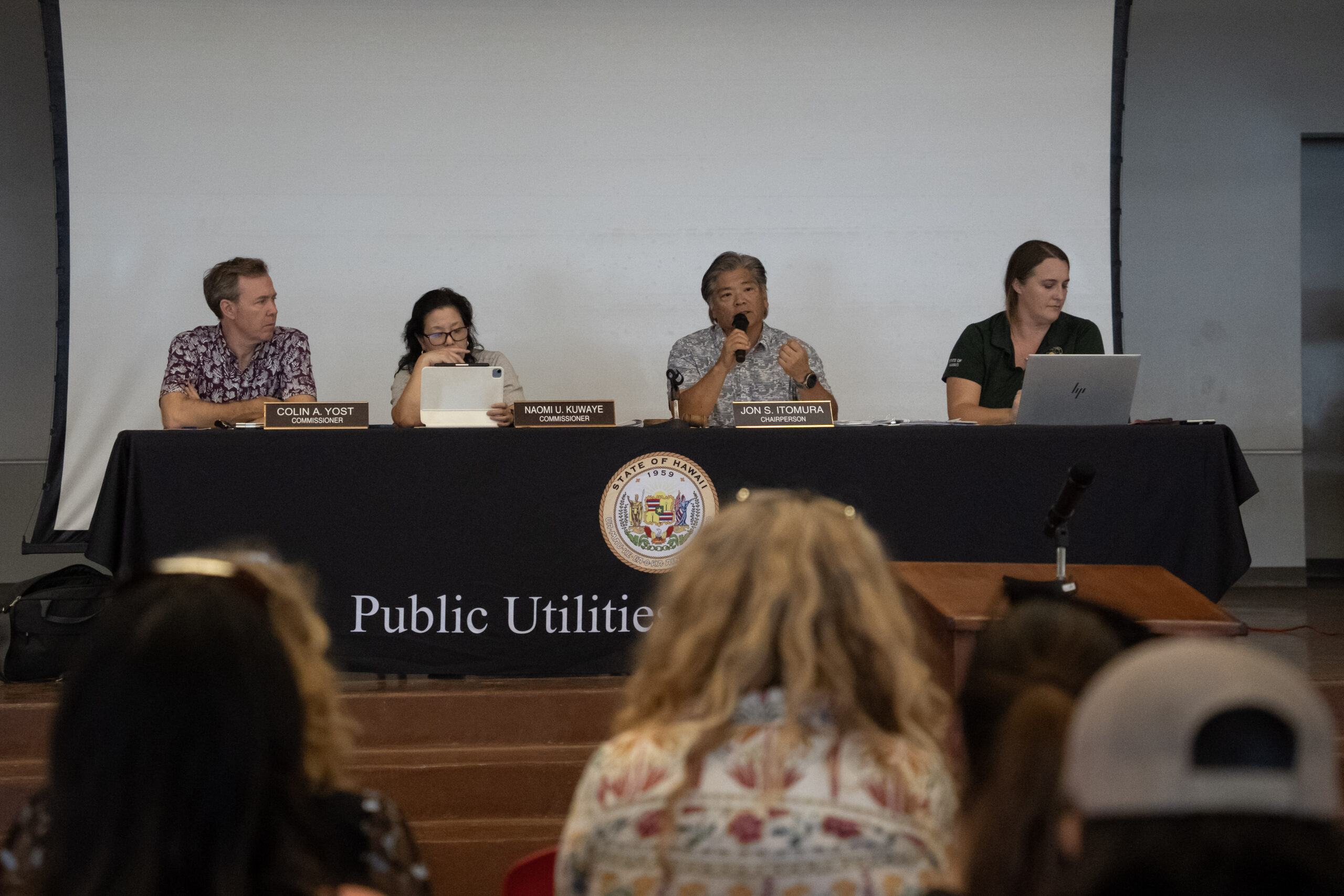
Customers opposed the company’s request, saying the new rates would make farming nearly impossible and pointing out that they can’t even rely on Olowalu Water Company for consistent supply.
Before she built her home on the property she acquired in early 2021, Olowalu resident Sharie Arbucci had to submit a farm plan to the county for approval. She planted citrus, papaya, coconut, guava, fig, mango, moringa, starfruit, avocado and other fruits and vegetables.
After years of nurturing them, the plantings are just starting to mature and produce, and Arbucci is at the point where the investment may finally start to pay off. But now, she said her nonpotable water bill would go from $155 a month to $935 a month under Olowalu Water Company’s proposed increase.
Last year when the company’s nonpotable water system broke down from June through October “during peak growing season,” Arbucci had “little to no water.” She faced a tough choice: let all the fruit trees, vegetables and herbs she’d planted over the course of five years die, or run drinking water through a garden hose to save them.
“I chose to save my plants, and not all of them survived,” Arbucci said. “My potable water bill tells the story.”

In September, during the worst of the outage, Arbucci used 42,782 gallons, 66% more than her normal use.
“That water wasn’t for drinking or bathing,” she said. “It was just to keep my county-mandated plantings alive because OWC’s system failed. OWC gave no warning, no backup water supply, no credits, no compensation. I paid the full cost of their failure.”
Eddy Garcia, who’s been doing regenerative farming between Moloka‘i and Maui for more than 35 years, also said he’s gone months without water due to leaks or breaks in Olowalu Water Company’s system.
He’s watched countless parched crops give out on his 25-acre farm in Olowalu and has about 300 ‘ulu trees “on the edge of dying.” He’s trying to water them on a meter with no pressure and has spent a “ludicrous” amount of money on solar systems to pump water to his crops.
Garcia said his water bills would go from $4,000 a month to more than $30,000 if Olowalu Water Company raises its rates.
“With a 600% rate increase, my farms will be destroyed,” Garcia said.
Garcia said the company just doesn’t have the staffing to address the “constant disarray in the system.” He said the solution is not a rate hike, but an overhaul of the entire system.
“You need to see where all the problems are at,” he said.

Affordable and accessible water is not only crucial for helping crops thrive, but also for keeping the landscape watered and less prone to fire, residents said.
Julian Bonfardin, who lives in the valley surrounded by the Olowalu Cultural Reserve, said his property was “just flat desert” when he first bought it. He estimated that there about “a dozen fires have ripped through the area” over the past decade, including a 200-acre brush fire in August 2018 that forced the evacuation of 30 homes, and a 120-acre fire June 2023, just two months before the devastating August 2023 wildfire in Lahaina.
“We’re surrounded by what amounts to a tinderbox,” he said.
Matthew Kramer, Bonfardin’s business partner at Olowalu Dog Ranch, said they’re growing $40,000 worth of crops “to protect this little piece of land.” Meanwhile he said, Olowalu Water Company isn’t doing anything to control the dry grass around them. When fires do break out, “it was us out there with 5-gallon buckets coming out of the river and bringing our skid-steers out and pushing the fire out of the way. It wasn’t the water company coming down there to help.”
Bonfardin said the water rate increase for his home is “feasible,” but the rates for their small dog-boarding business would drastically increase from about $600 a month for water to nearly $5,000 a month, a “substantial portion of the monthly revenue.”
He said he couldn’t imagine how the water company could “have the gall to ask for that,” especially given that many of the people living in the area are low-income families or retirees.
“It’s obvious that every year things get more expensive, every year you need to be able to make more money to fund the business itself,” Bonfardin said. “The issue is, if they’ve been running at a loss for the last seven years, it feels like what they’re trying to do is recoup seven years of poor management in one rate increase to us.”
Olowalu Water Company representatives declined to answer questions after the hearing but said via email that “customers have benefitted from lower rates for many years.”
“To be clear, those losses are not being recouped in this rate case,” the company told the Hawai‘i Journalism Initiative Thursday. “Those losses are carried by the company’s owners. The proposed rates are meant to cover OWC’s operating and energy costs going forward.”
The company confirmed that its nonpotable water system had reduced capacity from June to September of last year “due to a lack of water from Olowalu Stream and pump failure.” The need for a custom replacement pump delayed the repair, and in the meantime, the company said it diverted what it could from the stream and supplemented that with limited groundwater from the potable well.
While it asked nonpotable customers to conserve water, the company said it was still able to make 3 million to 6 million gallons of nonpotable water available per month for irrigation.
There were no interruptions to the potable water system, the company said.
Over the last four years, the company has made “significant improvements” to the nonpotable system, including adding a groundwater irrigation source, relining reservoirs and installing booster pumps and new filters.
However, “equipment is not foolproof, and repairs are needed form time to time,” the company said. Nonpotable water supply is also subject to service interruptions and pressure issues.
“Many residents of Maui have been consistently subject to water use restrictions,” the company said. “OWC does not have control over rainfall or water use restrictions. OWC will continue its efforts to provide sufficient non-potable and potable water for its customers.”
When it comes to fires, the company said that it “ensures that sufficient water is available for fire protection that is accessible to the fire department and private water trucks.” It encouraged customers to put in native drought tolerant plants with low flammability, which “would reduce the risk of fire and require less water, reducing water costs.”
Commission staff said that per state rules, a decision on the water rate increase should be made within six months of the company’s application date, which according to commission records was filed Dec. 30.