Hoʻonani Village project recommended for first reading passage by full Council; calls for deferral set aside
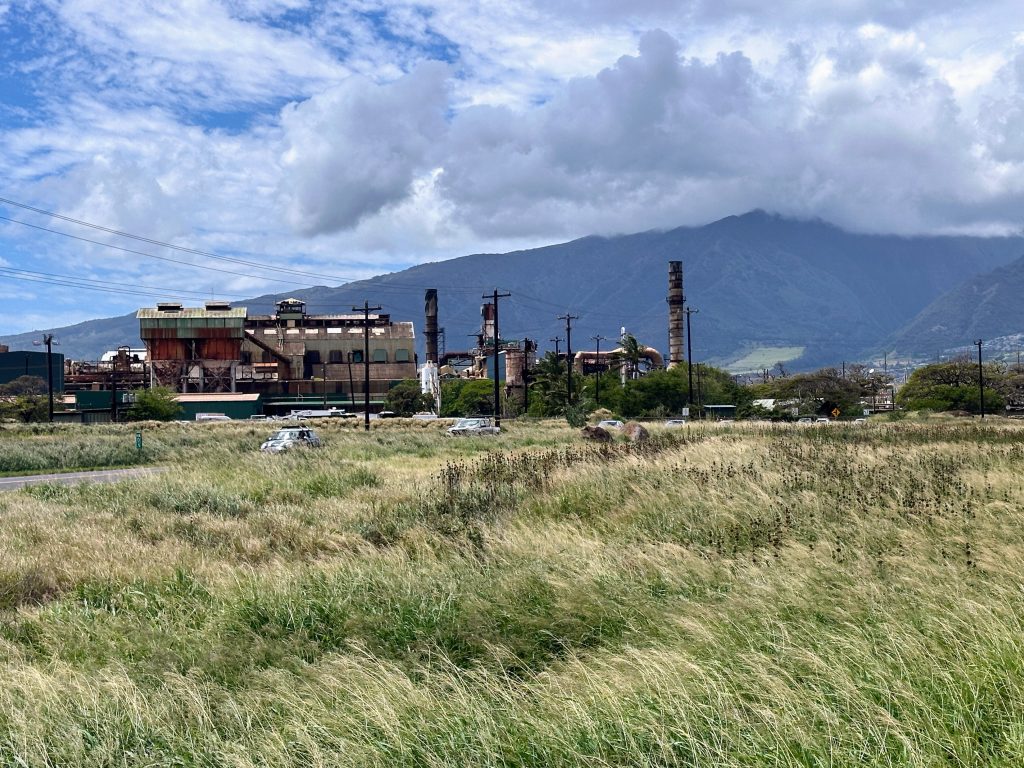
A Maui County Council committee voted 5-1 Wednesday to recommend passage of two land use bills that would clear the way for the proposed Hoʻonani Village mixed-use development on former sugarcane fields near Kahului Airport, overriding deferral recommendations from three county departments with concerns about infrastructure shortfalls.
Bills 163 and 164 would expand the Maui Island Plan’s urban growth boundary and change the Wailuku-Kahului Community Plan designation from agriculture to business-multifamily for approximately 166 acres near Pūlehu and Hansen roads and Maui Veterans Highway. The site is part of a larger parcel that Hoʻonani Development plans to transform into an approximately 1,608-unit workforce housing community with light industrial, commercial, office and open space components.
The Disaster Recovery, International Affairs and Planning Committee met for roughly two and a half hours Wednesday afternoon. Committee Chair Tamara Paltin presided, and Council Member Member Shane Sinenci cast the lone dissenting vote. Council Members Yuki Lei Sugimura, Keani Rawlins-Fernandez and Kauanoe Batangan were excused.
A third measure, Bill 165, which would change the project’s zoning to M1 Light Industrial, was not acted upon. The committee agreed to hold it pending the State Land Use Commission’s action on a district boundary amendment, which cannot proceed until the final environmental impact Statement is accepted.
Planning Department urges caution
Planning Director Jacky Takakura presented a detailed overview of her department’s concerns, recommending deferral. She warned that the Council-initiated legislative process, which allows the Council to move the project forward without a standard private applicant process, results in less thorough impact analysis than would normally apply to a development of this scale.
The director also presented updated land-use inventory data showing approximately 9,352 vacant acres within urban and small-town designations islandwide, with 3,042 acres in Central Maui alone. Combined with University of Hawaiʻi Economic Research Organization projections showing average Maui population growth of just 0.1% annually through 2043, Takakura argued the Maui Island Plan urban growth boundary expansion may not be warranted.
“Maui County might be able to accommodate population changes within the existing growth boundary,” she said. “Amendments to the urban growth boundary should only be expanded if the inventory indicates that additional urban density land is necessary to provide for the needs of the population growth.”
Takakura also raised concerns about the project’s proximity to Kahului Airport and chronic aircraft noise exposure, infrastructure deficiencies in water and wastewater, an inconsistency between the proposed community plan designation of business-multifamily and the proposed M1 Light Industrial zoning.
Other departments weigh in
The Departments of Housing, Water Supply, and Environmental Management all aligned with the Planning Department’s position.
Department of Environmental Management Michael Petersen confirmed the project is outside the county’s current sewer service area, and the county’s wastewater system does not have sufficient capacity currently for the project.
The developer’s options are to construct a private wastewater treatment facility or connect to the existing system — either by waiting until the Central Maui Wastewater Reclamation Facility is completed, estimated around 2030, or waiting for increased capacity at the Kahului facility, for which no completion date has been set, he said.
Department of Water Supply Engineering Program Manager James Jensen reported that the county’s system is currently operating between 98% and 100% of reliable capacity, meaning no new market-rate service connections can be issued in excess of 1,200 gallons per day. The developer is pursuing a private well and has discussed a long-term goal of partnering with the county and eventually dedicating the private water system to county ownership, though Jensen said those discussions remain in early stages with no commitments made.
Developer makes the case
Attorney Jeff Ueoka of Well Street Law, representing Hoʻonani Development, argued that the Council-initiated process was designed precisely to speed up housing delivery. He said the project’s primary focus is workforce housing—targeting rents at or below 140% of area median income—with the light industrial, commercial, and office components serving as ancillary uses to be developed in later phases.
Ueoka said the developer intends to seek a 201-H exemption to expedite the first phase of approximately 270 units, with a goal of obtaining building permits by January 2028 and having buildings online by mid-2029. He cited a September 2025 House Maui/Hawaiʻi Community Foundation study estimating a minimum of 3,800 new housing units are needed in Central Maui between 2020 and 2030, with a maximum projection of 6,700.
Ueoka said the developer is asking for flexibility, not a blank check. “We just want the flexibility to move forward without being locked into little boxes, because Maui will change as we move forward in time,” he said.
He noted that a draft environmental impact statement was published in March, and the public comment period closed May 7. A final EIS is targeted for submission to the State Land Use Commission in September.
Public testimony
Three members of the public testified. John Pele, executive director of the Maui Hotel and Lodging Association, testified in support, recounting how his daughter left Maui at age 25 because she could not secure housing. And, the same is true for workers in the hospitality industry, he said.
“The biggest hurdle is the housing situation,” he said. “We can promote all these jobs we want, but we can’t promote the housing opportunities to keep our people here.”
Maui Tomorrow Foundation Executive Director Albert Perez testified in opposition, urging the council to reject the proposal as currently presented. Perez said a 17-page analysis he submitted identifies deficiencies in the draft EIS, and raised concerns about chronic aircraft noise health risks and water quality.
Committee debate
Council Member Nohelani Uʻu-Hodgins delivered an extended statement of support, citing 2025 University of Hawaiʻi Economic Research Organization finding that Hawaiʻi remains in a severe housing crisis. She noted that Kahului ranks 55 out of 65 towns statewide for out-of-state home purchases—meaning it remains a deeply local community.
“I don’t need too many studies to study what we already know, that we have a housing shortage,” she said. “My primary issue is just for our local people to stay home, for our brain drain to stop, for our number one export not to be our people.”
Council Chair Alice Lee cautioned against front-loading conditions at the earliest stages before the project’s full scope is known, noting that conditions add costs and that many Maui affordable housing projects have ended up in what she called “the affordable housing graveyard” because developers agreed to requirements they ultimately couldn’t meet.
Paltin clarified that conditions on a Maui Island Plan amendment or community plan amendment are not permissible anyway; any conditions could only be attached to the change in zoning at a later stage.
Council Member Tom Cook said that the site—on disturbed former agricultural land with no active farming—is among the most cost-effective parcels on Maui to develop. “If we want to have housing for Maui’s local residents, that is as close to affordability as possible, this particular site is it,” he said.
Council Member Gabe Johnson called for urgency. “If we’re in a crisis, we best act like it now,” he said.
Council Member Kauanoe Batangan, representing the district where the project is located, said that had he been present for the vote, he likely would have preferred to wait for the final EIS before acting, though he leaned toward recommending approval given the number of additional steps that remain in the entitlement process before any building can begin.
Next steps
The committee approved amended versions of both bills on roll call votes of 5-1, with Sinenci casting the lone no on each.
The bills now head to the full Maui County Council. Paltin noted uncertainty about whether passage at the Council floor would require five or six votes, depending on whether the County’s updated island-wide land-use inventory is deemed to satisfy the criteria in Maui Island Plan Policy of whether existing available land.
Deputy Corporation Counsel Michael Hopper said that question would require further review.
Bill 165, the zoning change to M1 Light Industrial, will be held until after the State Land Use Commission acts on the District Boundary Amendment following acceptance of the Final EIS.
Sponsored Content