 Hawai'i Journalism Initiative
Family of Maui patient evacuated to O‘ahu after storm scrambles to relocate him again

Clayton Kim got the bad news on Wednesday. The O‘ahu hospital where his 57-year-old son Brent Kim has been receiving care since being evacuated from Maui in March can no longer care for him.
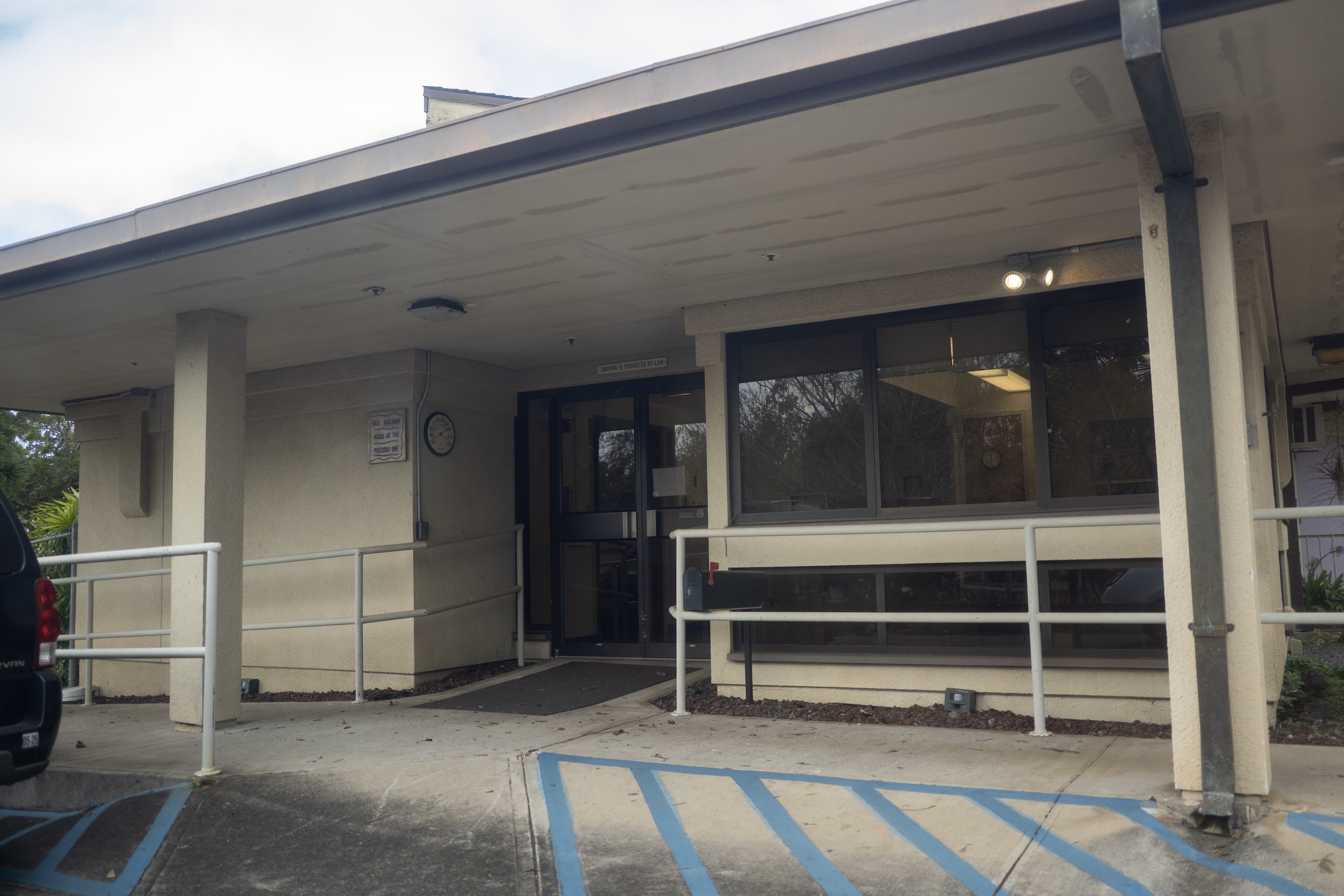
Now he’s scrambling to find another place that can take his son, who was one of 112 patients displaced from Kula Hospital after 4 feet of rain damaged the aging building and nearby Hale Makamae, an intermediate care facility for residents with developmental disabilities. It had been Brent Kim’s home for 51 years.
Brent Kim can’t speak, walk or eat on his own. He suffers regularly from seizures. Clayton Kim said the staff at Lē‘ahi Hospital took good care of him, but in the end the Kaimukī facility said it lacked the staffing and services that he needed.
“Wherever he goes, hopefully it’s as good or better as what was being done for him at Lē‘ahi,” he told the Hawai‘i Journalism Initiative. “Still, my long-term goal is to get him back to Maui under the care of the people who know how to care for him.”
Since eight of the nine Hale Makamae residents were evacuated from Maui to O‘ahu two months ago, they’ve struggled to adjust to unfamiliar settings and new staff. Families have had to make frequent interisland trips and keep in touch via video calls. One patient went two weeks without a critical device that serves as his only form of communication with the rest of the world.
Clayton Kim, who is 83, lives on O‘ahu, but the comfort of being closer to his son is offset by the stress of seeing him separated from the staff and fellow residents of Hale Makamae, which is the only facility of its kind in the state.
“The important thing is not me,” he said. “The important thing is him. Where is the best place for him? Is it on O‘ahu with his father nearby that could see him more frequently? Or is it back at his home, at a place that has been his home for over 50 years, with a staff that can care for him much better than his father could?”

Clayton brought his son to Hale Makamae when Brent was 6 years old. At the time, he was going through a divorce, and Brent’s mom was moving back to Korea. He felt he couldn’t care for his son by himself.
He started looking at group homes on O‘ahu and California, but he didn’t like what he saw. On a flight back home to Hawai‘i, he happened to sit next to doctor from Maui who told him about a newly founded center in Kula.
“As soon as I saw the place and what they were doing and how they were caring for people similar to my son, it was a no-brainer,” Clayton said.
There was an extra bed open, and he “jumped at the chance.” The transition was hard. For the first couple of years, he flew to Maui and brought Brent back home every other weekend. But he eventually grew to trust the Hale Makamae staff. Not only could they handle Brent’s high-level disabilities, but they treated him like family.
“My son doesn’t recognize me,” Clayton said. “He can’t speak. He can’t say, ‘hello, dad,’ or anything like that, so he doesn’t miss me. And that kind of helps a lot, too (with the separation).”
On March 21, a Saturday night, Clayton found out that Hale Makamae residents were going to be evacuated due to the storm damage. Maui Health told him that Brent was heading to a hospital in Pearl City on O‘ahu. He begged them to wait, to give him time to check out the place. After doing a quick search, he decided on Lē‘ahi, which offers nursing home and adult day health services. He approved the transfer “under duress.”
Ever since, he has been stressing about whether Brent will be able to stay. The staff said they didn’t have the kind of programs that he would’ve gotten at Hale Makamae, like how to use a spoon or move a toy from one place to another. And while those services are important, Clayton pointed out that “over decades, he hasn’t made progress that one would hope for even at a place like Hale Makamae.” He was more worried about his son having a place to stay.

Lē‘ahi also doesn’t have the staffing to constantly watch Brent, who once had free reign at Hale Makamae to roam the hallways in his wheelchair. At night, he sometimes crawls off his low-lying mattress onto the floor, which Clayton said has to be reported as a fall.
On Wednesday, Lē‘ahi told him Brent would have to transfer elsewhere. Clayton said he is looking at other places on O‘ahu with openings. The Hawai‘i Department of Health ombudsman who has been handling Brent’s case told him that if the hospital wanted to move Brent out this weekend, they could.
“My plan is to try and find something as soon as possible,” Clayton said.
He said he doesn’t understand why Maui Health could find places on Maui to keep most of the other patients but sent the Hale Makamae residents away.
Maui Health’s then-CEO Lynn Fulton said in March that there was no other place for them to go on Maui, and that the hospital operator “didn’t have a choice” but to transport them off-island. Clayton says he doesn’t buy that, “especially when the staff is available to take care of them” on Maui.
Interim CEO Wade Ebersole said in a statement to the Hawai‘i Journalism Initiative on Thursday that off-island transfers “were not ideal” and that decisions on where to place people were based on each individual’s “clinical needs, level of care required and the availability of appropriate placement options at the time.”
Ebersole added that there were “no new updates to share at this time regarding timelines or future operational decisions for Kula Hospital or Hale Makamae.” Comprehensive assessments are still ongoing.
“We know how important Kula Hospital is to the Upcountry community and to the families of our residents, and we understand that this uncertainty is difficult,” Ebersole said. “While no decisions have been made, we remain fully committed to serving the Upcountry community and are actively exploring several options to restore services at Kula Hospital and support our long-term care residents. We will share updates as soon as new information becomes available.”
Sean Hanada, CEO of the O‘ahu region of the Hawai‘i Health Systems Corporation that oversees Lē‘ahi, said he couldn’t speak directly about individual patients because of health privacy laws. However, he said because of the emergency on Maui, Lē‘ahi “knew that immediate care was needed” and agreed to take patients without the typical full assessment it usually does beforehand to make sure the facility is the right fit. The arrangement was expected to be temporary.
“We viewed ourselves as just a life raft, right?” Hanada said. “A life raft doesn’t stay at sea. So once the situation is more stabilized, then our anticipation was that an appropriate placement would become the next step. And so that’s where it is right now.”
Hanada added that the hospital still has a “legal obligation” to make sure anyone discharged from the facility has a safe, appropriate place to go.
When asked why there aren’t more places like Hale Makamae across the state, Hanada explained that the level of staffing and one-on-one care needed for people with high-level disabilities are financial barriers. Behavioral health tends to fall under the “broad umbrella” of intermediate and unskilled nursing facilities instead of getting the specialized type of care that a place like Hale Makamae provided.
Natalie Kaho‘ohanohano remembers how much effort it was to get Hale Makamae going in 1974. She and her late husband David Kaho‘ohanohano were major advocates for people with disabilities on Maui, and they were among the concerned parents who lobbied state lawmakers to secure the funding to build Hale Makamae’s facility in the 1980s.

In 1992, their son Kelly Kaho‘ohanohano moved in. Kelly is spastic and has cerebral palsy, “so his whole body is getting worse, but his brain is good,” Natalie said. An English teacher who volunteered for the Kula Hospital Auxiliary taught Kelly how to read and write and use a computer to communicate his thoughts.
“His first sentence was, ‘Kelly is a boy,’” Natalie recalled. “And then he said, ‘I love my mom.’ Oh, that was wonderful.”
Doctors thought Kelly wouldn’t live more than 12 years. He’s now 64.
Since the storm and evacuation, Kelly has been at Kulana Malama, a pediatric medical facility in Ewa Beach on O‘ahu. Natalie said it’s a “wonderful” place, but it’s hard to be separated from her son. She used to visit Kelly weekly at Hale Makamae, but now she has to make monthly interisland trips or visit him virtually on Microsoft Teams. She said he’s “doing OK” but has sores that have been getting worse and is preparing for surgery on them in June. He’s had to go to Queen’s Hospital twice for additional treatment.

The night of the evacuation was especially traumatic for Kelly. He wrote on his computer, asking what was happening, and cried as he was taken away on a gurney. His computer couldn’t fit on the medical transport flight, and his family couldn’t bring it on an interisland flight because of the size of the equipment. So, for two weeks, he was without the crucial device until Maui Health found a way to ship it over.
The family taught the staff on O‘ahu how to communicate with him using a spelling board, but that took longer and limited what Kelly could share, and he grew “so frustrated because he cannot say anything,” Natalie said.
She said she hasn’t gotten any updates from Maui Health and has no idea when or if the facilities will reopen. She hopes her son and other displaced Hale Makamae residents, whom she said have been sent to an acute care facility in Pearl City, can come home by Christmas.
“We’re really fighting to get Hale Makamae fixed and bringing them back,” she said.
Clayton and his wife Marilyn Kim, Brent’s stepmom and legal guardian, also worry about the future of Hale Makamae.
“My fear, if this reopening gets prolonged, is that they’re going to lose that group of people,” Clayton said.