Maui Council passes $1.6 billion budget; adds security funding after terroristic threatening arrest
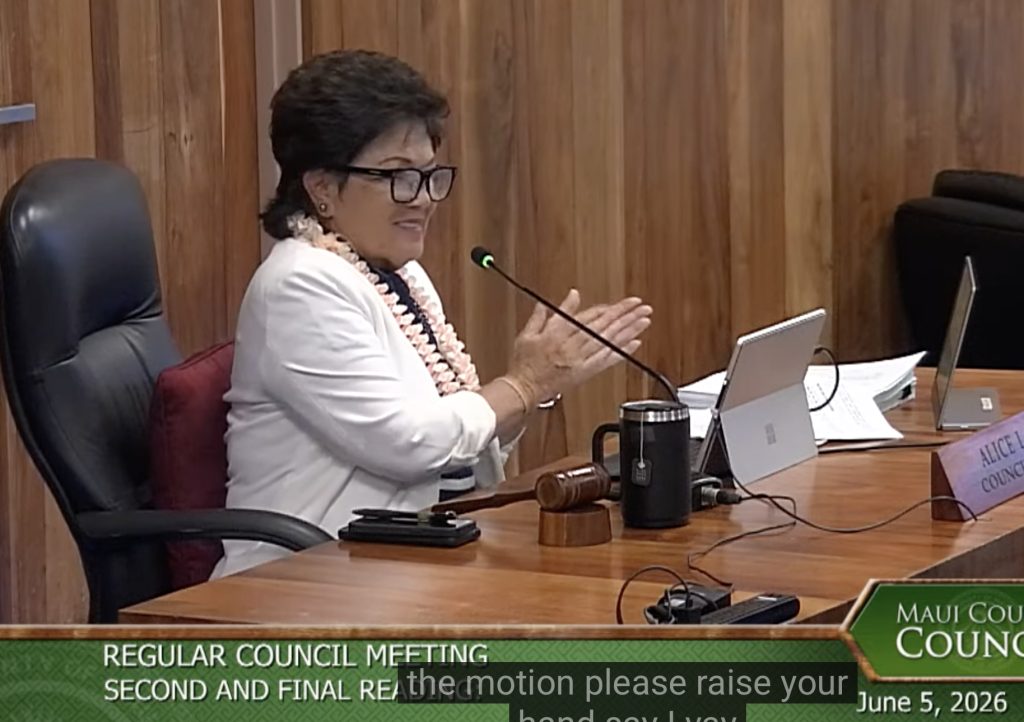
The Maui County Council gave final approval Thursday to a $1.6 billion fiscal year 2027 budget, sending the spending plan to Mayor Richard Bissen’s desk, but not before adding $50,000 for Maui County campus security.
Council Vice Chair Yuki Lei Sugimura proposed the last minute amendment in response last week’s alleged terroristic threatening incident at One Main Plaza in Wailuku.
Kirill Basin, a 40-year-old Kīhei man running for Congress, was arrested and charged May 29 with first-degree terroristic threatening after allegedly entering the One Main Plaza building on Main Street in Wailuku, brandishing a firearm and engaging in a verbal altercation with county employees.
“Unfortunately, it happened,” Sugimura said on the Council floor Friday. “It took an hour and a half for the police to be called. Why was that? Because there’s no plan.”
There’s a cry for help, she said. “We need better security.”
The Council approved the security funding amendment on a 7-2 vote, with Council Members Keani Rawlins-Fernandez and Gabe Johnson dissenting. The measure shifts $50,000 from an animal feed crop pilot program to the Department of Management for countywide campus security.
Sugimura said the amendment was revenue-neutral because the $50,000 shifted to security was funding she had originally proposed. The Council also conditioned the funds so they cannot be used to purchase or operate a security screening machine — a point of contention among members who held differing views on the money’s purpose.
The discussion was shaped partly by a training session held Thursday in which Maui Police Department personnel briefed council members and staff on responding to hostile or armed members of the public, following the One Main Plaza incident and other recent security concerns at county facilities.
Council Member Tamara Paltin raised concerns that the amendment was a late change that didn’t address the security threats prompting it. She noted that the May 29 incident occurred at One Main Plaza, while custodial staff had separately raised concerns about their safety in less-trafficked areas of the county campus and had asked for roaming security. A screening machine at the Kalana O Maui Building, she argued, would not address either problem.
“This is like 11th hour changing, total game changer,” Paltin said. “It’s pushing through something that’s not addressing the situations that are occurring.”
Johnson expressed sympathy for the security concerns but objected to taking the money from agriculture. Farmers, he said, are already under financial pressure from rising shipping costs and the escalating price of fertilizer.
“At the time when farmers really need all the help they can get, I’m concerned,” Johnson said.
He said he could support the security measure if the money were to come from something other than one intended to help farmers.
Council Chair Alice Lee said she has been working to organize a security task force that includes the County’s managing director and could help develop a countywide plan.
Council Member Tom Cook said he could support the amendment, noting that the training session had reinforced for him the vulnerability of county buildings.
“Right now, somebody could walk in here with a shotgun, right up in the elevator and be in this room,” Cook said. “I think having some level of security for whoever is going to be here is prudent.”
Council Member Kauanoe Batangan, who did not attend Thursday’s training, said he would be more comfortable with the funding if there were a specific plan for how to spend it. Rawlins-Fernandez said she could support the funds if they were specifically directed toward a countywide worker safety plan, rather than equipment at a single building.
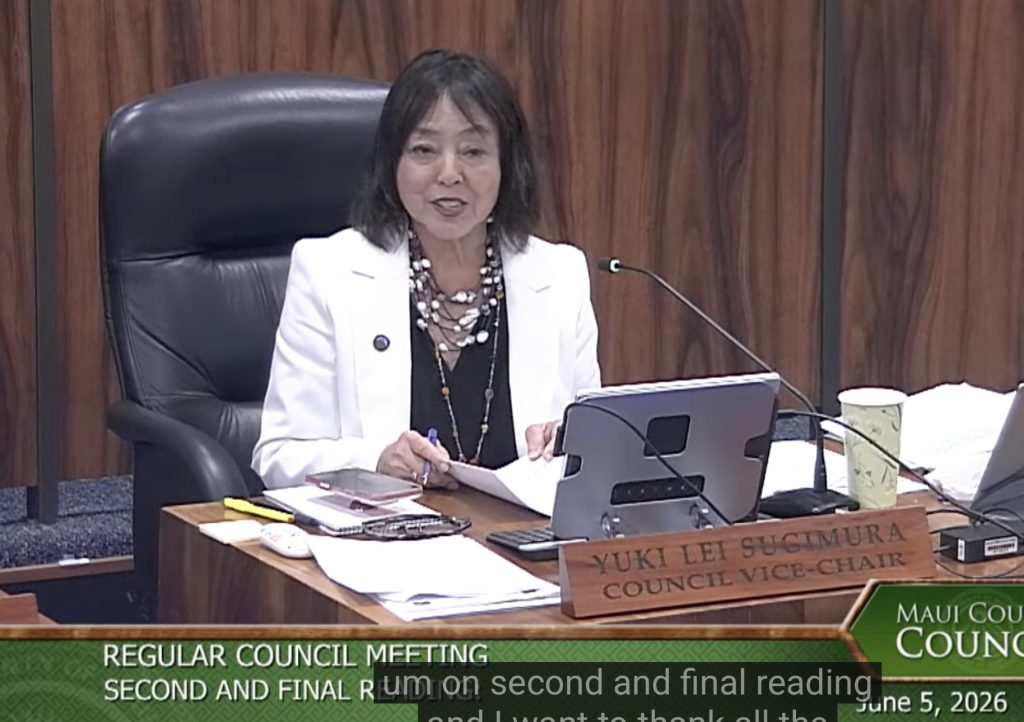
In the end, the Council agreed to condition the funds so they cannot be used for the screening machine, and approved the amendment.
For the budget overall and several accompanying bills, the Council passed the measures on second and final reading 9-0.
Council members expressed appreciation to everyone who helped get the County’s annual spending plan through the often grueling Council budget review process.
“I wish we could go faster,” Johnson said. “I wish we could agree on every little thing, but sometimes we don’t. But the results are a budget that I’m proud of, and I appreciate working with you guys.”
Sugimura said the budget reflects two months of public input, review of County departments, committee discussions and difficult decisions. “I really love the residency area meetings, which were especially important,” she said. “A lot of that was put into the budget, and that input shaped the final budget before us today.”
“Across the county, residents were clear about what matters most–reliable infrastructure, public safety, affordable homeownership, childcare, health services and support for kūpuna and keiki,” Sugimura said.
The budget totals roughly $1.6 billion — about $8.4 million less (roughly half a percent) than the administration’s proposed budget, with money shifted from capital projects to day-to-day operations.
The budget now goes to Mayor Richard Bissen for final action. The spending plan goes into effect with the beginning of the new fiscal year on July 1.
In other action Friday, council members needed at least six votes to approve a measure establishing new hotel zoning districts and surpassed that by passing Bill 88 on first reading by a vote of 7-2, with Rawlins-Fernandez and Johnson voting “no.”
Late last month, the Council’s Housing and Land Use Committee advanced the bill providing a pathway for thousands of short-term vacation rentals to gain hotel zoning instead of being phased-out of apartment-zoned districts.
The Council’s action was contrary to the unanimous recommendation for rejection by all three county planning commissions, which is why the Council needed a super majority for passage.
On Friday, public testimony largely supported the bill. The legislation would create two new hotel zoning categories—H-3 and H-4—intended to match the existing use of roughly 4,500 grandfathered vacation rentals at 104 properties on the so-called Minatoya List. The measure does not rezone any properties on its own but would establish a pathway for property owners to seek hotel zoning as the county phases out vacation rentals in apartment districts under Bill 9.
Councilors also approved Bills 70 and 80 on first reading to authorize $4 million in bond funding for the Hālau of ʻŌiwi Arts project in Wailuku, and they rejected Bill 102, which would have authorized spending $480,000 for the county’s purchase of a Kaʻehu Bay shoreline parcel in Waiehu. A Native Hawaiian family opposed the purchase because it members maintained they have a claim on the property owned by Church of Jesus Christ of Latter-day Saints. After consulting with family members, the Council decided not to support the proposed purchase, which the Bissen administration did not oppose.
Sponsored Content