


Maui Council weighs use of Affordable Housing Fund for homeless population

A Maui County Council committee is considering legislation that would require the County to set aside a portion of its Affordable Housing Fund each fiscal year to provide housing for residents with no income—a population currently excluded from the fund’s eligibility criteria.
Bill 77 would add a definition of “houseless” to the Maui County Code, covering individuals or families who lack a fixed, regular and adequate nighttime residence; whose primary residence is a supervised temporary shelter; or who sleep in “a place not designed for or ordinarily used as sleeping accommodations for human beings.”
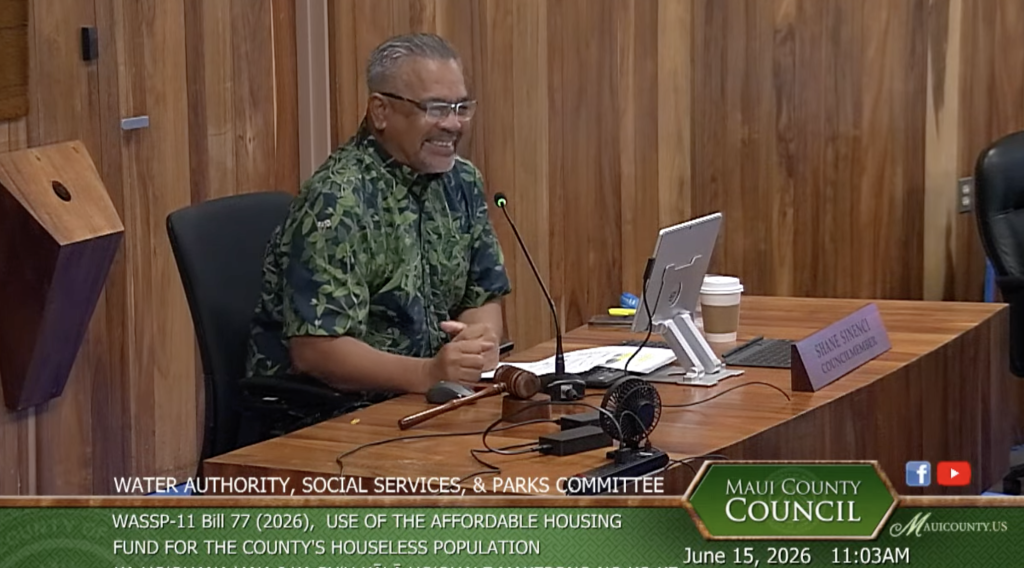
The Water Authority, Social Services and Parks Committee deferred the bill Monday on the recommendation of Chair Shane Sinenci, who said the panel would continue discussing the topic at its next meetings.
Currently, the County’s Residential Workforce Housing Policy defines “very low income” as households earning 50% or less of the area median income. Bill 77 is designed to reach below that threshold, addressing households with no income at all.
“To ensure that housing for the houseless is systematically addressed, the ordinance’s purpose is to require that a portion of the Affordable Housing Fund be used each fiscal year to address this specific need,” the bill says, although a specific percentage has yet to be determined.
The measure would also require the Department of Housing to submit an annual Affordable Housing Fund plan to the Council that specifies the number of housing units to be provided for people without housing and the number of people to be served.
Director flags bill language concerns
Housing Director Richard Mitchell said he supports the bill’s intent but raised concerns about the word “ensure” in a section requiring that a portion of the fund be used each fiscal year. He said that term could be read as a guarantee and suggested softening the language to reflect that the County would be “endeavored” to use funds or issue requests for proposals for appropriate houseless shelters.
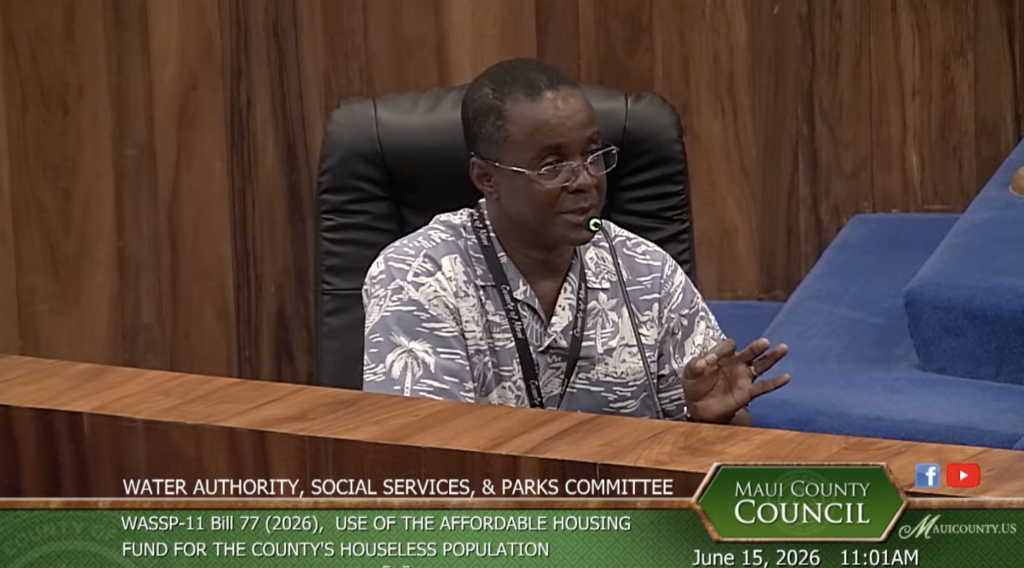
Mitchell also noted that the department, heading into Fiscal Year 2027, does not currently have funds identified for a mandate of this type and that a budget amendment would be needed.
When asked whether the Department of Housing envisions building and managing units directly, Mitchell said no—the department would work with nonprofit partners through a request for proposals process. He also said he intends to add bonus points in future RFP evaluations for projects that incorporate houseless sheltering, to encourage private developers to think more broadly.
Mitchell told committee members he plans to move aggressively on evaluating a roughly 100-acre parcel in South Maui, near the Kīhei Police Station, as a potential site that could serve multiple community needs.
Committee members voiced support for incorporating Mitchell’s suggested language amendments when the bill returns. They also asked that Human Concerns Director Margaret Willis be invited to the next committee meeting, along with housing advocates who can speak to data on the gap between shelter capacity and the number of people currently unsheltered.
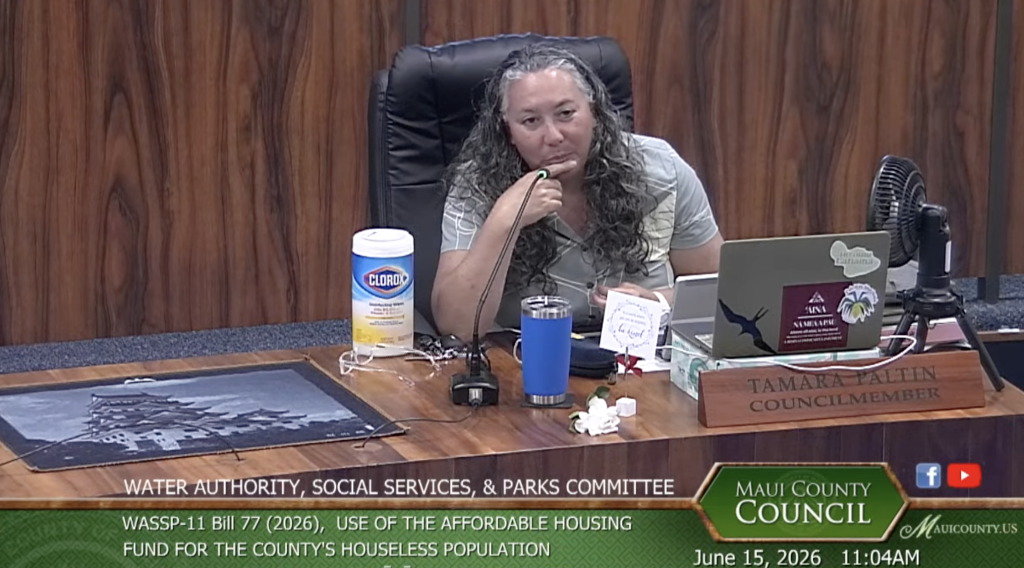
Council Member Tamara Paltin said she was open to creating a new zoning category to accommodate houseless housing projects on county lands, noting the Council recently advanced a bill for new hotel zoning designations as a pathway for transient vacation rentals facing a phase-out from apartment-zoned districts.
Council Member Keani Rawlins-Fernandez suggested that a conditional use permit approach for public lands might be faster than a full zoning code change.
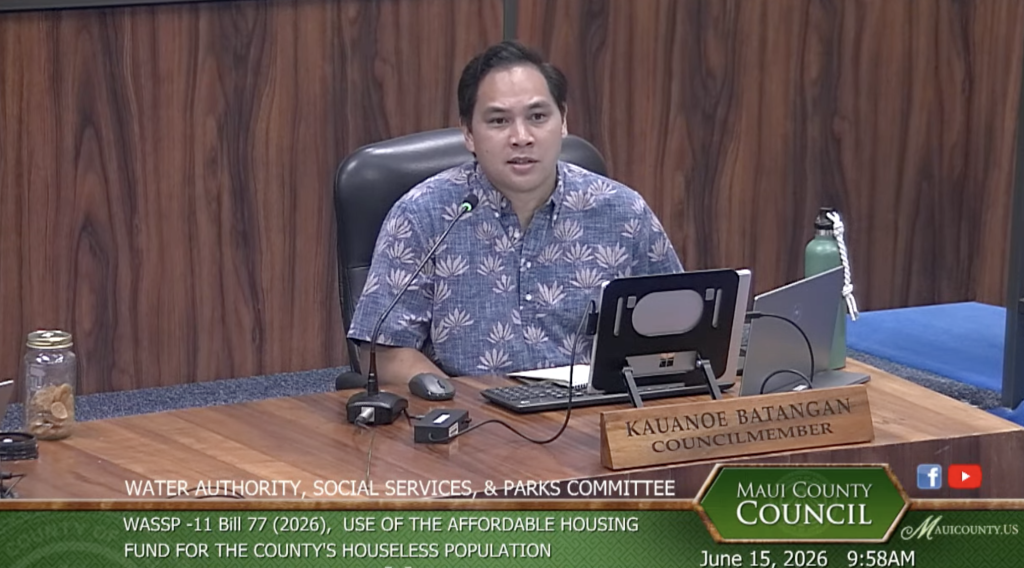
Council Member Kauanoe Batangan asked whether the department plans to manage long-term or permanent housing units directly, or contract out those services to a nonprofit. Mitchell confirmed the latter — the department is not staffed or equipped to manage facilities directly.
Paltin acknowledged that Kauaʻi’s houseless housing work took years to develop and that Maui would face its own learning curve, but said the County needed to start. “If we don’t start now, then we’ll be further years behind,” she said. “We needed to start 10 years ago.”
Council Member Nohelani Uʻu-Hodgins asked Mitchell to share the list of potential county properties that could be developed for housing.
Sinenci also noted that the US Department of Housing and Urban Development has restructured its Continuum of Care funding since June 1, shifting away from the “housing first” model toward a broader range of approaches including street outreach, addiction treatment and job training. A staff correction to the record clarified that a previous administration had drawn 90% of available Continuum of Care funding, the current administration brought that to 30%, and Congress has proposed restoring it to 60%.
Advocates urge action
Public testimony drew advocates with direct experience working with Maui’s houseless community.
Waiehu resident Lala Johnson, who has worked with houseless youth and families, testified in strong support of the bill.
“The housing crisis on Maui did not begin with the Lahaina fires, but the disaster exposed and intensified a crisis that already existed,” she said. “Today, many families remain displaced, living in temporary situations, doubling up with relatives, living in vehicles, or struggling to secure stable housing in a market that has become increasingly unattainable for local residents.”
Johnson, who said she experienced a homeless relocation firsthand in 2021, argued that displacing people without providing stable alternatives fails to address the root causes of homelessness. She called for puʻuhonua-style refuge spaces rooted in cultural practices and urged the committee to prioritize lifelong Maui residents, kūpuna, veterans, and families displaced by economic hardship and disaster.
“They are lifelong Maui residents — kanaka families, elders, workers and individuals who have simply been priced out of the place they call home,” she said.
Lori Jay testified that she has delivered food to encampments and hotels for roughly 10 months following the Lahaina fires. Then, she spent seven months working with a transitional housing operator said the County should redirect money spent on dislocating people toward housing solutions.
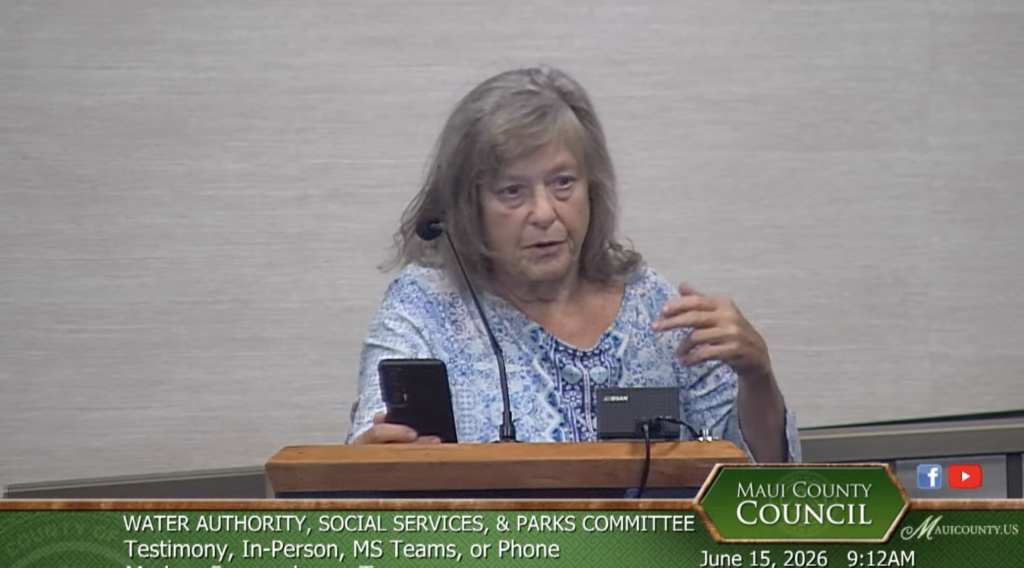
“The money that we’re spending on cleaning up the beaches and on doing sweeps — sending trash mobiles and moving cars — we could be spending to refurbish a couple of these places that are dormitories,” she said.
Many houseless individuals are not struggling with substance use and are clear-eyed about what they need, Jay said. Some don’t want housing for a variety of reasons, but if they’re asked, “What would make a difference in your life right now? A lot of them, it’s a shower, a locked door, you know, things that would get them off the street.”
Their needs and situations are unique. “But there needs to be like a sorting hat,” Jay said.
Next steps
Sinenci said the committee plans to focus on the houseless housing issue for the next couple of months. He has scheduled an update on the County’s safe parking initiative for June 29.
Sponsored Content