


Maui Council votes to authorize purchase of West Maui condo unit for kūpuna housing
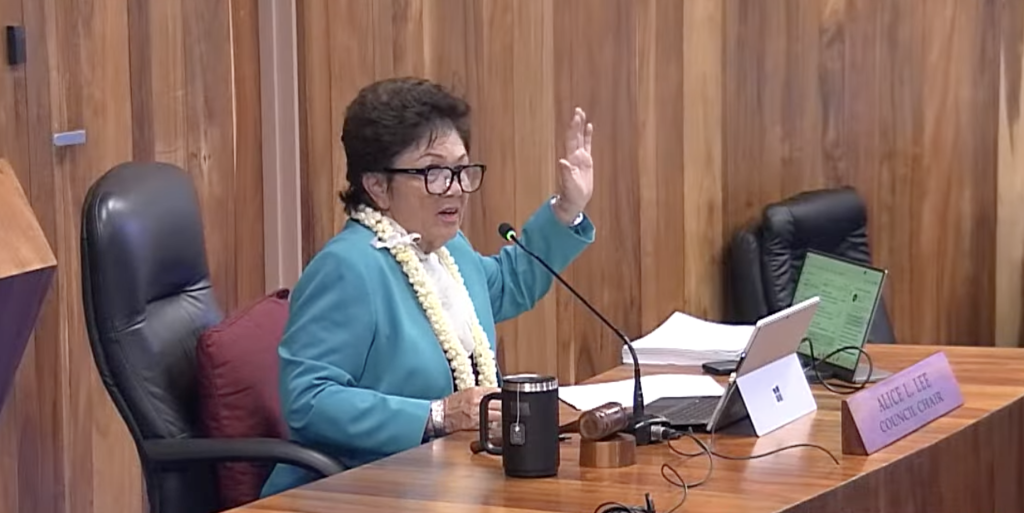
Maui County Council members voted unanimously to authorize the acquisition of a West Maui condominium unit for up to $278,000 to expand the Nā Hale Kūpuna program, which provides permanent housing for kūpuna displaced by the August 2023 wildfires.
Resolution 26-107, introduced at Mayor Richard Bissen’s request, authorizes the purchase of an apartment at Maui Lani Terraces, 3740 Lower Honoapiʻilani Road in Honokōwai, from the Zimmermann Trust. The price is capped at $278,000, excluding closing costs and expenses. The county Department of Housing is buying the one-bedroom, ground-floor unit with federal Community Development Block Grant funds.
The J. Walter Cameron Center, which has served as the resource hub for Maui nonprofits for more than 51 years, administers and manages the Nā Hale Kūpuna program on behalf of the county. Amy Johnson, the center’s development director, told council members the program currently houses 10 people in eight units and has 41 households on its waiting list, more than half of them are still in Federal Emergency Management Agency housing. About 90% of those on the list earn at or below 50% of the area median income, she said.
Johnson described the program’s impact on displaced seniors, including a couple who moved back into their rebuilt Lahaina home after the affordable rent freed up resources to speed construction, and another tenant who was forced into retirement by health issues.
“She says that Hale Kūpuna literally saved her because she could not otherwise afford rent, relying on Social Security,” Johnson said.
Council Vice Chair Yuki Lei Sugimura thanked the Cameron Center for taking on the work. “Until we found you, at one point, the Council was taking this up, and we needed someone to manage all of this, all the units,” she said.
Laurie Fukushima, a CDBG specialist with the County, testified that the program has housed 11 kūpuna displaced by the wildfires over the past two years and that roughly 60 individuals are now on its waiting list. She said the County has about $1.3 million remaining to acquire two or three more units, with a preference for properties in Lahaina. Fukushima said that monthly homeowners association fees on the Maui Lani Terraces unit total $635 and cover water, sewer, rubbish and Wi-Fi, but not electricity.
Gail Rumbaoa, administrator of the Department of Housing’s Federal Housing Programs Division, testified in support of the acquisition on behalf of the department, saying it would preserve long-term affordability for an eligible senior household and help the county meet federal timeliness requirements tied to its use of CDBG funds.
“Unlike new construction, acquisition of an existing unit allows the county to expand its affordable senior housing inventory without the extended development timeline, construction cost uncertainty, and other barriers associated with developing new affordable housing units,” she said.
During questioning, Council Member Tamara Paltin asked about the unit’s location and configuration and confirmed the Council was being asked to act on the resolution on the Council floor on Tuesday. Testifiers confirmed the studio-style, one-bedroom unit sits on the ground floor, a layout Johnson said is in high demand because most program participants are single occupants or couples.
Council Member Gabe Johnson said he likes to reference pop culture, and quoted Star Wars character Boba Fett as saying, “This is the Way.” Johnson said the bit of wisdom traces back to Roman emperor Marcus Aurelius, who ruled from 161 to 180 AD. Today, he is remembered as a prominent Stoic philosopher who wrote “Meditations,” a private journal of his reflections. Aurelius wrote about how what stands in the way becomes the way; that is, reframe the obstacle as a way forward.
Referring to the County’s acquisition of apartments for low-income housing, Johnson said: “This is the way . . . What stands in the way is the way, and I think that buying up housing units with CDBG money is the way, especially for housing our folks.” Residential use of former vacation rental properties would lead to less water consumption, housing for local residents, a reduction of urban sprawl and more open space, he said.
In other business, council members voted 7-2, with Johnson and Keani Rawlins-Fernandez dissenting, to pass Bill 119 on second and final reading. The measure raises fines for loud vehicle sound systems. However, an earlier provision to seize stereo equipment from repeat offenders was dropped from the measure.
Johnson and Rawlins-Fernandez reiterated that limited police resources should be focused on serious crimes and not on responding to noise complaints with ordinance that could be difficult to enforce.
The bill raises the maximum fine for a first noise violation to $500 from the current range of $25 to $100. A second offense carries a $750 fine, up from $100 to $250. A third or later offense brings a $1,000 fine, up from $250 to $500.
Rawlins-Fernandez suggested public education instead of fines, and Lee said she would consider that in future legislation.
Council members also approved a half dozen resolutions on first reading to place various Maui County Charter amendments on the November general election ballot. Those include:
- Resolution 25-216, which would standardize the various deadlines the County Clerk’s office has to follow when processing voter initiative petitions, recall petitions and charter amendments.
- Resolution 26-85, which would remove the English translation of the state motto (“Ua mau ke ea o ka ʻāina i ka pono”) from the charter’s preamble, leaving only the original Hawaiian text.
- Resolution 25-217, which would specify that the time in which an action must be done is computed by excluding the first day and including the last, unless the last day is a Saturday, Sunday or holiday, which would also be excluded.
- Resolution 26-88, which would allow the mayor, with the approval of the Council, to pass an emergency appropriation for an application for a line of credit and clarify that the 1% limitation for emergency appropriations does not apply to funds that have already been allocated to an emergency fund.
- Resolution 26-93, which would dissolve the Independent Nomination Board after a consensus had been reached that it has not worked as intended to vet prospective members of Maui County boards and commissions.
- Resolution 26-95, which would allow the mayor, with Council approval, to reappoint Board of Ethics members to one consecutive term. Currently, members must step down at the end of their terms before they can serve again.
Sponsored Content