Schatz, colleagues introduce legislation to provide paid family, medical leave for federal employees
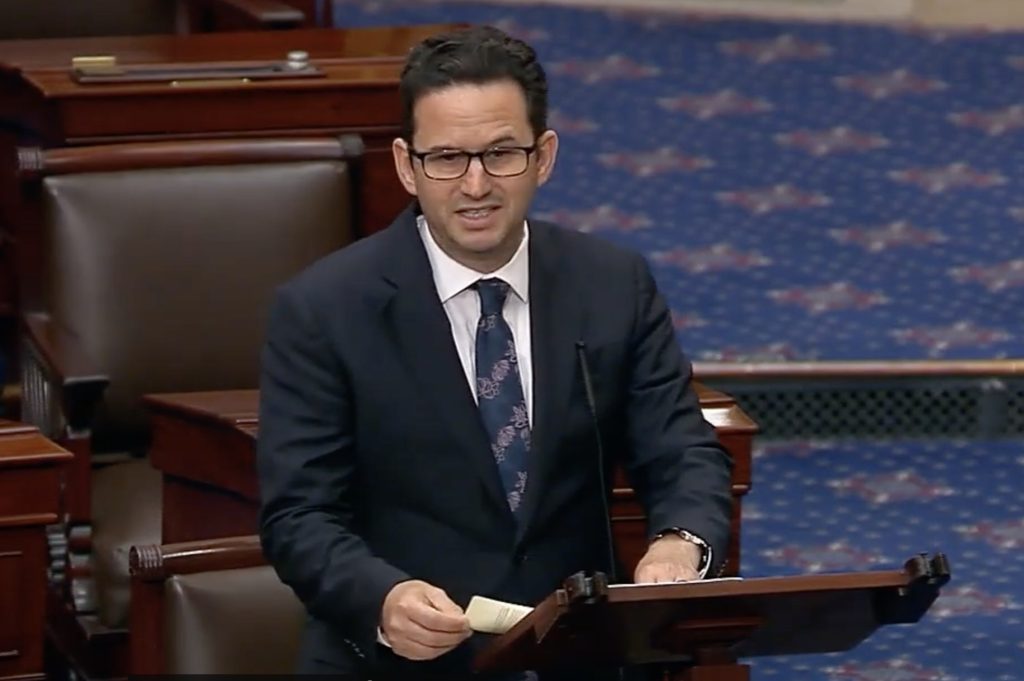
US Sen. Brian Schatz (D-Hawai‘i) led a group of eight senators in introducing the Comprehensive Paid Leave for Federal Employees Act, legislation to expand federal paid leave to include 12 weeks of family and medical leave.
“Right now, our laws are forcing federal workers to make the impossible choice between caring for their families and keeping their jobs,” said Schatz. “Our bill will provide federal workers with 12 weeks of paid leave, giving them the time they need to take care of their own health and their loved ones.”
Currently, under the Family and Medical Leave Act (FMLA), employees in the private sector can take up to 12 weeks of unpaid leave to care for a newborn or an ill family member without fear of losing their jobs. For federal employees, while parental leave is paid due to the passage of Schatz’s Federal Employee Paid Leave Act in 2019, family and medical leave continues to be unpaid.
Studies have shown that providing paid leave for federal employees would save the government at least $50 million annually in turnover and replacement costs, according to Schatz. With federal agencies struggling to recruit and retain young talent, family-friendly policies are necessary to maintain a robust workforce, he said. Just 6% of the federal workforce is under the age of 30, while roughly 40% of the workforce is eligible to retire within the next three years.
In addition to Schatz, the bill is co-sponsored by US Sens. Alex Padilla (D-Calif.), Bernie Sanders (I-Vt.), Tammy Duckworth (D-Ill.), Kirsten Gillibrand (D-N.Y.), Chris Van Hollen (D-Va.), Elizabeth Warren (D-Mass.), and Martin Heinrich (D-N.M.).
The Comprehensive Paid Leave for Federal Employees Act will guarantee 12 weeks of paid family leave for federal employees in all instances covered by the FMLA, including:
- In order to care for the spouse, child, or parent of the employee, if such spouse, child, or parent has a serious health condition;
- Because of a serious health condition that makes the employee unable to perform the functions of the employee’s position; and
- Because of any qualifying exigency arising out of the fact that the spouse, child, or parent of the employee is on covered active duty (or has been notified of an impending call or order to covered active duty) in the Armed Forces.
The Comprehensive Paid Leave for Federal Employees Act is supported by the American Federation of Government Employees, National Treasury Employees Union, International Federation of Professional and Technical Engineers, National Federation of Federal Employees, NARFE, National Association of Letter Carriers, American Postal Workers Union, and American Association of University Women.
The text of the bill is available here.
Sponsored Content