Air Force secretary’s space weapons confirmation raises concerns about planned Haleakalā telescopes

Air Force Secretary Troy Meink’s confirmation that the United States has deployed weapons in orbit has raised new concerns on Maui about the Air Force’s plan to build up to seven more telescopes atop Haleakalā, a summit many Native Hawaiians consider sacred.
Speaking Sept. 14 at the Air & Space Forces Association’s Air, Space & Cyber Conference in Maryland, Meink said the United States has “on-orbit space control weapons capable of defending the Joint Force against hostile adversary action.” The Associated Press reported it as the first time the United States has confirmed deploying weapons in space.

Meink gave no details on the type of weapons, when they were launched or how many are in orbit, Military Times reported. The threat is changing faster than he expected when he took the job 18 months ago.
“Today, we face a mix of rapidly changing technologies, adversaries moving aggressively to employ them, and a budget process for a different pace of warfare,” Meink said.
Before becoming secretary, Meink was principal deputy director of the National Reconnaissance Office and earlier ran satellite acquisition programs there and in the Air Force, according to his Air Force biography.
Protect Haleakalā ʻOhana, a community collective that opposes the telescopes, raised its concerns in an email to Maui Now. “This is a military expansion into more sacred space, not a scientific addition to it,” the group wrote. “Haleakalā is a sacred site in a conservation district. Haleakalā is the piko. Hawaiians return there to connect with kūpuna.”
The Air Force is “deploying find, fix track and target sensors, not just astronomy telescopes,” and that Meink’s announcement “makes plain what the chain is for,” the ʻOhana group said. “We do not want Maui to be a larger target in an escalation we had no say in.”
Kingi Gilbert of the group said it agrees the proposed telescopes are tracking instruments, not weapons.
“We are not claiming a telescope is a munition. It isn’t,” he wrote in responses to Maui Now’s emailed questions. But he said Air Force documents describe one planned instrument as providing “timely and accurate tracking data on adversary threat satellites,” which he said puts the instruments in the first links of a chain, “pointed at adversary satellites.”
The ʻOhana group would welcome the Air Force saying on the public record, which systems would and would not receive data from the Haleakalā telescopes.
Hina Kneubuhl, another ʻOhana group spokesperson, said the military’s public information about its plans for Haleakalā are opaque.
“It’s impossible to have conclusive “evidence” of anything the military does because they don’t
disclose that information to the public,” she said. “Therefore we have no choice but to study what is available and make inferences.”
Experiments conducted with existing Haleakalā telescopes in the 1980s—documented in a 2013 RAND report—provide “some of the most compelling information that leads us to believe these sensors would be additional eyes feeding information back into a larger war-fighting architecture,” Kneubuhl said. Early experiments were mostly about tracking ballistic missiles.
Whether or not a link exists between the proposed telescopes and weapons targeting, she said, the group opposes adding military equipment on the summit. More sensors could make Haleakalā a bigger target, she said, and fighting in orbit could create debris that threatens satellites that provide services such as GPS.

The ʻOhana group held a community stand Sept. 15 outside the 27th AMOS Conference at the Wailea Beach Resort Marriott, where Gen. Stephen Whiting, commander of US Space Command, gave the keynote. Kneubuhl said the stand was planned weeks before Meink spoke in Maryland. She called his remarks “an open admission of what we’ve been researching for months,” which she described as the United States wanting to dominate space and being willing to go to war to do it.
The Air Force’s response
Maui Now put the group’s concerns to the Air Force. Asked whether AMOS STAR’s mission includes any tracking, targeting or data-sharing role connected to the weapons Meink described, a US Air Force spokesperson said the mission is “focused on Space Domain Awareness (SDA), utilizing its dual facilities to conduct satellite detection, identification, imaging, and orbital tracking.” AMOS STAR is short for the Air Force Maui Optical and Supercomputing Site Small Telescope Advanced Research facility. The spokesperson called its role “centered on scientific research and development, observational surveillance, and data modeling to understand the space environment.”
Asked whether data from the telescopes feeds any targeting chain, weapons system or Space Command decision-making, the spokesperson said: “Space Domain Awareness provides the decision advantage needed to protect assets, coordinate actions, and maintain safety and stability in the space domain.”
Neither answer says whether data from the telescopes would feed a weapon system or targeting chain.
Haleakalā has hosted defense and research facilities since the 1950s. Today six academic and four space surveillance telescopes sit on 18 acres at the summit, the Hawai’i Journalism Initiative reported. AMOS STAR would add up to seven more, at an estimated cost of $5.9 million, with construction expected to start around 2026-2027 and last about two years.
Opposition predates Meink’s statement. Maui County Mayor Richard Bissen and all nine County Council members formally opposed the project in 2024, and hundreds of people attended 2024 scoping meetings where opposition ran heavily against it. The project also comes as the Air Force continues cleanup of a 700-gallon fuel spill at the summit from January 2023. Space Force officials said in 2025 that the full cleanup could take as long as 2032.
More from the Air Force
On jobs, Protect Haleakalā had cited the draft environmental impact statement in arguing the project would add no ongoing jobs after construction. The Air Force said the draft EIS statement that no personnel work at the site refers specifically to a vacant building on the summit where part of AMOS STAR would be built. The equipment would be operated remotely from Kīhei, the spokesperson said, and those operations and maintenance jobs would be “filled primarily by local residents, allowing us to create high-quality technical jobs for Maui without increasing daily traffic on the summit.” A February statement from Space Force public affairs said that most operators and maintenance workers would be local, long-term residents.
Beyond construction, the Air Force spokesperson said the AMOS program brings an estimated $30 million a year into the local economy and that the Air Force supports local STEM education through community partnerships. The spokesperson also said construction would take about two years, not the roughly 12 months cited in the group’s email.
On consultation with Native Hawaiian organizations, the Air Force said formal Section 106 consultation, the federal historic preservation review, began Jan. 27, 2025, and that a revised package went out again Jan. 19, 2026.
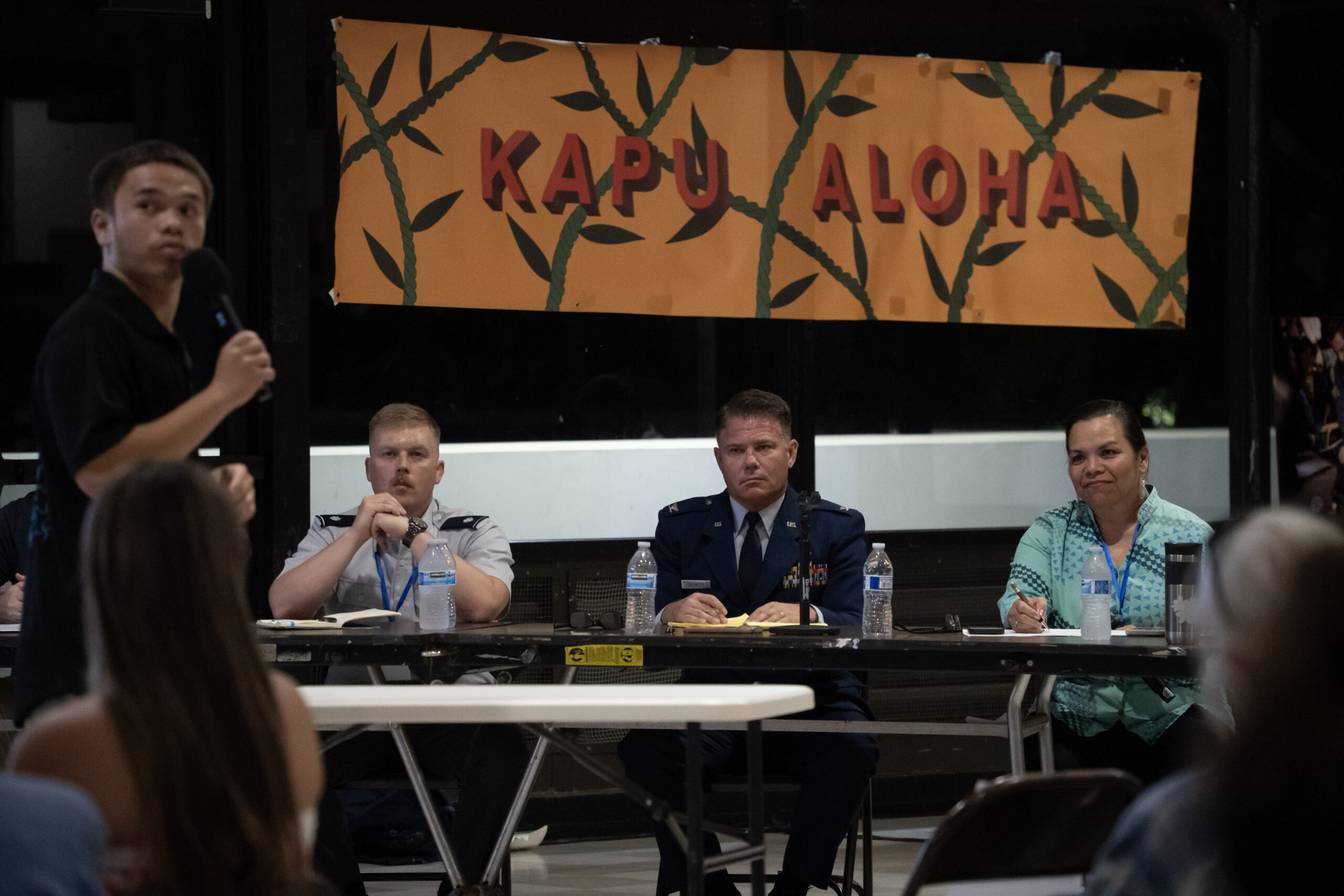
The spokesperson said the Air Force began consulting on the project when it published public notice in the Federal Register on April 22, 2024. The Air Force pointed to public scoping meetings in May 2024, public hearings in February 2026 and an extended 75-day comment period on the draft EIS that closed April 15, 2026. It said it received 656 public comment submissions in total across the environmental and historic preservation reviews.
Asked about opposition from the mayor, the County Council and the Office of Hawaiian Affairs, the spokesperson said the Air Force deeply respects those positions and will evaluate public feedback before a Record of Decision. Asked whether a smaller project or a moratorium is under consideration, the spokesperson said the Air Force is “evaluating ways to minimize impacts and our physical footprint.”
On endangered species, the Air Force said its Endangered Species Act consultation ended April 2, 2026, when the US Fish and Wildlife Service concurred that AMOS STAR “may affect, but is not likely to adversely affect” listed species, as long as the project follows recommended conservation measures. The Air Force said it will apply for any permits required by law once its environmental review is complete. It is working with the State Historic Preservation Division to finalize a memorandum of agreement on mitigation under Section 106.
The Air Force said the final EIS is “in coordination” and that it expects a record of decision by the end of the year.
A disputed timeline
Gilbert disputes the Air Force’s account of when formal consultation with Native Hawaiian organizations began. He cites a chronology he says comes from the Air Force’s own records:
- The Advisory Council on Historic Preservation received notice of an adverse effect finding in January 2025. In a Feb. 7, 2025, letter it told the Air Force the submission was incomplete and asked for summaries of consulting parties’ views, including Native Hawaiian organizations.
- More than a year later, on Feb. 13, 2026, ACHP’s director of Federal Agency Programs wrote that the agency “has not received a response” to that 2025 letter.
- Four days after that, the Air Force’s Cultural Resource manager, Charlie Lawton, wrote that “the initial invitation to consult on AMOS STAR through the Section 106 process was transmitted to the Hawaii State Historic Preservation Division and NHOs… on 27 January 2026.” Gilbert says that date conflicts with the draft EIS, which he says puts the start of formal consultation in January 2025.
“The inconsistency is in the Air Force’s own records,” Gilbert said. He argued that a summary of comments could not have gone to ACHP in April 2025, as Lawton’s email also states, if the invitation to consult did not go out until January 2026. Gilbert said the documents are available on Protect Haleakalā’s website.
Maui Now has asked the Air Force to explain the difference between its written response and Lawton’s email and to produce the transmittal records. A response is pending.
Land status and state review
Gilbert said the site is state land in a Conservation District that Executive Order 1808 (1957), updated by Executive Order 4451 (2014), set aside for Federal Aviation Administration use. The draft EIS takes the position that the executive order overrides Conservation District rules, he said.
“We think the state should decide that question rather than accept it by silence,” Gilbert said.
Protect Haleakalā wants the state Department of Land and Natural Resources to say whether it agrees. It also wants the department to say whether state environmental review under the Hawaiʻi Environmental Policy Act still applies. Gilbert said the Air Force’s April 2024 scoping letter committed to Hawaiʻi Environmental Policy Act review, but the January 2026 draft EIS dropped it after a redesign avoided a utility easement across state land. The group asked DLNR in a Feb. 13, 2026, letter and has not received an answer, he said.
Maui Now has asked the Air Force about both questions in a follow-up. A response is pending.
State: ‘Continue to monitor’ federal review
The state responded in a statement from Laurie Moore, executive director, State of Hawaii Military and Communications Office, after Gov. Josh Green’s communications office referred Maui Now’s inquiry there.
“The state recognizes the deep cultural and environmental significance of Haleakalā and understands the concerns raised by members of the Maui community regarding the proposed AMOS STAR project, including questions about jurisdiction and the extent of environmental and cultural review,” the statement said.
“The state respects the public’s right to gather peacefully and express its views. Community perspectives are an important part of the environmental review process. While the project continues undergoing federal environmental review, the state will continue to monitor that process and engage as appropriate to help ensure that concerns raised by Maui communities are understood by Department of the Air Force decision makers.”
The statement does not say whether DLNR considers HEPA review necessary, or whether it agrees with the Air Force that the executive orders override Conservation District rules. Those are the two questions Gilbert says DLNR has not answered since February.
County Council and mayor: two resolutions
Maui County’s opposition is on record twice. The County Council voted 9-0 on June 5, 2024, to adopt Resolution 24-103 opposing AMOS STAR. On March 6, 2026, the Council adopted Resolution 26-54, FD1, by an 8-0 vote with one member excused. It urges denial of the draft EIS, which was released in January with a full build-out near the existing complex as the preferred alternative.
The newer resolution questions who owns the site. It says the draft EIS “fails to provide a comprehensive overview of the project site’s ownership history.” It says the FAA owns the site and has “unfettered and inappropriate authority to transfer ownership” to the Air Force. If the EIS process continues, the resolution urges the Air Force to provide a “comprehensive chain of title” for the site, including how the FAA received the land. Gilbert describes the land differently, as state land set aside for FAA use by executive order. Both want the land’s ownership history and its transfer to the Air Force examined.
The 2024 resolution lays out more of the county’s case. On the fuel spill, it says then-Brig. Gen. Anthony Mastalir, who commanded US Space Forces Indo-Pacific at the time, acknowledged in February 2023 that the site was on sacred ground. It says he promised to go “above and beyond” standard cleanup practices.
More than a year after the spill, the resolution says, the cleanup was not finished, according to Dane Uluwehiokalani Maxwell, a cultural advisor the military hired to monitor the work. The resolution says Maxwell considered it insulting to build more telescopes before the cleanup within the same footprint was done.
The resolution says more than 19,000 people live within 10 miles of the site, including residents of the Kahikinui and Waiohuli Hawaiian Homestead Lands. It says the Air Force has not adequately addressed potential health effects from the microwave transmissions the project would emit.
Resolution 26-54 says the mayor and the Office of Hawaiian Affairs submitted testimony opposing AMOS STAR. Bissen’s June 7, 2024, letter to the project’s EIS team cited OHA’s opposition as well.
County of Maui spokesperson Laksmi Abraham said the mayor’s position has not changed.
“Mayor Bissen’s position, as outlined in his June 7, 2024, letter and in alignment with the Maui County Council, has not changed,” Abraham said. “He will continue to represent the best interests of our community, and that requires listening to and respecting the voices of the people he serves. While he remains open to discussion, meaningful community input must remain at the center of any conversation regarding Haleakalā.”

In that 2024 letter, Bissen said dismantling old telescopes and rehabilitating the environment “must be prioritized ahead of creating a new footprint” on the summit. He noted the cleanup of the 2023 fuel spill was not complete, “and remedial technologies have yet to be presented to the public.”
The Air Force “made no contact” with him or his administration before the proposal was published in the Federal Register, and that community meetings were held over three days in the evening with little notice, the mayor wrote. The letter said all 17 people who testified in person at the June 5, 2024, Council meeting opposed the project, as did 10 of 13 who submitted written testimony. It said hundreds testified at the Air Force’s scoping meetings, the vast majority in opposition.
Hina Kneubuhl: a sovereignty perspective
Kneubuhl ties her opposition to AMOS STAR to the 1893 overthrow of the Hawaiian Kingdom, which she says the US Navy aided when it “turned its guns on ʻIolani Palace,” and to what she describes as continued bombing, poisoning and destruction of Hawaiian lands by the US military.
“As a Hawaiian living under occupation, I have no reason to believe the Air Force’s claims that these telescopes are necessary for America’s national security,” Kneubuhl wrote in responses to Maui Now. She wrote that you cannot separate how Hawaiians feel about the military today from that history, calling it “a straight line from 1893.”
Kneubuhl argued the project is as much about money, “maintaining Haleakalā as a site of commercial extraction,” as national security. She cited a RAND Corporation history of the AMOS site that she said shows the Air Force Research Laboratory, as congressional funding dwindled, sought to “make the Maui site attractive to defense and intelligence community customers.”
“The AFRL has been collecting rents on our mountain, and they want more,” she wrote.
On the targeting question, she said the group’s concerns draw on a RAND report documenting AMOS experiments in 1978 on handing off ballistic targets to another sensor and, in 1987, taking part in “Surveillance, Acquisition, Targeting, and Kill Assessment” experiments. She wrote that “whether or not this AF project feeds directly into the same architecture or not, it is still an escalation by the same set of agencies.”
Kneubuhl also argued the work does not need a 10,000-foot summit. “In fact, tracking and studying objects in Low Earth Orbit (LEO) can happen from 5,000 ft., which immediately refutes their claim that this project needs to happen on Haleakalā,” she wrote. The draft EIS says the Air Force needs a site with favorable viewing conditions in the Pacific, the Hawai’i Journalism Initiative previously reported.
Protect Haleakalā ʻOhana’s goals
Kneubuhl said the group wants no new telescopes, each existing telescope decommissioned as its lease expires, no lease renewals, and the entire summit region added to Haleakalā National Park or listed on the historic register as a protected cultural property.
Gilbert said the group proposes the no-action alternative, meaning AMOS STAR is not built. If the Air Force goes ahead, he said, the group wants a genuine alternatives analysis, proof that other sites are not feasible, meaningful Section 106 consultation and a supplemental EIS. He noted that key leases at the summit expire in 2027 and 2031 and said those decisions should involve the community.
What’s next
The public comment period on the draft EIS closed April 15, 2026. The Air Force says the final EIS is in coordination and it expects a record of decision by the end of the year. Gilbert said that under the National Environmental Policy Act the decision cannot come sooner than 30 days after the final EIS is published.
Maui Now’s follow-up questions to the Air Force about the consultation dates, state environmental review and the status of the memorandum of agreement with the State Historic Preservation Division remain outstanding.
Sponsored Content