Last-ditch efforts to kill Honuaʻula project amendments fail amid bickering; controversial development passes final vote
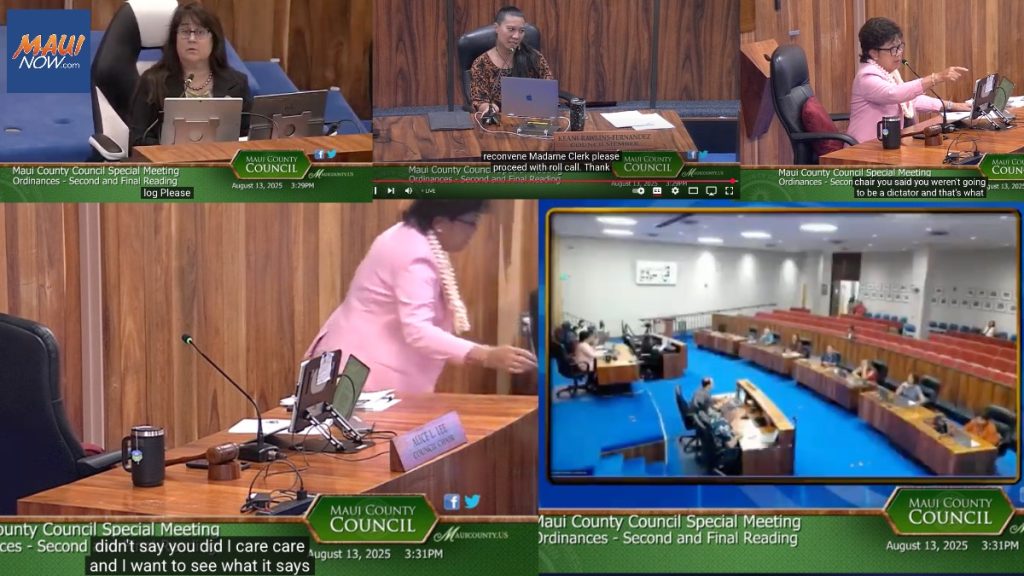
On a day full of intense tension and high drama, the Maui County Council voted 5-4 to approve amendments on second-and-final reading for the hotly debated Honuaʻula project. But the final vote of the Council meeting came amid a noisy floor fight between Council Chair Alice Lee and Council Member Keani Rawlins-Fernandez.
The interaction was not physical. But Lee and Rawlins-Fernandez raised their voices and talked over each other, with the Molokaʻi council member often laughing, as Chair Lee struggled to regain order of the meeting. (Rawlins-Fernandez later said via email that her laughter was not “disrespectful.” “My laughter was to point out the absurdity of the moment and to not intensify emotions more than it was,” she said.)
The fracas was so intense that the council members’ roll call vote could not be heard during the televised and live-streamed meeting. The vote was reported later as 5-4, along the usual Council majority-minority lines. (Majority members are Lee, Yuki Lei Sugimura, Tasha Kama, Tom Cook and Nohelani Uʻu-Hodgins; and minority members are Rawlins-Fernandez, Tamara Paltin, Shane Sinenci and Gabe Johnson.)
The incident was recorded live on YouTube and can be seen here beginning at 3:29 p.m. (Maui Now will update this story as new information and reactions are available.)
One shocked observer said via text message: “That was ugly!” Another said she had “NEVER” seen anything like it before.
The verbal clash followed a failed amendment (again, on the same 5-4 vote) by Rawlins-Fernandez to amend the Honuaʻula project bills to require the developer provide 450 workforce housing units. And, an attempt by Rawlins-Fernandez to require a public hearing in South Maui with the assent of three council members.
On that point, Lee noted that a public hearing had already been held, and Office of Council Services Director David Raatz cited an opinion that because a public hearing had been held there was no requirement for a public hearing. Rawlins-Fernandez insisted on seeing the written opinion. After a short recess to locate it, Lee brought the meeting back to order and called for the roll call vote. Rawlins-Fernandez continued arguing her point as the roll call vote was ongoing.
Below are snippets of the back and forth between Lee and Rawlins-Fernandez. (The transcript is somewhat difficult to follow because of overlapping arguing from both council members.)
Lee: “Clerk, please proceed with roll call.”
Rawlins-Fernandez: “Chair! Mahalo, so Director Raatz is still looking (for documentation) because the minute (recess) wasn’t long enough, because he didn’t have it readily available.”
Lee: “Excuse me, but I did not recognize you… “
Rawlins-Fernandez: “I didn’t see. I’m just saying… “
Lee: “I don’t care.”
Rawlins-Fernandez: “I know you don’t care.”
Lee: “I have not recognized you.”
Rawlins-Fernandez: “And he (Raatz) said that the charter… doesn’t prevent us… at your discretion, chair… . Director Raatz is still looking for that opinion. They think it’s from 2006 and past practice has let us do this hearing. Yes, and so it’s up to us, chair.”
Lee: “Proceeding with roll call.”
Rawlins-Fernandez: “You said you weren’t going to be a dictator, and that’s what you’re doing right now… . Let us have that information be put up so that I can see for myself what it was that is being said… . Respect is supposed to be mutual. You know, I asked for this. And, then under Charter Section 4-2… “
Lee: “Are you voting yes or no?”
Rawlins-Fernandez: “I want to see the information that I requested.”
Lee: “I don’t care what you want.”
Rawlins-Fernandez: “I know you don’t care, chair… . I care! And, I want to see what it says!… He was trying really hard to find it really quickly.”
Lee: “And we have to count Member Uʻu-Hodgins (who was participating online). This is to pass Wailea 670 on second-and-final reading.”
Rawlins-Fernandez: “And Director Raatz is still looking for that information that I requested, chair, so I’m still waiting for that information. Director Raatz, as soon as you find that, I’d love to be able to see it. I appreciate that. Thank you.”
(Rawlins-Fernandez continued along the same inquiry a few more times.)
Lee (to Rawlins-Fernandez): “You have to vote yes or no.”
Rawlins-Fernandez: “And I was requesting to see the opinion from Director Raatz.”
(Lee told Rawlins-Fernandez that the vote was 5-3).
Lee: “Five to three, yes. So either you can vote now, or you are going to be put down as a yes.”
Rawlins-Fernandez: “Chair, I have so much aloha for you, (Laughter.) But just like the testifiers before us I feel like you don’t care, and you actually, that is what you said to me, that you don’t care. And that’s what the testifiers said again and again that you don’t care what they say. And, that’s very disheartening. My vote is ʻaʻole (no).”
Lee: “The meeting is adjourned.”
In response to a request for an explanation of what happened, Rawlins-Fernandez said via email that three council members were in the midst of calling a three-member hearing, as stipulated in Section 402 of the Maui County Charter.
“But Chair Lee said she would hold a public hearing in the district – so we didn’t call one,” Rawlins-Fernandez said. “Chair Lee and Clerk (Moana) Lutey gave their reasons for not holding the public hearing in South Maui at the beginning of today’s meeting after I requested the explanation.”
“My understanding is that a three-member hearing could still be called, regardless of a public hearing being held,” she said. “The practice of holding public hearings at the same time as Council meeting at our chambers in Wailuku is antithetical to holding a public hearing. Our new … rules require public hearings required by law to be held in the district specifically impacted after 4:30 p.m. Director Raatz explained that the rule isn’t triggered unless it’s a public hearing required by law, which would have been, had we called for a three-member hearing under the charter.”
Rawlins-Fernandez went on to say that: “After I called for a public hearing in the district after work hours, Director Raatz explained that a corp counsel opinion from 2006 stated that if a public hearing was held, a three-member hearing couldn’t be mandated.”
“What was upsetting is that we were assured that a public hearing would be held in South Maui at the last meeting,” she said. “Had Chair Lee not made that assurance, we would have called the three-member hearing and it would have been required by law triggering the Council rule.”
Rawlins-Fernandez concluded by saying: “For me, I want our constituents — our residents — to know that some on the Council, myself included, are fighting against corporate greed for them, that we will never give up, and they shouldn’t either.”
Chair Lee responded to Maui Now briefly in an email, explaining that Wailea 670 passed final reading 5-4.
“Rawlins-Fernandez tried to request a second public hearing. We had one today. Since we just had one, I did not recognize her,” Lee said.
The disorderly vote capped a day of controversy, including passionate public testimony, most of it against the proposed project district condition amendments. And, Cook faced a charge of a conflict of interest that testifier Les Iczkovitz, a member of the Maui Tomorrow board of directors, said was the subject of a Board of Ethics complaint against Cook, and a conflict of interest that should disqualify him from voting.
Cook said the complaint was baseless, and he has no conflict of interest. He said he was going to vote on the Honuaʻula project, and he looked forward to having his name cleared by the Board of Ethics.
The Council vote advances the legislation Bills 171 and 172 to the desk of Mayor Richard Bissen.
In response to a Maui Now request for comment on the bills’ passage, Maui County spokesperson Laksmi Abraham said: “The Mayor’s Office has received Bills 171 and 172, passed today by the Maui County Council. Mayor Bissen will review both measures in detail before providing further comment. We appreciate the Council’s work on these bills and thank community members for their time, testimony, and valuable input throughout the process.”
The former Wailea 670 project, a development first approved 17 years ago for 1,400 homes (later reduced to 1,150), has languished on 660 acres that remain undeveloped wildland south of Maui Meadows and mauka of the Wailea Resort.
The amendments sought by the project included removing what the developer identified as “outdated geographical references” to 450 affordable units in the Kīhei-Mākena Project District 9 ordinance. The amendments eliminate provisions for a golf course and related facilities, instead incorporating cultural and educational centers as permitted uses.
Sponsored Content