UHERO data shows how politics shape Hawaiʻi’s legislative agenda, from housing to wildfire recovery
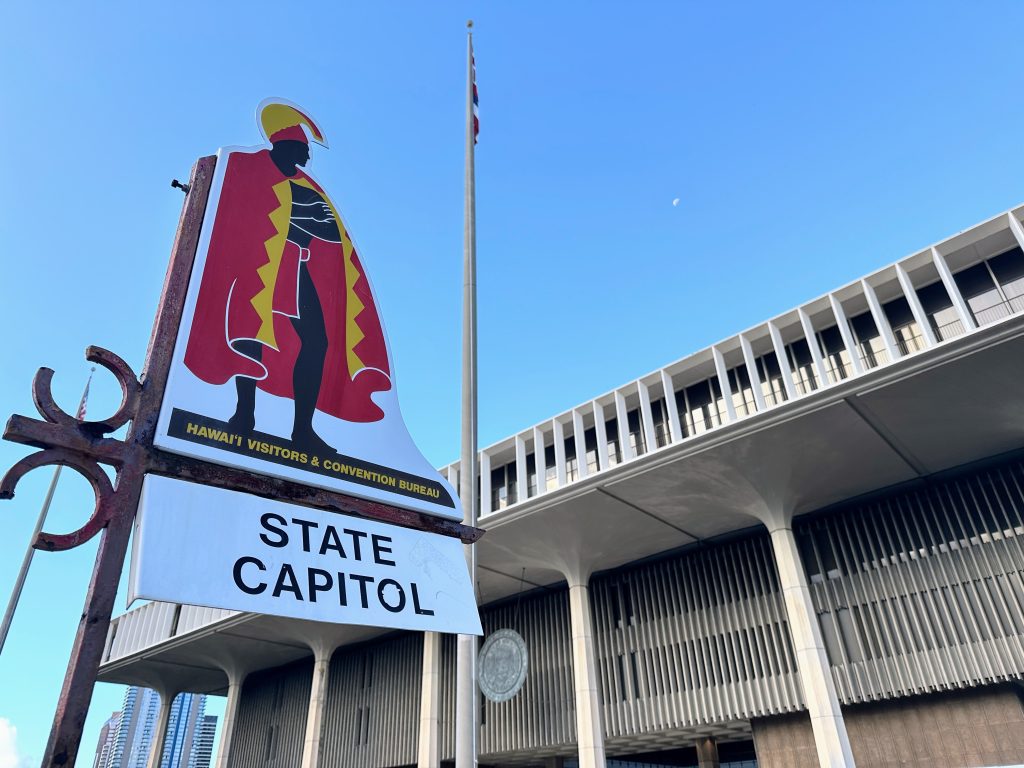
A recent blog post by faculty member Colin Moore and data scientist Trey Gordner of the University of Hawaiʻi Economic Research Organization takes a data-driven look at how political forces shape legislation at the state Capitol.
For Maui County, one takeaway is the blog’s finding that the environment and Native Hawaiian lobbying sectors are “broad allies” and “consistent opponents” of the tourism/hospitality sector and how that dynamic underscores Maui’s ongoing public policy debates – such as balancing tourism’s economic and social impacts with demand for local resources including housing, real estate, water, wastewater, recreation and roadway capacities.
The data for the UHERO blog post, titled “Consensus and Conflict: A Data-Driven Look at the Biggest Bills in Hawai‘i’s 2025 Legislature” is derived from the Hawai’i State Ethics Commission’s Public Documents System (referred to as Legislative/Administration Action Report). The data is deployed as a structured analysis — at the bill level — to examine lobbying at the state Legislature. Put another way, it looks behind the scenes at who lobbied for and against measures and what bills and proposals united or divided stakeholders.
Regarding consensus and conflict among sectors, Moore and Gordner said that each bill at the Legislature tells “a unique story, a meaningful instance where organizations agreed, disagreed, or remained silent.”
With data gleaned from lobbying filings with the State Ethics Commission, “we can uncover themes behind these stories that link Hawai‘i’s economic sectors in persistent and surprising ways.”

The analysts measured connections among stakeholder sectors in what they call “breadth” and “depth.”
“When organizations in two sectors testify together on many bills, regardless of their position, they have breadth,” Moore and Gordner said. “When organizations from the same sectors testify on the same side of an issue, they have depth. Put another way, breadth measures shared attention, while depth measures shared interests.”
“Most sectors rarely take sides on the same bills, which reflects specialization: tourism groups focus on tourism bills, health on health, and so on,” the analysts said. “But when we compare the results to chance, a few relationships stand out. Environment and Native Hawaiian (stakeholders) co-engage far more frequently than chance, and they usually take the same side. That pair of facts — high co-presence and high agreement — signals a consistent alliance on a shared set of priorities.”
However, “not all frequent meetings are among allies. Environment and tourism/hospitality (stakeholders) meet more than chance and on opposite sides of the debate. These are broad adversaries, consistent opponents on many fronts. Finally, some pairs show high agreement but low co-engagement relative to chance. These could represent occasional alignment between ‘uncommon bedfellows’ or bills sufficiently broad in scope to attract unusually broad participation.”
The analysts point to one bill of particular interest to Maui County residents: House Bill 1, which died in a House committee without most people knowing of its existence. The measure would have amended the responsibilities of the State Building Code Council and addressed the state’s housing crisis, including the dire need for housing on Maui after the August 2023 wildfires.
Moore and Gordner said the House bill proposed reforms to the State Building Code Counsel that aimed to reduce delays and construction costs.
“It required the council to conduct financial analyses of proposed code changes, distinguish between safety-related and non-safety-related standards, and consult more directly with developers, contractors and trade associations,” the analysts said. “It was supported by major developers and trade unions, who argued it would reduce delays and lower construction costs.
“Opponents, including the Sierra Club of Hawai‘i and the International Code Council, warned that the bill could weaken building standards and disaster preparedness. With 16 lobbying positions, HB1 revealed a quiet but substantive debate about how the state should balance the urgency of housing development with the need for regulatory oversight,” Moore and Gordner said.
They cited House Bill 1 as an example of legislation that flew under the public’s radar.
“Some of the most contested bills in the 2025 session received little to no media coverage,” the analysts said. “Often these bills are highly technical, but the Legislative/Administrative Action Report data reveals just how much lobbying activity takes place even when bills remain relatively unknown to the public. Indeed, these are the kinds of measures where lobbyists may have the most influence — outside the spotlight, when public scrutiny is low and policy complexity is high.”
Another bill that drew divisive attention was Senate Bill 897, which became law July 1 as Act 258.
That bill allows electric utilities to recover wildfire mitigation, repair and restoration costs through an automatic ratepayer adjustment. It requires the Public Utilities Commission to initiate a proceeding to adopt rules, subject to the governor’s approval, to determine a limit for liability for economic damages from a covered catastrophic wildfire.
Moore and Gordner said Senate Bill 897 “generated 41 lobbyist positions with some trade associations and labor unions taking opposing positions.”
“Because internal splits among long-standing allies are rare, these divisions offer important insight into how policy debates unfold within established coalitions,” they said.
As part of their analysis, the blog authors established a “simple bill-level metric of political controversy.” They call it the “Heat Score,” the share of organizations taking the minority position on a given bill.
“A score of 0 indicates complete agreement among testifying organizations, while a score of 0.5 reflects an even split between support and non-support (including opposition and comments),” the analysts said. “By this metric, 238 bills, or 14% of lobbied bills, were hotly contested in the 2025 session.”
The housing and Maui wildfire bills garnered “heat scores” in the vicinity of 0.4, a graph in the blog shows.
The analysts conclude by saying that the data “offers a unique and enlightening lens on the policymaking process.”
“It reveals not only which bills matter to which organizations, but also where political coalitions in Hawai‘i appear to align, diverge, or remain intact on specific pieces of legislation. For researchers and political observers, the data reveal major policy disagreements among powerful actors, sometimes over technical bills that generate little emotion or public discussion but have significant implications for Hawai‘i’s future. These patterns help us better understand how influence is exercised and how policy takes shape in the less visible corners of the legislative process.”
Sponsored Content