

NOAA: Climate models support wetter-than-normal conditions in Hawai‘i through Spring 2026

NOAA’s Climate Prediction Center is forecasting a wetter-than-average wet season for Hawai‘i, with La Niña conditions expected to influence rainfall patterns through early spring 2026.
According to NOAA’s Climate Prediction Center, a La Niña Advisory is in effect after conditions emerged in September. The event is expected to persist through January or February, with a likely transition to ENSO-neutral conditions by March. Probabilities favor a weak La Niña, typically associated with above-normal rainfall across the islands—especially for the northwestern half of the state.
Weaker La Niña events have historically produced more winter weather systems capable of widespread rain in Hawai‘i. However, forecasters note that rainfall during weak La Niña years can vary widely and may not always lead to record-setting wet seasons.
NOAA’s outlook also calls for above-average temperatures statewide through spring. If the wetter conditions materialize, meteorologists expect drought conditions affecting about 70% of the state to ease significantly—or even end—by the close of the wet season.
Residents are urged to prepare for potential flooding, road closures and lightning-related power outages, especially during periods of heavy rain.
Dry Season Recap: 2025 Among the Driest in 30 Years
From May through September 2025, rainfall across Hawai‘i was mostly below average, continuing the dry trend of recent years. Overall, the 2025 season ranked as the third driest in the last 30 years, behind 2007 and 2010—the driest in that period.
Rainfall totals were mostly below average across Maui County during dry season, with leeward and central valley areas particularly dry. Gauges at Kahului Airport, Lahainaluna, Keālia Pond and Kahakuloa all recorded under 25% of their normal precipitation during the period, according to National Weather Service data.
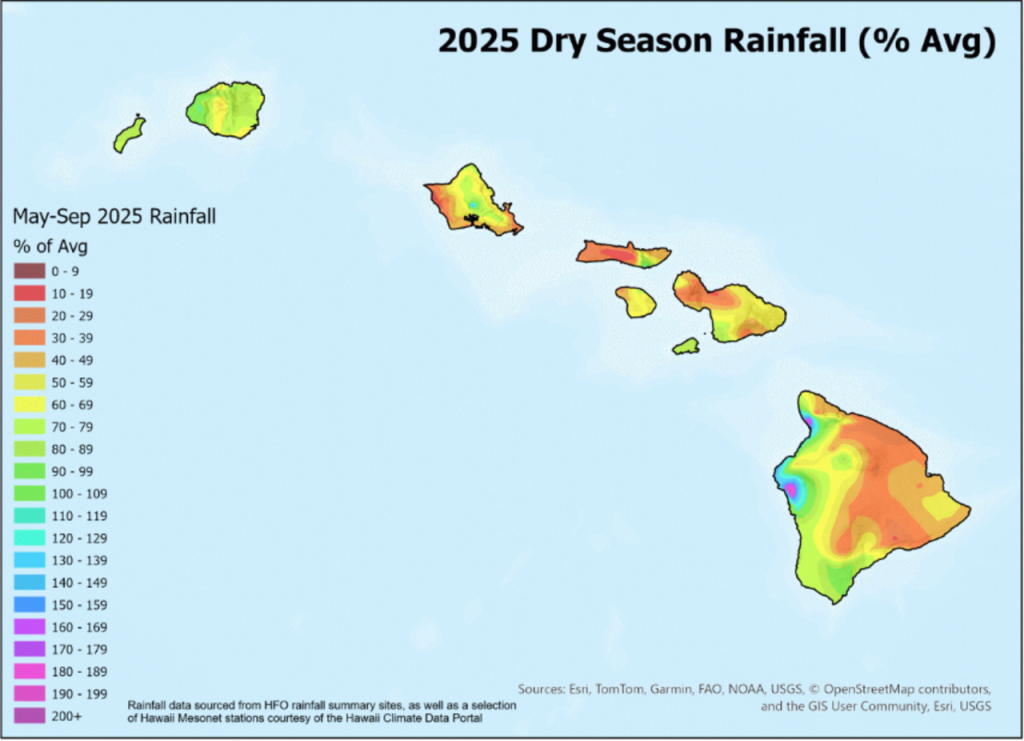
Hawai‘i Island, except for the typically wetter Kona district, also experienced consistent dry conditions. O‘ahu recorded near to below-average rainfall, while Kaua‘i experienced near to slightly above-average totals.
Around 70% of the state remained in drought conditions (D1 or greater) through the season, with the most notable worsening along the Hāmākua and Kaʻū districts of the Big Island and the windward and leeward coasts of Oʻahu.
While long-range precipitation forecasts remain inherently uncertain, NOAA says if the wetter pattern holds, drought conditions across the islands could improve or even be eliminated in many areas by the end of the wet season.
For more information, see the NOAA Climate Prediction Center’s latest monthly and seasonal outlook discussion.
Sponsored Content