Facilities authority uses new tech to speed school construction, cut costs
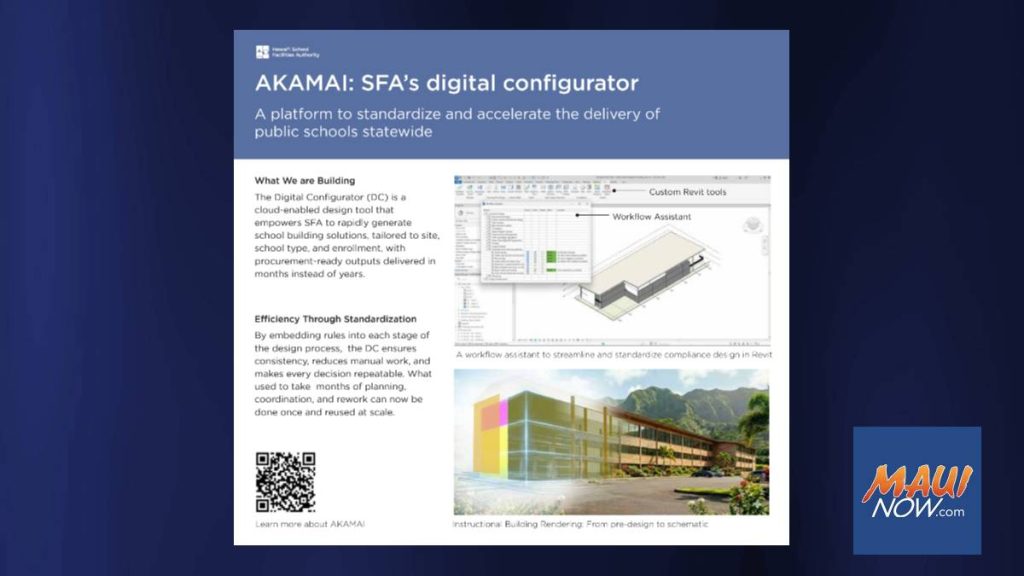
The Hawai‘i School Facilities Authority (SFA) is adopting a new digital tool designed to speed up school construction planning and reduce costs.
The tool, called Akamai, is software that automates parts of the early planning and design process for new school construction and classroom renovation projects. SFA officials said it is capable of doing the work of multiple teams with specialized skills.
According to SFA Executive Director Riki Fujitani, the agency estimates the tool could cut pre-planning timelines by up to 60% and reduce costs by as much as 15% compared to traditional approaches.
“Technology is changing the way everyone is doing business,” Fujitani said. “We want to make out-of-the box approaches and innovation the new norm.”
Users of Akamai can input factors such as enrollment numbers, grade levels, site constraints and project type. The system then generates building design options, floor plans, material selections and preliminary cost estimates—outputs that often take months to produce through standard processes.
Fujitani said the average age of Hawaiʻi public school buildings is more than 50 years and many were designed for static classroom layouts. The Akamai system, he said, optimizes spaces to support more dynamic, 21st-century teaching methods.
Fujitani also said the agency plans to adopt standardized designs over time to avoid having to reinvent the wheel for each new school building project, which could lower maintenance costs because all schools would share the same building parts.
SFA commissioned MKThink, a strategic planning and architectural firm with offices in Honolulu and San Francisco, to develop the Akamai platform.
Over the past six months, MKThink has integrated more than a dozen existing software systems into a single, cloud-based platform that connects enrollment data, site information, space programming and cost modeling.
The system can move projects from initial planning to schematic design in less than a day, compared to an estimated six to 18 months under conventional methods. The workflow then links to Revit, a widely used building information modeling program, to generate 3-D schematic designs and construction options.
MKThink anticipates the system will be fully developed by early 2027, with the first phase of the configurator expected to be in use by this summer.
“We are compressing the timeline on these tasks and saving taxpayer dollars so that more funds can be allocated for other pressing needs in our state,” said MKThink CEO Nate Goore. “The Akamai digital configurator also reduces human error to avoid costly change orders and delays.”
More capabilities related to construction documents, procurement and construction phases are expected to be added to Akamai next year.
Sponsored Content