

1,935 whales spotted across Hawaiʻi, 847 off Maui during second count for the 2026 season
A total of 1,935 whales were observed across all islands, during the second Ocean Count and Great Whale Count for the 2026 season. That’s down by 12 whales from the same time last year. The number may represent duplicate sightings of the same whale by different observers or at different time periods or different locations throughout the day.
On Maui, 847 whales were observed, the most of any location, followed by 337 on Kauaʻi, 288 on Oʻahu, 244 on Hawaiʻi Island, 166 on Molokaʻi and 53 on Lānaʻi. A total of 256 whales were observed during the 9:30 -9:45 a.m. time period, the most of any time period throughout the day’s count.
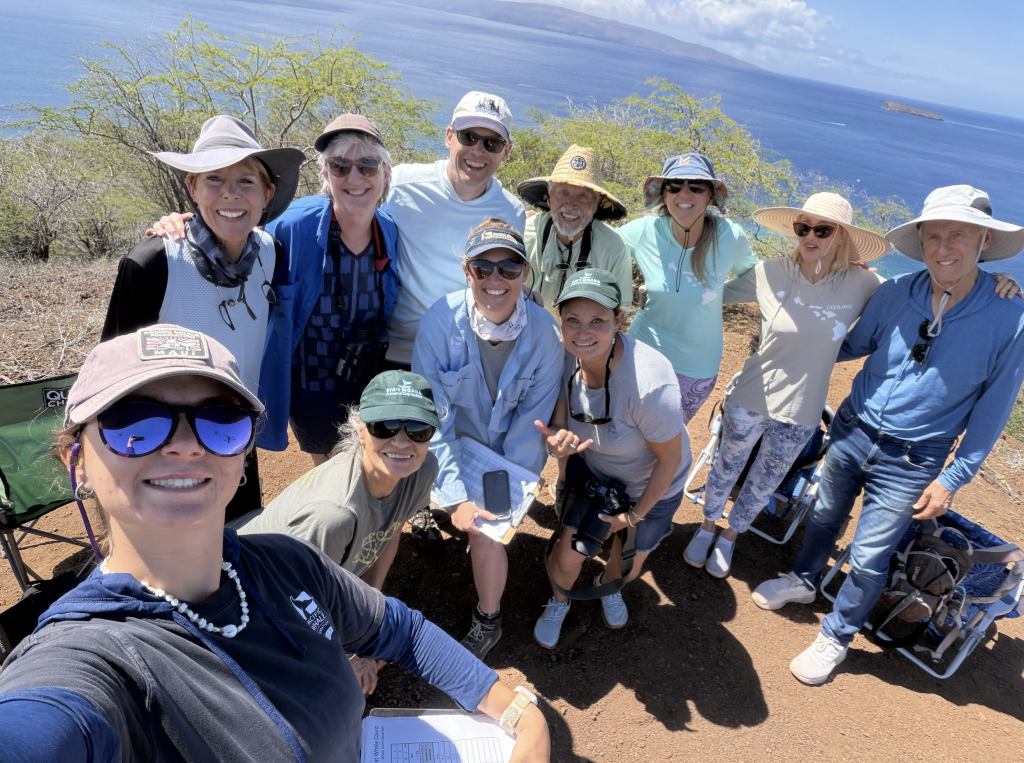
A total of 487 volunteers gathered data on koholā, humpback whales, at 46 sites across the main Hawaiian Islands on February 28.
The observations were made from the shores of Kaua‘i, O‘ahu, Molokaʻi and Hawai‘i islands during the Hawaiian Islands Humpback Whale National Marine Sanctuary Ocean Count and from Maui and Lānaʻi during the Great Whale Count by Pacific Whale Foundation.
Data collected during the Sanctuary Ocean Count and Great Whale Count combined with other research efforts can help reveal trends in humpback whale occurrence within and amongst whale seasons.
Across the main Hawaiian Islands, weather conditions were nearly perfect for observing whales with sunny clear skies, light winds and calm seas, according to organizers. Viewing conditions were impacted during the last hour of the count at a few sites due to rain, increased winds and clouds.
A variety of other species were also spotted during the count including honu (green sea turtles), mālolo (flying fish), naiʻa (spinner dolphins) and multiple bird species such as koaʻe ʻula (red-tailed tropicbird), ʻiwa (great frigatebird), mōlī (Laysan albatross), noio kōhā (brown noddy), kōlea (Pacific golden-plover), and more.
Ocean Count promotes public awareness about humpback whales and shore-based whale watching opportunities. Volunteers tally humpback whale sightings and document the animals’ surface behavior during the survey, which provides a snapshot of humpback whale activity. Ocean Count is supported by the National Marine Sanctuary Foundation.
The Great Whale Count by Pacific Whale Foundation had site leaders count whales from shore as part of a long-term survey of humpback whales in Hawaiʻi, with 12 survey sites along the shoreline of Maui and one site on the shoreline of Lānaʻi. This event provides a snapshot of trends in relative abundance of whales and is one of the world’s longest-running community science projects.
Both counts take place three times during peak whale season annually on the last Saturday in January, February, and March.
- Preliminary data detailing Sanctuary Ocean Count whale sightings by site location are available at: https://oceancount.org/resources/. Additional information is available on the sanctuary’s website at http://hawaiihumpbackwhale.noaa.gov. 2026 marks the Sanctuary Ocean Counts 30th anniversary. Learn more at https://sanctuaries.noaa.gov/news/2026/how-community-science-helps-track-whales-across-hawaii.html.
- Pacific Whale Foundation’s Great Whale Count data can be found at https://www.pacificwhale.org/research/community-science/ with additional information at www.mauiwhalefestival.org. This year, Pacific Whale Foundation celebrates 45 years of research, education, and conservation. Learn more about the week of events to celebrate here: https://pacificwhale.org/world-whale-day-2026/
Hawaiian Islands Humpback Whale National Marine Sanctuary, administered by NOAA’s Office of National Marine Sanctuaries and the State of Hawai‘i Division of Aquatic Resources, protects humpback whales and their habitat in Hawaiian waters where they migrate each winter to mate, calve, and nurse their young.
Pacific Whale Foundation is a nonprofit organization founded in 1980 to protect a declining humpback whale population from global threats, including commercial whaling. PWF protects the ocean through science and advocacy, works to inspire environmental stewardship, and conducts research, education, and conservation programs for the communities it serves in Maui, Australia, Ecuador, and Chile.
The National Marine Sanctuary Foundation, established in 2000, is the official non-profit partner of the National Marine Sanctuary System. The Foundation directly supports national marine sanctuaries by protecting species, conserving ecosystems and preserving America’s maritime heritage through on-the-water conservation projects, public education and outreach programs and scientific research and exploration.
Sponsored Content