Planning Department navigates ‘relentless’ workload amid staffing shortages
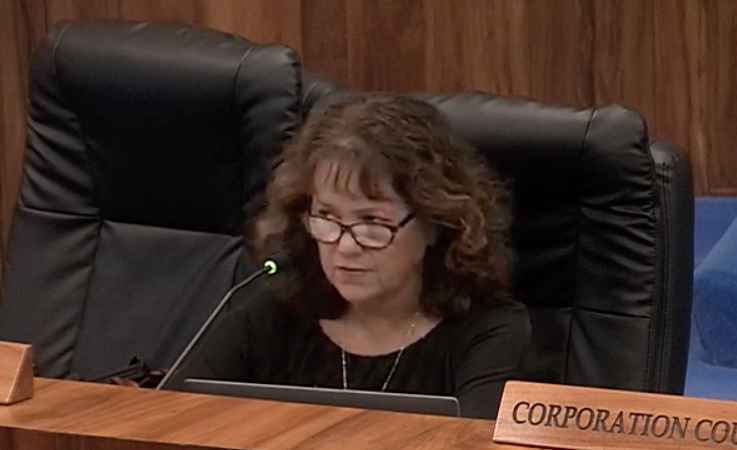
Maui County planners are managing a “relentless” amount of work, including permit applications for Lahaina rebuilding, while operating with 15 staff vacancies, acting Planning Director Jacky Takakura told Maui County Council members Wednesday.
Takakura briefed the Housing and Land Use Committee during an operational review to prepare for the upcoming budget season. Mayor Richard Bissen’s fiscal 2027 budget proposal is due to the County Council on March 25.
The Planning Department has an annual budget of $9.3 million and currently operates five divisions with a 17.5% vacancy rate across 85.5 budgeted positions.
The department’s half-year performance measures as of the end of last year include: 1,463 staff responses to public inquiries; 883 land use verifications; 893 building permit reviews; 280 enforcement inspections; 146 special management area exemptions and minor permits issued; 49 public meetings for boards and commissions; 43 notices of warning; 10 notices of violation; and eight rules and ordinances amended.
“So the work is relentless, and it can be very complicated,” Takakura said. “But like our mission says, we have an important job to do to manage growth and preserve land in an equitable and sustainable manner that balances cultural, environmental and economic needs. And, it’s not just for us, but it’s for our future generations.”
Staffing and budgetary hurdles
Takakura reported that the Zoning Administration and Enforcement Division and the Current Planning Division — the teams responsible for building and special management area permits — have most of the vacancies – seven out of 29 positions (24%) in the Current Planning Division; and four of 30 positions (13.3%) in the Zoning Administration Division. (There are 13.5 positions in the Long-Range Planning Division; nine positions in Administration; and four in Plan Implementation.)
Council Member Gabe Johnson asked for specifics about vacancies in the zoning division, questioning why – “Is there a trouble spot?”
Takakura said one of the vacancies was the result of a recent promotion within the department, and there are two zoning inspector trainees and an office assistant position that remain vacant. “I can’t answer why those are vacant,” she said.
Johnson said he assumed the vacancies were because of low pay. “That’s something we struggle with,” he said.
Takakura said the Zoning Administration Division is playing a “big role” in coordinating permit reviews for post-fire rebuilding. The division is tasked with making sure permits are completed in a legal and timely fashion, and it’s responsible for updating the county’s zoning code “to allow for rebuilding that would not have been able to occur without those updates, like the non-conformities and then kitchenettes for the multigenerational housing,” she said.
The Current Planning Division also is “heavily involved” in the Lahaina rebuild. “They’ve been meeting with shoreline property owners and managing permit reviews as quickly as they can, while still making sure that all the requirements are met,” she said.
The department’s current spending as of late last month includes:
- Salaries and Wages: 49.4% spent out of nearly $6.5 million.
- Operations: 28% spent of almost $2.8 million.
- Equipment: 65% spent of $25,000.
Lahaina rebuild and zoning reform
The department also is working on an overhaul of “Title 19,” Maui County’s zoning code, which has not been comprehensively revised since it was adopted in 1960. Zoning shapes the layout, design and character of communities.
While the county has adopted various Title 19 amendments over the decades, the result is a disjointed, piece-by-piece document. A 2018 audit confirmed the regulations are outdated and need modernizing to keep up with current technology and transportation. The planned rewrite aims to replace the patched code with a unified rulebook that aligns with the county’s general plan.
Council Member Tamara Paltin asked Takakura about the “Title 19 rewrite,” which is identified as “coming soon” on its website. “What is the ‘soon’ that is referred to, and is it coming soon?” she asked.
Takakura said “it’s normal for these kind of huge projects to take multiple years, but coming soon, we are planning to meet with you folks in the summer, in fall, . . . and then actually start with presentations in the outreach in the fall.”
She attributed the department’s delays in the zoning code revision to the COVID-19 pandemic, the 2023 wildfires, staffing and “all kinds of issues.”
“So it’s been awhile; I admit it’s been awhile,” Takakura said.
According to data compiled by permitting contractor 4LEAF Inc. and posted on the MauiRecovers website, 163 structures have been rebuilt in the burn zones — 153 residential and 10 non-residential. Overall, 563 permits have been issued — 538 residential and 25 non-residential. And, 356 permits are being processed — 171 residential and 185 non-residential.
Council Member Keani Rawlins-Fernandez raised a concern from the Cultural Resources Commission about “recovery coordination directive No. 6.”
“While there is support for expediting permit reviews, it shouldn’t be at the cost of the environment and our culture,” she said.
In response, Takakura said permits always need to follow Section 19.52 of Maui County’s Zoning Code, which covers historic districts, “and so that’s not going to go away.”
“They still have to be consistent with the requirements of the historic districts,” she said. “And also they have to submit to (the State Historic Preservation Division), which is the authority on archaeology. And then we’ve always been working closely with them on a staff level.”
And, “for the architecture reviews, too,” she said. “So none of that’s going to change. The thing that’s going to change is it going to the CRC for final approval, and, as you’re probably already aware, we’ve had problems with quorum and different things. And so it’s been very hard for applicants to get through the process.”
Public concerns and SMA ‘loopholes’
During public testimony, residents raised concerns regarding the enforcement of special management area permits, alleging there’s a “systematic failure” in how the county verifies that subdivision plans meet environmental and safety conditions.
Takakura told the committee that planners do review most subdivisions through the SMA process, but state law exempts certain projects. She said state law dictates that subdividing land into four or fewer parcels, or creating lots larger than 20 acres, are considered exempted.
“They’re not part of the definition of development,” she said.
So, for a family splitting a large residential parcel to build a second home, this state exemption removes the requirement for an SMA permit and the associated public hearings.
Takakura said residents who suspect a specific subdivision bypassed regulations can track the property’s permit history through Maui County’s Automated Planning and Permitting System, known as MAPPS. Residents also can use the county’s SeeClickFix or COMConnect to submit a complaint for the department to research.
Next steps
Looking ahead, planners will begin the Upcountry Community Plan update after finishing the South Maui plan.
“The only way we’ll ever catch up is by having two going on at once,” she said of community plan updates that are required once every 10 years. “And we do use consultants to help us with the foundational work. But once the draft plan is completed, we’re going to be probably taking it on ourselves and running with it, because our staff know the community the best, and we’ll be doing the outreach in all those meetings.”
Committee members took no legislative action during the briefing.
The Council’s Government Relations, Ethics and Transparency Committee has recommended confirmation of Takakura’s appointment as planning director. The full Council will take up her confirmation, along with Department of Human Concerns appointee Margaret Willis, on Friday. That meeting begins at 9 a.m.
Sponsored Content