Maui Council panel rejects charter amendment to set aside transient accommodations tax for climate fund

The Maui County Council’s ongoing review of 14 proposed charter amendments continued Tuesday, with members balking at a proposal to set aside 20% of the County’s annual transient accommodations tax revenue to fund climate plan initiatives.
Among other proposals, the Council’s Government Relations, Ethics and Transparency Committee advanced a change to the Board of Ethics reappointment process and deferred other charter amendment proposals ahead of the Nov. 3 general election ballot.
The committee is continuing its review of proposals after beginning its vetting process June 2, when two proposals received committee approval. The panel plans to continue deliberations at 10 a.m. Thursday, June 18, 2026. The amendments range from technical housekeeping updates to structural changes with significant policy, fiscal and accountability implications.
The committee voted 8-1, with Council Member Gabe Johnson dissenting, to file—effectively killing—Johnson’s proposal to dedicate a portion of hotel tax revenue to climate initiatives.
Resolution 26-87 would have set aside at least 20% of the County’s transient accommodations tax revenue for a Climate Action and Resiliency Revolving Fund to support implementation of the county’s climate plan.
Four public testifiers supported the proposal, arguing that it would create a reliable funding stream for climate adaptation and mitigation.
Lucienne de Naie of the Sierra Club said a dedicated amount of county funding is needed to implement the Climate Action and Resiliency Plan, which the Council established in the Maui County Code early last year.
“We need a way to actually implement it, make sure that we’re ready for these changing events that seem to keep happening because we’re in a very changing world,” she said.

Alex de Roode, a former county staff member who helped lead the development of the action and resiliency plan, told council members that the goal was to have dedicated funding and not leave the plan as an “unfunded mandate.”
The funding would allow the county to make progress toward more resiliency for Maui County communities, he said.
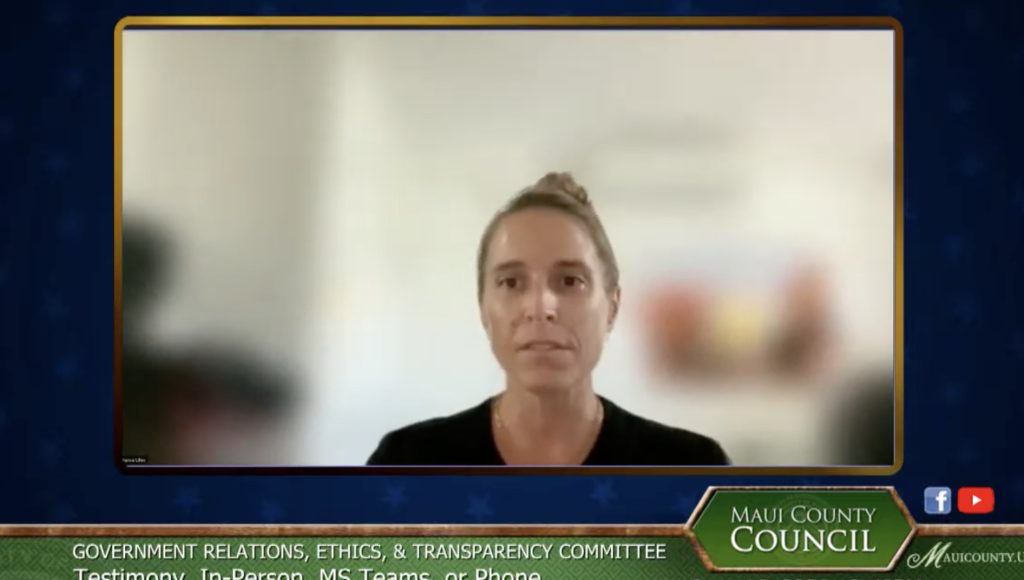
Hanna Lilley, the Hawaiʻi regional manager for the Surfrider Foundation, testified in strong support of the proposed charter amendment.
To address issues such as wastewater solutions, fire resilience, water quality monitoring and long-term planning for sea-level rise and chronic coastal erosion, “one of the biggest challenges that we consistently encounter is the lack of dedicated funding,” Lilley said. “Too often, we find ourselves operating in a reactive cycle responding to disasters after they occur, rather than investing in the actions needed to reduce the risk before the next crisis arrives.”
The king tides that impacted South and West Maui were “a really sobering experience,” she said.
“These impacts that we often talk about are not some distant future,” she said. “They’re already here; albeit in glimpses.”
Testifiers also urged the Council to add guardrails on how departments could use the funds, citing concerns that vague language around shoreline management could allow spending on projects like sand dredging rather than proven resilience strategies.
Council members, however, raised concerns about locking a fixed percentage of transient accommodations tax revenue into the charter.
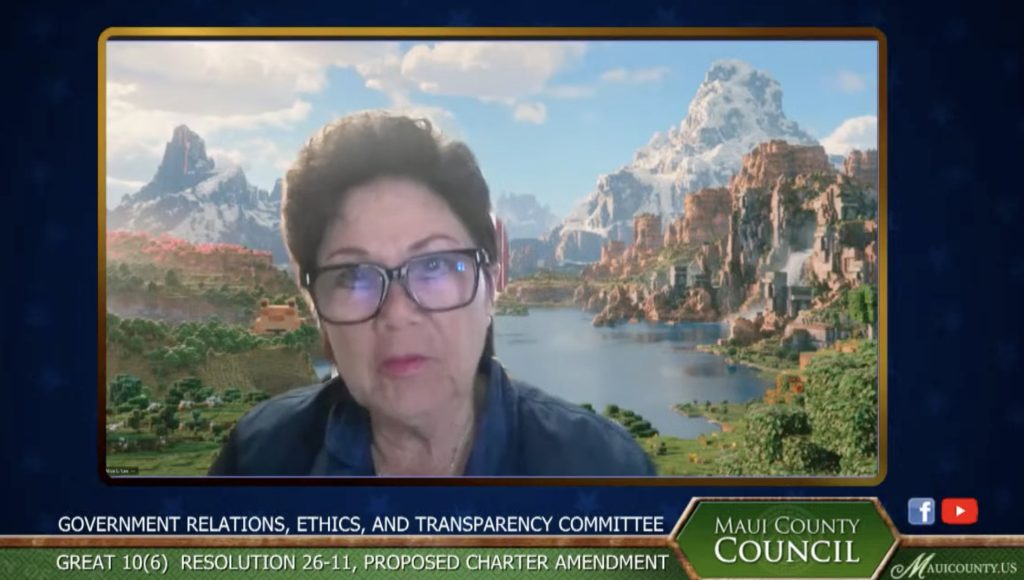
Council Chair Alice Lee opposed the proposed amendment, arguing that diverting 20% of transient accommodations taxes—an already declining revenue—would be ill-advised, especially as the County moves to phase out short-term rentals in apartment-zoned districts. She said the amendment would limit flexibility and put climate funding in competition with housing, homelessness and other programs that also rely on the same source of revenue.
Council Member Keani Rawlins-Fernandez noted that the state Legislature allows counties to levy the tax and could reduce or eliminate it, potentially leaving “an unenforceable section in our charter.”
Budget Director Lesley Milner said 20% of the County’s projected $65 million in accommodations revenue for fiscal year 2027 would amount to about $13 million. She added that the County has already spent roughly $90 million on climate-related work across departments in the current fiscal year.
Council Member Tom Cook said he would prioritize transient accommodations funding for housing and services for the houseless.
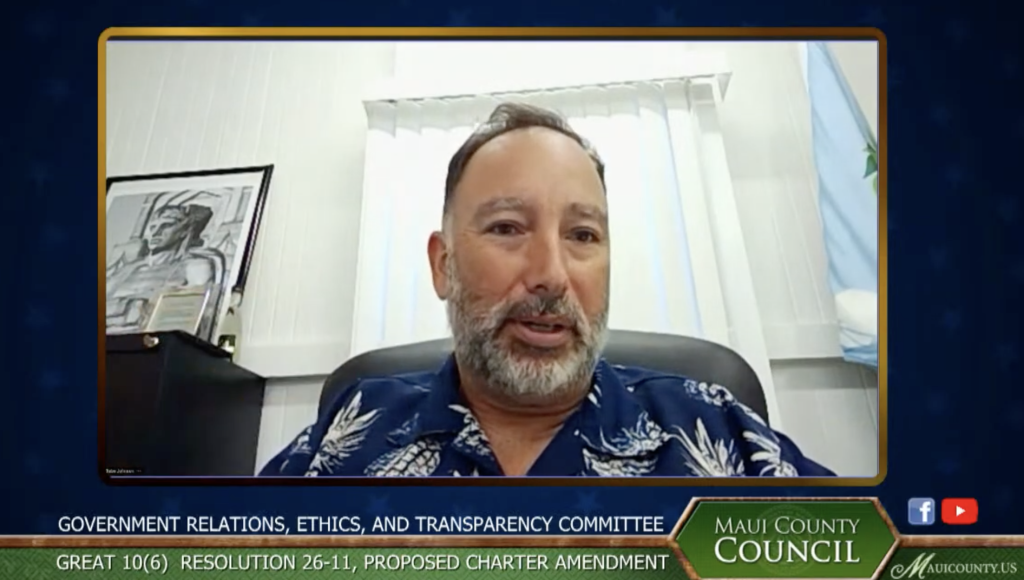
Johnson strongly disagreed, arguing that the County is underinvesting in climate resilience, pointing to recent storm recovery costs and warning that the financial impacts of inaction will continue to grow.
“This is needed to be done after years and years of ignoring climate change, of ignoring our seashores, of ignoring the way we live,” he said. “The pigeons are coming home to roost.”
Without dedicated funding from the hotel room tax, he said the County won’t be prepared for climate-related disasters like hurricanes, fires and droughts.
Johnson plans to pursue dedicated funding through some other mechanism, perhaps as an ordinance.
Ethics board change advances
The committee unanimously voted to recommend passage of Resolution 26-95, which would allow the mayor, with Council approval, to reappoint Board of Ethics members to one consecutive term.
Currently, members must step down at the end of their terms before they can serve again.
Board of Ethics Executive Director Lauren Akitake testified in support, saying the change is needed to maintain continuity as the board expands its work, including new training programs and other multi-year initiatives. The change also would reduce the risk of the panel losing a quorum needed to conduct business, she said.
The board sought a similar change in 2024, but voters rejected it as part of a broader charter amendment.
Several council members said they preferred two five-year terms with a midpoint performance review rather than a single extended tenure. The committee amended the measure to correct an effective-date error before advancing it to the full Council.
Independent Nomination Board debated
The committee deferred Resolution 26-93, which would dissolve the Independent Nomination Board, after extensive testimony and discussion.
Rawlins-Fernandez, who introduced the resolution, said the board has not functioned as intended and described it as “more of an obstacle” than a tool for improving transparency and public participation in appointments.
The gist of the committee’s discussion pointed to the current system of nominating and approving members of boards and commissions isn’t working as intended, but members continued discussing how to fix it.
Public testifiers urged the Council to reform the board rather than eliminate it.
The Council considered a recommendation to retain the nomination board while strengthening it with dedicated staff, authority to conduct background checks and broader reforms to recruitment and confirmation processes.
Testifiers also proposed technical fixes, including allowing temporary extensions of board members’ terms to avoid quorum issues.
Committee Chair Kauanoe Batangan deferred the item and directed staff to compile data comparing vacancy rates and canceled meetings before and after the independent board’s creation.
Two proposals headed to full Council
During its June 2 meeting, the committee recommended approval of two charter amendment resolutions on first reading. Those are:
- Resolution 25-216, which would standardize the various deadlines the County Clerk’s office has to follow when processing voter initiative petitions, recall petitions and charter amendments.
- Resolution 26-85, which would remove the English translation of the state motto (“Ua mau ke ea o ka ʻāina i ka pono”) from the charter’s preamble, leaving only the original Hawaiian text.
Other structural proposals deferred
The committee postponed several additional measures.
Resolution 26-11 would require a special election if a Council seat becomes vacant with six months or more remaining in the term. The proposal stems from difficulties the Council faced when it tried to fill the late Council Member Tasha Kama’s seat and ultimately had to allow the mayor to make the appointment after members failed to agree.
Members debated whether to extend the threshold to 365 days, which County Clerk staff said would simplify administration given the roughly three months required to organize a special election. Some members supported the longer window, while others warned it could leave seats unfilled for extended periods.
The committee also deferred Resolution 26-86, which would stagger terms for members of the Cost of Government Commission, after Corporation Counsel indicated the Council could likely make the change by ordinance instead of amending the charter.
Two additional measures—Resolutions 26-88 and 26-89—would expand the mayor’s flexibility in managing emergency financing and shifting funds within departments, with oversight mechanisms including Council approval, spending caps and reporting requirements. The committee deferred both items.
Housekeeping measures pending
On Tuesday, the committee did not hear a few technical and administrative amendments, including proposals to eliminate the requirement to publish public meeting notices in a newspaper, streamline the claims process against the County and allow online posting of bill summaries.
Resolution 24-100, which would allow an existing preservation fund to cover vegetation clearing for wildfire risk reduction, also remains pending.
The committee will continue its review Thursday morning members work to finalize which measures they will send to voters on the general election ballot in November.
The meeting can be viewed on YouTube or on Akakū: Maui Community Media, cable Channel 53. Public testimony is open in person in the 8th floor Council Chambers, online or in writing. For details on how to testify, see the committee agenda here.
Sponsored Content