



 Hawai'i Journalism Initiative
In West Maui, Democrat-turned-Republican defends House seat against Lahaina Strong organizer, local business advocate

Growing up in Lahaina, Pā‘ele Kiakona looked up to Elle Cochran.
She was one of the founding members of the Save Honolua Coalition, an organization that fought to stop development above a beloved West Maui bay that Kiakona would one day help steward. Her advocacy led to a career in politics where she developed a brand as a champion of the environment.
“Going into high school, into college, I knew I wanted to come back home and fight for my community and Hawai‘i in general and felt like I could do the same and take a similar track,” Kiakona said.
Now the 31-year-old is trying to unseat Cochran for the Hawai‘i House of Representatives’ District 14, which includes the West Maui communities from Olowalu to Kapalua.
The three-person race is between Kiakona, who is running as a Green Party candidate, Democratic nominee Sne Patel and Cochran, a longtime Democrat who switched parties during the legislative session in March to run as a Republican.
The pivotal contest comes at a time when Lahaina is still rebuilding from the 2023 wildfire, especially its commercial corridor, and the district’s tourism-dependent economy has yet to fully recover.
Hawai‘i political analyst Colin Moore called it “by far the most interesting House race this year.”
“It’s both a very important seat and it’s very interesting because you have this competitive third-party candidate, which is largely unheard of,” Moore said.

In the Aug. 8 primary, Patel got the most votes with 995 (31.5%), beating out Ashley Olson with 931 votes (29.5%) and Kanamu Balinbin tallied 726 votes (23%). Cochran also got 726 votes in an uncontested Republican primary, while Kiakona also ran unopposed for the Green Party and received 181 votes.
Patel is leading the way in fundraising with $66,729 across the entire election period, followed by Kiakona with $30,714 and Cochran with $1,600, according to the latest campaign spending reports as of September.
In West Maui, each candidate has their own claim to fame.
Cochran, a 61-year-old Lahaina resident, is well known from her decades in activism and local government, serving as a Maui County Council member from 2010-2018, when she lost to Mike Victorino in the mayor’s race, and later winning election to the House in 2022. A lifelong West Maui resident, she grew up in Lahaina during the plantation era and lived on Front Street when it was still made of mom-and-pop shops. She worked in the visitor industry for over 30 years with jobs ranging from prep cook to bartender.
Patel, a 47-year-old Kahana resident, is the director of sales and advocacy for Maui Resort Rentals and president of the LahainaTown Action Committee, which advocates for local businesses and organized many community events pre-fire. Born in India and raised in Chicago, he moved to Maui right after college in 2002, meeting his wife and raising three boys on the island. He lost his unit at the Spinnaker condos in the 2023 fire.

Kiakona, a Honokōhau Valley resident, rose to prominence as a leading voice for Lahaina Strong, which has organized community aid and spoken up for local families after the 2018 and 2023 wildfires. He was born and raised in Lahaina, attending Hawaiian immersion schools and learning place names “like the back of my hand.” His grandmother’s house, where six generations of his family had lived, burned down in the 2023 fire. She moved in with him.
Cochran has the advantage of incumbency, but faces the challenge of running as a Republican in a district that has voted for a Democrat for State House in every election since 2002.
She said she changed sides due to frustration with the way the Democratic Party, the dominant political force in Hawai‘i, did business at the Capitol. She called it a “dictatorship,” where dissent was squashed and bills advanced based on connections and power. She found the Republican caucus to be a “free for all” where they could speak their minds.
“I had to switch to get more support and be more effective for the people I represent,” she said. “It’s not about party politics per se. It’s about trying to survive in that toxic environment up at the State Legislature. I was trying to shed a little bit of light on how it functions behind closed doors.”
Patel said there was “some shock” in the community when Cochran switched teams, and while he thinks voters will consider it come November, “it’s hard to predict how it’ll play out” given that she’s the incumbent but he represents the majority party.

“My focus is to make a case for myself, what I bring, and making sure that if I am elected, it’s important to know that I will be part of the majority at the Legislature, and be able to work with the leadership there to help secure the resources for the whole district, not just Lahaina,” Patel said.
As the third-party candidate, Kiakona said he knows he’s “going into this as an underdog 100%.” People in his inner circle have told him it was “extremely naive” to run as a Green Party candidate. But, he pointed out, “my party affiliation did not matter when we were in that (Capitol) building advocating for our town that just burned down.”
“Given what has happened to Lahaina and the amount of work that we’ve put into caring for our community, I feel like this is the one opportunity that we had to kind of really make a statement and bring awareness to everybody because people just vote out of habit and not necessarily out of who’s the right person for your district,” Kiakona said.
Kiakona said whoever wins “will determine who gets represented” at the Capitol. He said he would represent the people “who have been hurt the most” by the fire — the generational families of West Maui, the immigrant workers and other groups who have been overlooked in the recovery. He said he’s not just for Hawaiians — he’s for anyone who has made Lahaina home and puts people and the land above their own pride.
Kiakona sees taking care of the ‘āina as key to improving the affordability of housing. He said that “a healthy environment is a buffer zone” for the shoreline erosion and storms that have battered the islands and impact what residents pay for costs like electricity, insurance and home repairs. He said finding more ways to help people rebuild their homes is a top priority, especially as costs climb.
He also wants to diversify the economy and said that starts with the tourism industry, creating more opportunities through things like regenerative tourism that would allow the thousands of visitors to help restore the environment. He said he’s “not so naive and stupid” to think tourism would come to a halt. He just thinks the community doesn’t have to sacrifice its soul for economic stability.
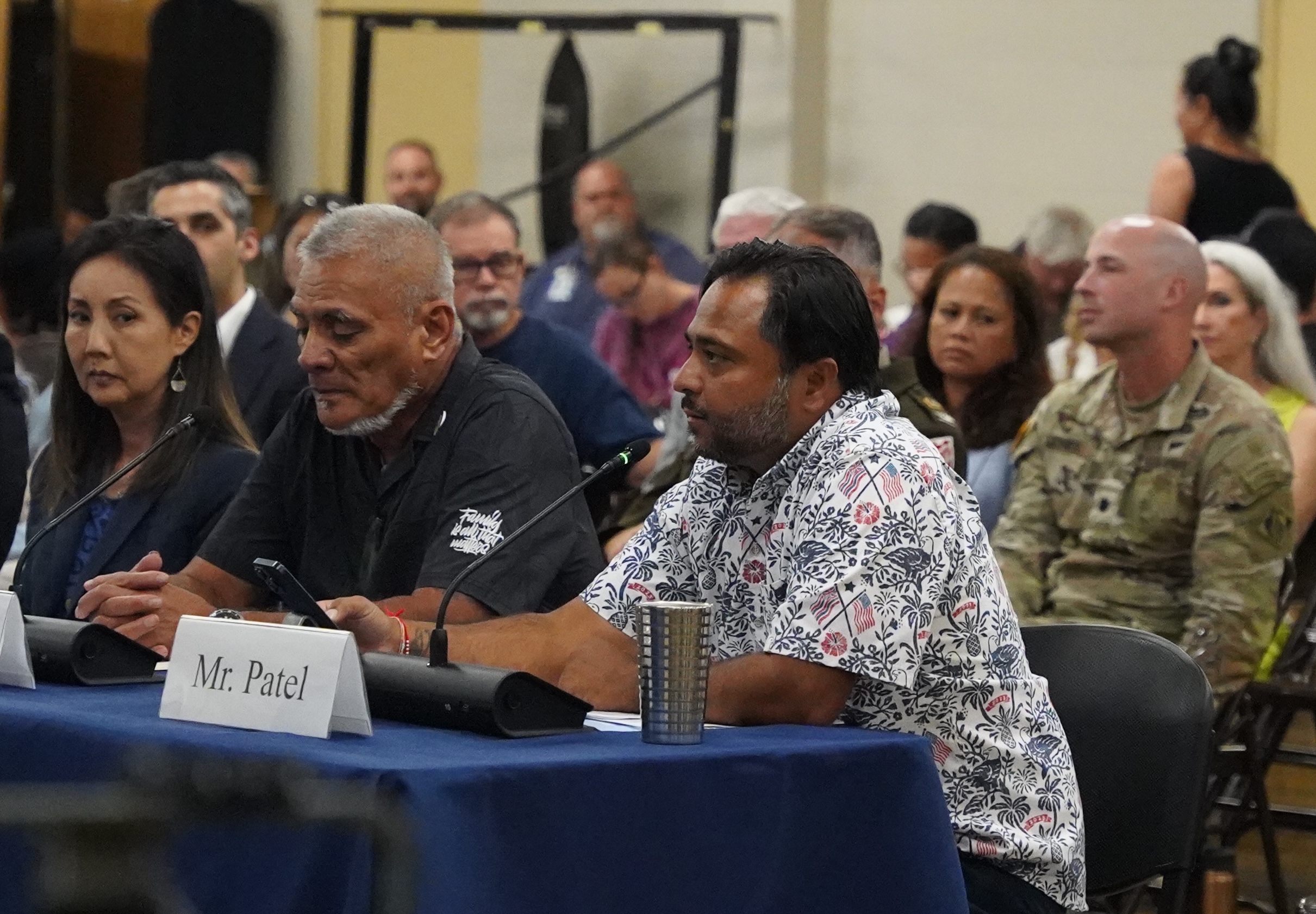
Patel said his priority is also affordability and helping people stay in West Maui. He said as a lawmaker, he would work to get funding for more housing and workforce training for fields like construction, health care and clean energy. He’s supportive of public-private partnerships to lower the cost of building homes.
Patel, who highlighted the struggle of businesses to recover during a congressional hearing after the fires, said it’s been “frustrating” that the commercial recovery in Lahaina has not moved forward yet, with the first commercial property to rebuild breaking ground just this month. He said he hoped to “clear some of the barriers” businesses have faced in rebuilding and give them a boost through things like a state historic rehabilitation tax credit for rebuilding historic structures. He also wants to see Lahaina included in the new opportunity zone program that he hopes will bring more investment to the area.
And while tourism is still an important part of the local economy, he said now is the time to start looking at lessening the community’s dependence on it in the long term and encouraging other sectors that will provide good-paying jobs.
Cochran said one of her biggest priorities if reelected would be government transparency, citing a recent report by the state auditor that found more than $13.7 million unauthorized, unsupported or questionable payments under Gov. Josh Green’s kauhale initiative that builds tiny home villages for unhoused people.
She sees herself as “the watchdog of the Legislature” and wants to dig more into public spending and give auditors more power to conduct investigations effectively. She also wants to curb what she sees as the governor’s excessive use of emergency proclamations in the wake of recent disasters, saying they’ve suspended important rules on procurement and transparency.
Cochran also wants to protect rebuilding families from contractor scams by making the failure to fulfill the contract for building a home a felony offense. She also hopes to push state agencies to move forward with multifamily housing projects in Lahaina that she said should have already started rebuilding since the fire.

The candidates also pushed back against criticism from each other.
Cochran described Patel as a “transplant” and knocked Kiakona’s lack of political experience as well as his involvement with Lahaina Strong and the group’s “no tourists, get out of here kind of attitude” that followed the fire.
Kiakona pointed to Cochran’s high absence rate for floor sessions, which he said came at a time when West Maui really needed a voice at the Capitol. He said he and Patel have agreed “not to speak ill of each other,” and that their differences stem from Patel representing the party of “business as usual” and accepting corporate donations, while Kiakona said he does not.
Patel said he respects Lahaina Strong’s effort to bring attention to critical issues after the fire but added that some community members “feel like the message wasn’t delivered in a way that was helpful” in moving the recovery forward.
Kiakona said Lahaina Strong’s message reflected “the fuel and the feeling of what was happening around us” after the trauma of the fire that killed at least 102 people. He said Lahaina Strong has “suffered silently” through misinformation, racist comments and attempts to scapegoat him for his father’s drug convictions, when “his mistakes are not my mistakes.” He said people focus on the controversy rather than the money they raised for local families, the neighborhood watch they launched to curb theft and the disaster case management work they’ve done.
“All they want to pay attention to is the bad and how they can use that narrative to try and bring down this group,” he said. “And I’m going to stand by my word. I’m going to say that I have no regrets because I’m standing and fighting for this community, and if it makes you feel uncomfortable, then maybe you got to reevaluate.”

Cochran has defended her attendance record in the past, telling the Hawai‘i Journalism Initiative in May that she and other lawmakers who had the most absences came from districts that suffered disasters during the Kona low flooding in March. She said that when she was not in Honolulu, she was back home helping the community.
“I lost an entire town that I literally grew up in and lived in for 61 years,” she said. “So I don’t know how anybody can’t figure that’s sort of a little bit of a damper on a person’s life and strain on a person’s whole entire world. People want to keep picking on that. It’s just, move on already.”
In a video on Facebook earlier this week, she posted a breakdown of her schedule from January to May showing the meetings, bill discussions, interviews and other commitments on her slate. Cochran said that she was “kinda flattered that people think my one vote makes all the difference” at the Capitol.
Patel acknowledged that “there is a lot of tension in the race” given the different experiences each candidate brings. Even as he leads in donations, Patel said, “our community is my only priority, no contribution buys my vote.” And while he didn’t grow up on Maui, he said that he and his family chose to make Lahaina their home, and that he is “committed to listening and showing up for the entire district.”
“Lahaina and West Maui is made up of many voices, and survivors of all different nationalities, and they’ve come from different places,” he said. “The beautiful thing about this community is … after the fires, you saw community really coming together and it didn’t matter if you were this or that or where you came from. It was all of us working together for that same goal.”
Even after switching to the minority party, Cochran still thinks she has a good chance to win, pointing out that Patel and Kiakona could split the progressive voting bloc and give her the victory.
“I think if as long as people remember that it’s me and they’ve always supported me and believed and trusted in me and my voice and what I do, then that will carry me over,” she said.
She added, “better off having somebody like me, I think, on that side,” than some of the “cuckoo clocks” and “insurgents” in the Republican Party.
Moore, who was a research fellow at Yale University’s Center for the Study of American Politics before he joined the University of Hawai‘i, sees Kiakona as the frontrunner in the race because he has landed endorsements from organizations that typically back Democratic candidates, including five of Hawai‘i’s largest labor unions.
If Kiakona wins, it would be “nationally significant” because he’d be just one of four people to ever be elected to a State House as a Green Party candidate.
He added that while Patel and Kiakona could split some votes, Kiakona could draw some Republicans because “Hawai‘i Republicans are not necessarily traditional MAGA Republicans.” They’re populists who could be attracted to his candidacy because he doesn’t represent the institutional Democratic Party, and because Cochran is not a traditional Republican.
If Kiakona wasn’t running, Moore said he’d figure Patel to be the “shoe-in” as the Democratic nominee.
The race is not only intriguing because of the candidates, but because of the stakes.
Moore said: “It’s obviously a very sensitive time for the district and it’s undergone a lot of change.”