Gov. Green signs bills to address youth homelessness and property insurance stability
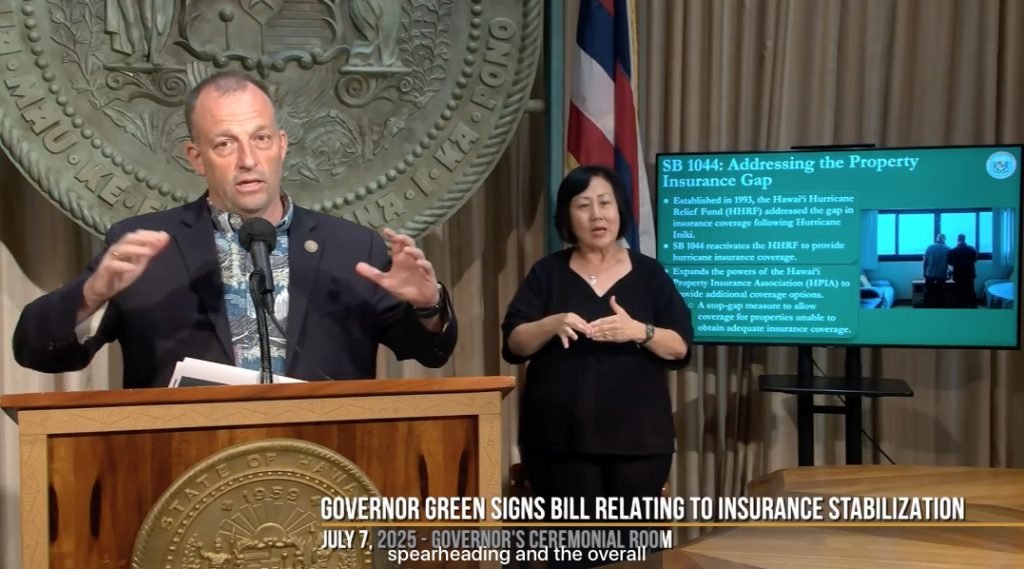
Gov. Josh Green signed into law today bills to expand resources for young homeless people and those facing homelessness and to stabilize the state’s property insurance market.
Both measures respond to what the Governor’s Office calls “a nuanced housing crisis.” The governor’s “administration remains committed to actively reducing barriers to safe, stable, reliable and insurable housing for all residents,” according to an announcement from the Office of the Governor.
Bills signed into law include:
Senate Bill 1044: Relating to the stabilization of housing insurance. Due to the instability in the insurance market that has been exacerbated by local and national environmental disasters, Senate Bill 1044 (Act 296) aims to stabilize the state’s property insurance market amid escalating premiums and limited coverage options.
“The rising cost of insurance has become yet another unbearable burden for Hawaiʻi and its residents over several years and mirrors a similar crisis on the Mainland,” Green said. “I am appreciative of the Legislature, the Hawaiʻi Insurance Division and all the passionate stakeholders for the dedicated and collaborative effort over the past two years as we addressed this challenge.”
Act 296 reactivates the Hawaiʻi Hurricane Relief Fund to provide insurance coverage in scenarios where the private market fails to do so. Applications are now being accepted by the HHRF for Condominium and Townhouse Associations of Apartment Owners seeking to obtain hurricane commercial property insurance coverage.
“This bill is a lifeline for thousands of Hawai‘i residents crushed by soaring insurance costs — and finally gives them somewhere to turn,” said Senate Commerce and Consumer Protection Committee Chair Jarrett Keohokalole.
Act 296 enhances the powers of the Hawaiʻi Property Insurance Association to provide additional coverage options, establishes the Condominium Loan Program to help buildings remain insurable, and mandates the Insurance Commissioner to conduct a comprehensive study aimed at developing sustainable strategies for market stabilization.
“We targeted this bill to help the average condominium building, not the luxury high-rises,” said Rep. Scot Matayoshi, chair of the House Consumer Protection and Commerce Committee. “In addition to increasing the market capacity for insurance coverage, which will allow many associations to return to the lower-cost admitted market, this bill also contains a low-interest loan pilot program, encouraging condominiums to make specific high-impact repairs that should lower insurance premiums and raise unit values. The long-term solution is for condominiums to address essential repairs and deferred maintenance, which will help them secure insurance in the future and improve the lives of their residents.”
Formed in 1993 in response to the devastation caused by Hurricane Iniki, the Hawaiʻi Hurricane Relief Fund was established to address the gap in property insurance coverage created when many private insurers withdrew from the hurricane insurance market. As time passed and private insurers resumed offering hurricane coverage, the HHRF ceased operation and remained dormant. In 2024, Green reactivated the HHRF to address the growing instability in the property insurance market caused by major climate events, rapidly rising premiums, and a decrease in available insurers, which created significant barriers to obtaining coverage for many AOAOs.
“The HHRF board of directors worked tirelessly to get the program operational to bring additional coverage availability for the market. We anticipate this program can provide every eligible association with full coverage or a portion of their full coverage,” said Acting Insurance Commissioner Jerry Bump. “In just two weeks, we’ve seen pricing pressure and market competition significantly decrease the cost of coverage.”
“The condominium community will now benefit from much-needed premium relief. As we have already seen in some of the initial submissions, properties of all sizes have seen upwards of 70% savings on their hurricane insurance,” added Alex McLaury, commercial insurance agent at ACW Group.
To be eligible to apply for hurricane insurance under the HHRF, an AOAO must: (1) have been previously denied hurricane coverage by at least two state licensed insurance companies operating in Hawaiʻi; and (2) have buildings with a total insured value exceeding $10 million.
Commercial property insurance policies offered under the HHRF are limited to hurricane coverage only and this is excess coverage that only can cover the portion of losses above $10 million. AOAOs must purchase separate primary insurance to cover hurricane losses up to $10 million. All applications must be submitted through a licensed insurance producer.
More information about the HHRF, including frequently asked questions, application and other forms are available at https://hhrf.hawaii.gov.
House Bill 613: Relating to homeless youth.
House Bill 613 (Act 297) makes permanent the youth pilot program originally established under Act 130, Session Laws of Hawai‘i 2022. The measure creates a safe space and youth program in each county for youth and young adults experiencing or at risk of homelessness. These safe spaces will provide 24/7 access to lodging, meals, showers, medical and behavioral health services, as well as educational and employment support. Through the joint efforts of state and county departments, those in need of further support shall be connected to nonprofit institutions with the expertise to offer long-term support and shelter. Reports of this program will be submitted to the Legislature. Appropriations will be $871,016 for fiscal year 2026 and $1.8 million for fiscal year 2027.
“This is how we break the cycle of homelessness,” Green said. “By investing in people, especially our youth, we are shaping a future where everyone has a chance to thrive. This program shows what is possible when a community comes together with a purpose.”
“House Bill 613 makes the Safe Places for Youth program permanent, providing 24-hour access to shelter, mental health care, education support, and job training for homeless youth,” said Rep. Lisa Marten, chair of the House Committee on Human Services and Homelessness. “With continued services on Oʻahu and Hawaiʻi Island and plans to expand statewide, this program is a lifeline for our most vulnerable youth. I am thankful to all the advocates who made this possible.”
Sponsored Content